 |
| Place of Origin: | China |
| Brand Name: | Golden Grain |
| Certification: | ISO9001, ISO22000, HALAL, KOSHER, COA, SDS |
| Model Number: | GLMK-03 |
| Minimum Order Quantity: | 1300kg |
|---|---|
| Price: | USD450-USD550/MT FOB QINGDAO, CHINA |
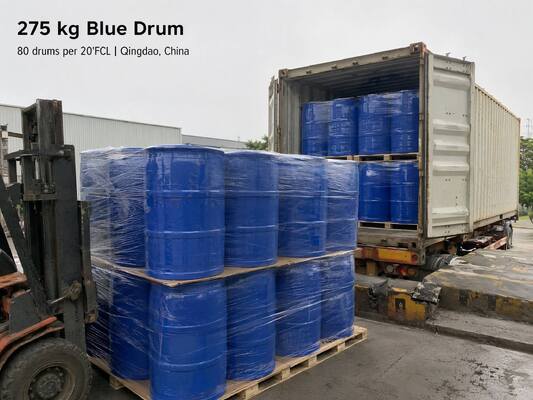
| Packaging Details: | 250kg/drum, 270kg/drum, 275kg/drum with new plastic drum, 1300kg IBC drum, flexible bag |
| Delivery Time: | 7 - 10 working days |
| Payment Terms: | L/C, T/T, D/P, D/A |
| Supply Ability: | 1000MT per month |
| Molecular Formula: | C6H14O6 | Cas: | 50-70-4 |
|---|---|---|---|
| Storageconditions: | Store In A Cool, Dry Place Away From Direct Sunlight | Physical: | Liquid |
| Chemicalname: | Sorbitol | Chemical Formula: | C₆H₁₄O₆ |
| Molecular Weight: | 182.17 G/mol | Appearance: | Clear, Colorless To Pale Yellow Solution |
| Shelf Life: | 24 Months In Unopened Drum | Freezingpoint: | Not Easy To Crystallize |
| Dry Substance: | 70% Min | Supply Type: | Factory Direct / Manufacturer |
Sorbitol Solution 70% is a clear, colorless, syrupy liquid produced by the catalytic hydrogenation of glucose. For Vitamin C manufacturers, it is not a generic sweetener—it is the direct metabolic precursor in the Reichstein process and modern fermentation routes. D-Sorbitol is oxidized by Gluconobacter strains to L-sorbose, the committed step toward L-ascorbic acid synthesis. This is the specification industrial buyers actually need: consistent concentration, controlled reducing sugars, and bulk availability.
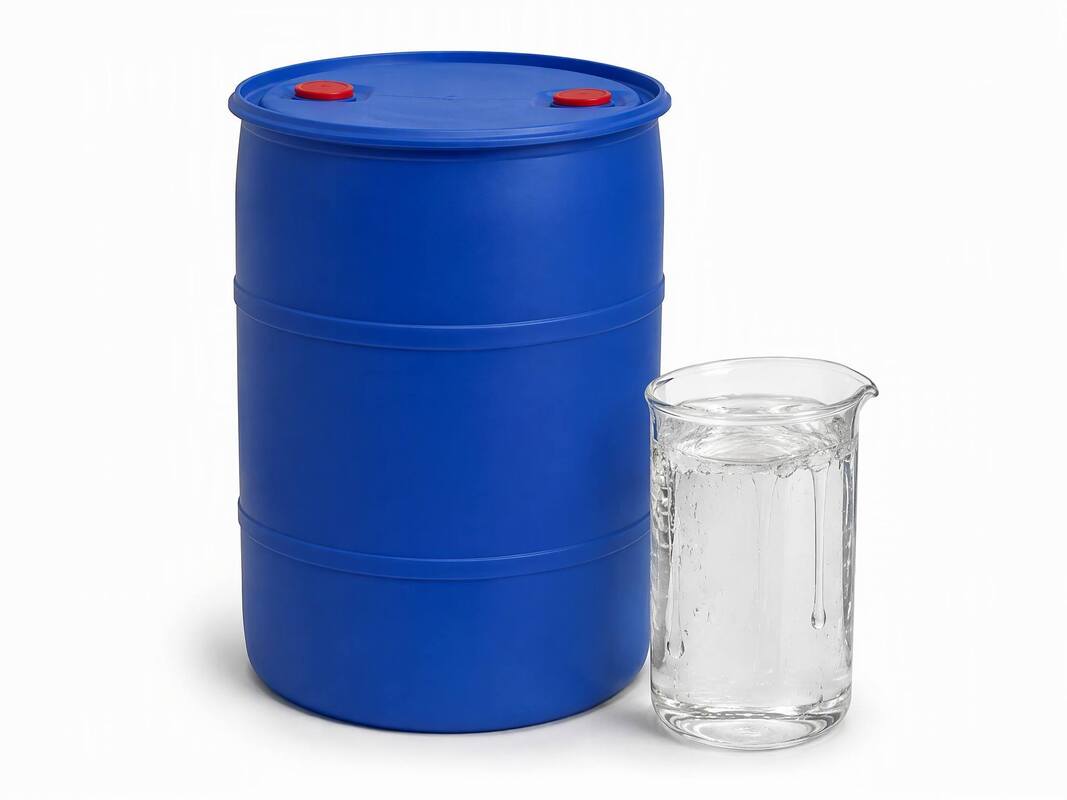
Sorbitol Solution 70% Industrial Grade is a clear, colourless, odourless syrup supplied at 70% dry substance. It is produced by catalytic hydrogenation of glucose derived from refined corn starch, followed by ion exchange purification and vacuum concentration.
This is the intermediate grade, not the sweetener grade. What separates it is what has been taken out: reducing sugars are held at 0.15% or below, heavy metals at 1 ppm or below, and conductivity is controlled, because the next reaction step — whether fermentation or esterification — is usually more sensitive to trace impurities than to the sorbitol content itself.
The product is fully miscible with water at any ratio, is non-hazardous under normal handling, and is supplied ready to pump or weigh directly into a batch.
Specification written against the BP, USP, EP and FCC monographs.
| No. | Item | Specification |
| 1 | Appearance | Colourless, syrupy liquid |
| 2 | Dry substance, % | ≥ 69.0 |
| 3 | Water content, % | ≤ 31 |
| 4 | Total sugars, % | ≤ 0.30 |
| 5 | Reducing sugars, % | ≤ 0.15 |
| 6 | D-Sorbitol, % | ≥ 68.0 |
| 7 | D-Mannitol, % | ≤ 2.0 |
| 8 | Resistivity, µS/cm | ≤ 20 |
| 9 | Refractive index (20 °C) | ≥ 1.4575 |
| 10 | Specific gravity (20 °C), g/ml | ≥ 1.290 |
| 11 | Chloride, mg/kg | ≤ 10 |
| 12 | Iron, mg/kg | ≤ 1.0 |
| 13 | Nickel, mg/kg | ≤ 1.0 |
| 14 | Arsenic (as As₂O₃), mg/kg | ≤ 1.0 |
| 15 | Sulphated ash, % | ≤ 0.10 |
| 16 | Sulphate, mg/kg | ≤ 20 |
| 17 | Heavy metals (as Pb), mg/kg | ≤ 1.0 |
| 18 | Specific rotation (20 °C) | ≤ +5.3° |
Typical physical data: density approx. 1.30 g/cm³ at 20 °C; pH 5.0–7.0 as a 50% solution; shelf life 2 years in the unopened drum.
Each drum carries a batch number and ships with its own Certificate of Analysis. The batch record reports, at minimum:
| Test | Typical result (acceptance limit) |
| Appearance | Colourless, syrupy liquid (pass) |
| Dry substance | 69.5 – 71.0% (≥ 69.0) |
| Reducing sugars | ≤ 0.15% (≤ 0.15) |
| D-Sorbitol | 68.5 – 70.5% (≥ 68.0) |
| D-Mannitol | ≤ 2.0% (≤ 2.0) |
| Conductivity / resistivity | ≤ 20 µS/cm (≤ 20) |
| Heavy metals (as Pb) | ≤ 1.0 mg/kg (≤ 1.0) |
| Specific gravity (20 °C) | 1.290 – 1.310 g/ml (≥ 1.290) |
A Safety Data Sheet is issued on request. Lot-specific values replace the typical figures above — the acceptance limits do not move.
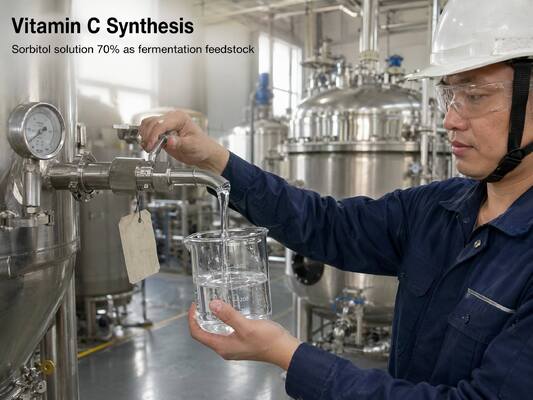
Vitamin C (ascorbic acid) synthesis. Sorbitol is the starting point of the classical route: it is fermented to L-sorbose and then converted to 2-keto-L-gulonic acid, which is lactonised to ascorbic acid. Because the fermentation step is run by living cultures, low reducing sugars and low heavy metals in the feed matter more here than a point of extra assay.
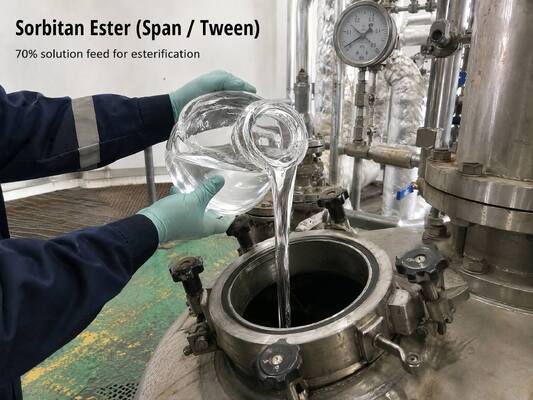
Sorbitan esters (Span) and polysorbates (Tween). Sorbitol is dehydrated to sorbitan and then esterified with fatty acids. For reactions that require anhydrous sorbitol, the water is removed before esterification — the 70% solution is the feed, not the reaction medium.
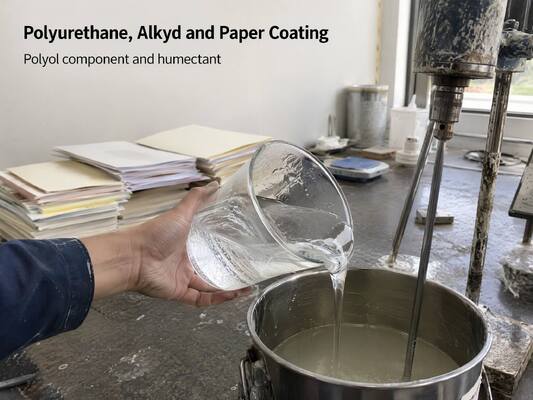
Polyurethane, alkyd and polyester systems. Used as a polyol component and as a moisture conditioner in resin and coating formulations.
Paper coating and adhesives. Acts as a humectant and plasticiser, keeping the coating film flexible and reducing brittleness during drying and storage.
General industrial humectant and plasticiser. Where a non-crystallising, low-impurity polyol is needed and food-grade certification is not a requirement.
| Item | Detail |
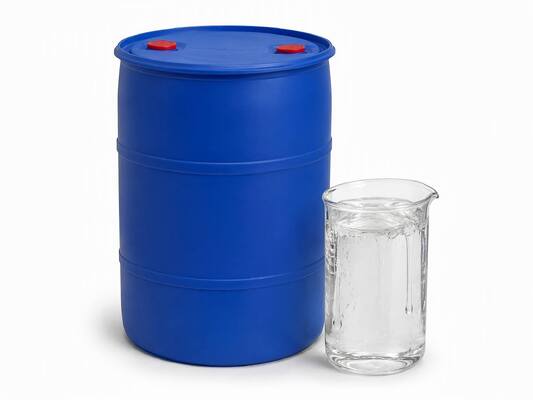
| Standard pack | 275 kg HDPE drum, blue, closed with two bungs |
| Loading | 80 drums per 20'FCL |
| Other formats | IBC tote and flexitank quoted on request |
| Minimum order | 1,000 kg |
| Lead time | 7 – 10 working days |
| Port of loading | Qingdao, China |
| Incoterms | FOB, CIF, CFR |
| Payment | T/T, L/C, D/P |
Drums are new and food-contact-grade HDPE even for industrial use, so the same packaging can be reused on a food line without a material query.