 |
| Place of Origin: | Qingdao, Shandong, China |
| Brand Name: | Golden Grain |
| Certification: | ISO9001, ISO22000, HALAL, KOSHER, COA, SDS |
| Model Number: | GLMAS-03 |
| Minimum Order Quantity: | 1300kg |
|---|---|
| Price: | USD450-USD550/MT FOB QINGDAO, CHINA |
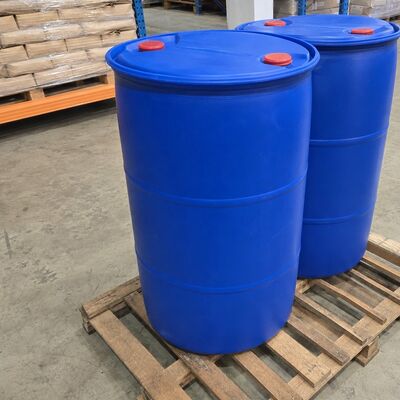
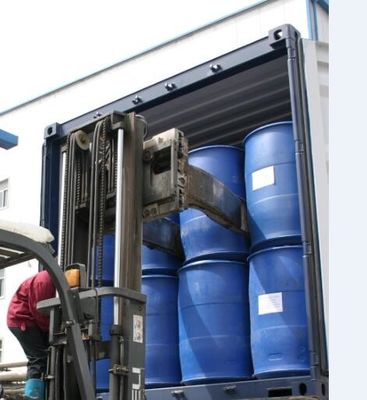
| Packaging Details: | 250kg/drum, 270kg/drum, 275kg/drum with new plastic drum, 1300kg IBC drum, flexible bag |
| Delivery Time: | 7 - 10 working days |
| Payment Terms: | L/C, T/T, D/P, D/A |
| Supply Ability: | 1000MT per month |
| Product Name: | Sorbitol Liquid 70% (Sorbitol Solution 70%) | Synonyms / Other Names: | Sorbitol Solution, D-Glucitol, Glucitol, Sorbitol Syrup, E420(ii), INS 420(ii), Sugar Alcohol, Polyol |
|---|---|---|---|
| CAS No. / E-Number: | 50-70-4 / E420(ii) (INS 420) | EINECS No.: | 200-061-5 |
| Molecular Formula: | C6H14O6 | INCI Name: | Sorbitol |
| Grade: | Food Grade E420(ii); Bar, Confectionery And Oral Care Use | Standard: | FCC, BP, USP, EP, GB 1886.187 |
| Form & Appearance: | Clear, Colourless, Syrupy Liquid; Free From Visible Impurities | Concentration / Dry Substance: | 70.0% Min Dry Solids (sorbitol Content 69.0-71.0%) |
| Water Content: | 30.0% Max | PH: | 5.0 - 7.5 |
| Reducing Sugars: | 0.2% Max | Heavy Metals: | Pb 1 Mg/kg Max; As 1 Mg/kg Max; Ni 1 Mg/kg Max |
| Sweetness: | 50-60% Of Sucrose, Clean Sweet Taste, No Aftertaste | Function: | Binder, Humectant, Moisture Retention Agent, Plasticiser, Crystallisation Inhibitor, Bulk Sweetener |
| Application / End Use: | Protein Bars, Cereal Bars, Granola And Muesli Bars, Nut And Seed Bars, Nougat, Chewy Candy, Fruit Leather, Sugar-reduced Confectionery | Process Compatibility: | Cold Blending, Syrup Premix, Binder Spraying, Continuous Dosing |
| Water Activity Control: | Lowers Water Activity And Slows Moisture Migration In Multi-phase Bars | Solubility: | Fully Miscible With Water; Dispersible In Glycerin And Propylene Glycol |
| Packaging: | 275 Kg HDPE Drum Standard; 250 Kg / 270 Kg Fills And 1,300 Kg IBC On Request | Shelf Life: | 24 Months In Unopened Drums Under The Stated Storage Conditions |
| Storage: | 15-30 C, Sealed, Away From Direct Sunlight And Strong Odours | HS Code: | 38246000 |
| Certification: | ISO 9001, ISO 22000, Halal, Kosher | OEM / ODM: | Private Label And Custom Packing Available |
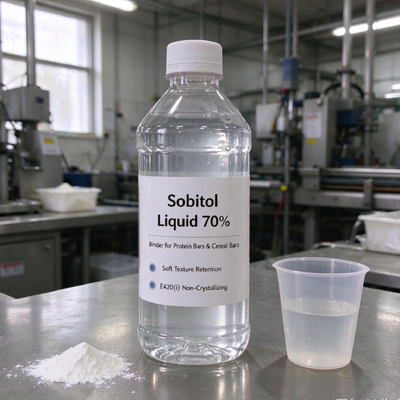
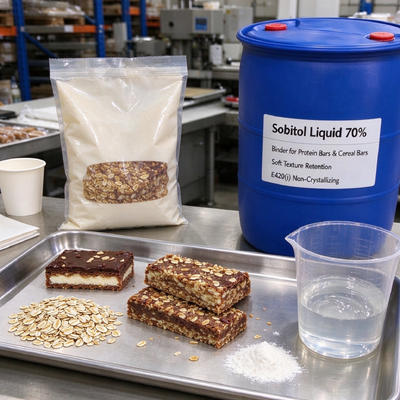
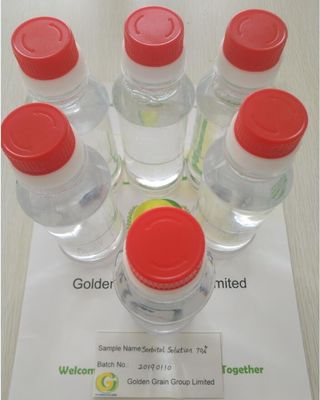
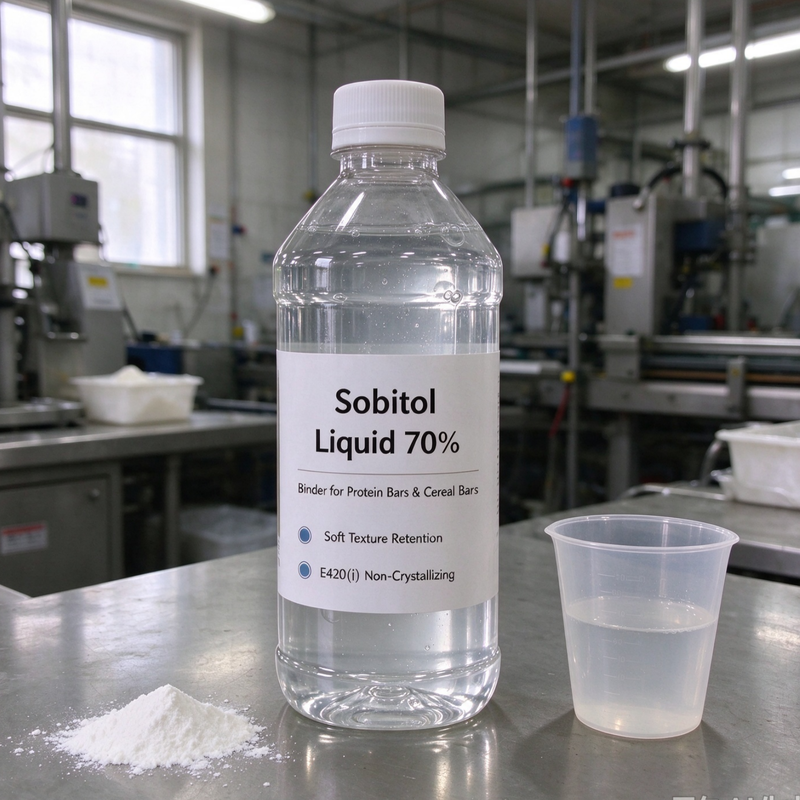
Sorbitol liquid 70% — also written sorbitol solution 70%, D-glucitol syrup or E420(ii) — is a sugar alcohol supplied as a clear, colourless, odourless syrup at 70% dry solids and 30% water. It works as a humectant, plasticiser and bulk sweetener in the same molecule: it holds water in the continuous phase of a matrix, keeps that water from migrating into the dispersed particles, and at this concentration does not crystallise. That combination is why it is used as the binder phase in protein bars, cereal bars and sugar-reduced confectionery, where texture has to survive months of transport and shelf life. The grade described on this page is food grade E420(ii), tested against the FCC, BP, USP and EP monographs, and shipped with a batch COA, SDS, ISO 9001, ISO 22000, Halal and Kosher documentation.
A protein bar rarely fails because of the protein. It fails because the water inside it moves.
Over the first weeks of shelf life, moisture migrates out of the binder and into the dispersed particles. The matrix tightens, the chew turns to crumble, and a bar that was soft on the packing line is brittle by the time it reaches a shelf in another country. At the same time the sugar in the binder starts to crystallise, so the surface goes grainy just before it goes hard.
Sorbitol solution 70% is used in that binder for one reason: it holds water in the continuous phase, and it does not crystallise while doing it.

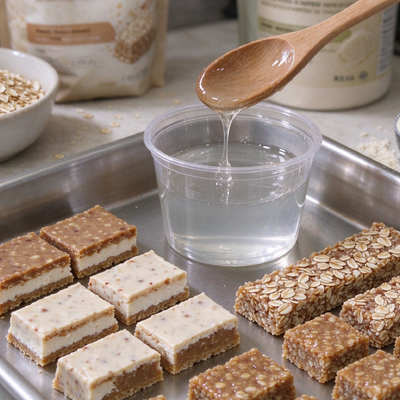
The syrup is added in the binder phase, alongside the other humectants and fats. Because it arrives already dissolved, there is no crystal-dissolving step and no risk of undissolved particles surviving into the finished bar.
The same mechanism carries over to cereal and granola bars, where the syrup binds the particulate phase and stops the bar drying into a biscuit between the packing line and the shelf.
One number matters more than the rest: the syrup is 70.0% dry substance, which means roughly 30% of what you weigh out is water. That water is part of your moisture budget, not a free addition. Formulators normally fix the water activity ceiling first and back-calculate the humectant load from there, rather than setting the sorbitol level by sweetness.
| Product | Sorbitol Solution 70%, non-crystallising |
| Chemical name | D-Glucitol |
| CAS number | 50-70-4 |
| E number / INS | E420(ii) / INS 420 |
| HS code | 38246000 |
| Appearance | Clear, colourless, syrupy liquid, free from visible impurities |
| Odour and taste | Odourless; faint sweet taste |
| Dry substance | 70.0% min |
| Sorbitol content | 69.0% – 71.0% |
| Water content | 30.0% max |
| pH | 5.0 – 7.5 |
| Reducing sugars | 0.2% max |
| Nickel | 1 mg/kg max |
| Heavy metals (as Pb) | 1 mg/kg max |
| Arsenic (as As) | 1 mg/kg max |
| Total aerobic microbial count | < 100 cfu/g |
| Shelf life | 24 months in unopened drums under the stated storage conditions |
Purity is reported as figures from a chromatogram, not as an adjective. A typical batch reads 70.4% sorbitol by HPLC, 29.6% water by Karl Fischer, and 0.05% reducing sugars.
Every shipment leaves with a batch-specific Certificate of Analysis carrying the test methods as well as the results. Alongside it: a specification sheet, an SDS, and the certificates buyers usually ask for before a first order — ISO 9001, ISO 22000, Halal and Kosher.
The point of the document set is that a quality team can approve the material without asking us a single follow-up question about method or tolerance.
The standard fill for this grade is a 275 kg food-grade HDPE drum. 250 kg and 270 kg fills are available on the same drum, and 1,300 kg IBC totes are offered where the plant prefers to decant from a single vessel.
Drums are filled to a stated net weight, sealed, and shipped palletised. Store unopened, away from direct sunlight; reseal any part-used drum and use it within the period agreed on the order.
Can we run a trial before committing? Yes. Trial quantities are drawn from production grade, not from a laboratory batch, so the sample and the commercial shipment carry the same COA limits.
Are the ranges in the table fixed? They are the published specification. If your process needs a tighter window on pH or reducing sugars, that is a conversation at order stage rather than something we change silently between shipments.
Does the grade drift from batch to batch? The grade does not change. The batch does, and each batch is documented on its own COA, which is the only number that should be used for release testing.
What happens to the 30% water? It is the water that keeps the syrup pourable and it stays in the syrup. It is counted as an ingredient contribution in the formulation, not treated as an extra.
Send the water activity target and the texture you are trying to hold, and we will send a sample with its COA. If the bar is already on the market and hardening late, a side-by-side trial at two humectant levels usually answers the question inside one shelf-life cycle.