Frozen surimi loses its gel-forming ability not because it freezes, but because ice crystals concentrate the residual liquid around the myofibrillar proteins. As that unfrozen phase gets saltier and more concentrated, myosin and actin begin to unfold and aggregate — and once they aggregate, no amount of chopping will bring the gel strength back. Sorbitol is one of the two cryoprotectants that stops this, and it is the one that does it without adding sugar.
This page covers the mechanism, the blend ratio used in commercial surimi, which mesh and grade to specify, and the specification points that actually affect frozen stability.
1. It stops freeze-induced protein denaturation. Sorbitol and sucrose work by preferential hydration: they are excluded from the protein surface, which increases the hydration layer around myosin and actin and keeps the proteins from unfolding as the unfrozen phase concentrates. Add neither, and the protein aggregates during frozen storage.
2. It preserves gel-forming ability. Surimi that holds its cryoprotectant still forms an elastic, springy gel after six to twelve months at −18 °C. Surimi without it produces a soft, watery gel that breaks down on cooking — the defect buyers describe as "chalky" or "rubbery".
3. It keeps Ca2+-ATPase activity measurable. Ca2+-ATPase activity retention is the standard laboratory indicator of myofibrillar integrity, and it is the number your customer's QA lab will ask for. Cryoprotected surimi holds activity far longer through frozen storage than unprotected surimi.
4. It cuts sweetness compared with sucrose alone. Sorbitol is roughly 60% as sweet as sucrose. In fish balls, kamaboko and crab stick — all savoury products — replacing part of the sucrose with sorbitol protects the protein without making the product taste sweet, and it avoids the browning that sucrose contributes during heat setting.
Commercial surimi almost never uses sorbitol alone. The reference formulation is a 1:1 blend with sucrose, added at 4% + 4% on surimi weight:
| Blend | Total addition | Typical use |
|---|---|---|
| Sorbitol : sucrose = 1 : 1, at 4% + 4% | 8% | The classic cryoprotectant formulation; the benchmark most technical specifications are written against |
| Sorbitol : sucrose = 1 : 1, at 3% + 3% | 6% | Cost-reduced grade, lower-value minced fish |
| Sorbitol alone at 6 – 8% | 6 – 8% | Reduced-sugar or clean-label products; check gel strength and sweetness after the swap |
| Sorbitol-dominant 2 : 1 with sucrose | 6 – 8% | Savoury products where sweetness is a defect |
Two practical notes:
For surimi, buy powder, not 70% solution. A liquid grade adds 30% water to a system where you are already fighting moisture control, and it has to be re-dried or compensated for in the formulation.
| Grade | Why it suits surimi |
|---|---|
| 20–60 mesh, food grade, FCC IV | The standard choice. Dissolves fast enough in the silent cutter without generating heavy dust |
| 60–80 mesh granular | Faster dissolution, less dust in the plant; slightly higher cost |
| 80–120 / 100 mesh fine powder | Fastest dissolution for high-throughput lines; needs enclosed handling because of dust |
Three specification points matter more here than anywhere else:
Limits below are the FCC IV specification for our sorbitol powder, with a recent batch result alongside. The batch COA issued with your shipment always governs.
| Parameter | FCC IV limit | Batch result |
|---|---|---|
| Appearance | White powder, granules or crystalline masses | Conforms |
| Identification | A, B | Conforms |
| Assay | 91.0 – 100.5 % | 99.60 % |
| Water | ≤ 1.5 % | 0.42 % |
| Total sugar | ≤ 0.30 % | 0.20 % |
| Reducing sugar | ≤ 0.30 % | 0.05 % |
| Density | ≥ 1.45 | 1.48 |
| Specific rotation | 4.0 – 7.0 | 4.6 |
| pH (10 % solution) | 3.5 – 7.0 | 6.0 |
| Residue on ignition | ≤ 0.1 % | Conforms |
| Heavy metals (as Pb) | ≤ 5 ppm | Conforms |
| Nickel | ≤ 1 ppm | Conforms |
| Lead | ≤ 2 ppm | ≤ 0.5 ppm |
| Chlorides | ≤ 10 ppm | Conforms |
| Sulphates | ≤ 20 ppm | Conforms |
| Arsenic | ≤ 1 ppm | Conforms |
| Particle size | 20–60, 40–60, 60–80 mesh | 20–60 mesh |
| Total plate count | ≤ 1,000 cfu/g | 63 cfu/g |
| Moulds and yeasts | ≤ 100 cfu/g | 10 cfu/g |
| E. coli | Negative | Negative |
| Product | Total cryoprotectant | Sorbitol share | Comment |
|---|---|---|---|
| Frozen surimi, standard grade | 6 – 8 % | 3 – 4 % | 1:1 with sucrose; the 4% + 4% reference formulation |
| Surimi for fish ball / kamaboko | 6 – 8 % | 4 – 6 % | Shift the ratio toward sorbitol to keep the product savoury |
| Reduced-sugar or clean-label surimi | 6 – 8 % | 6 – 8 % | Sorbitol alone; re-check gel strength and sweetness after the swap |
| Frozen minced fish, lower grade | 4 – 6 % | 2 – 3 % | Cost-driven; accept shorter frozen shelf life |
Percentages are on surimi weight, added before freezing. Above roughly 10% total cryoprotectant the texture starts to soften and the product becomes noticeably sweet — diminishing returns.
Browning or off-flavour after frozen storage. Look at reducing sugars first. Maillard between reducing sugars and fish protein is the usual cause, and it is invisible on the day of production — it develops over weeks in storage. Ask for reducing sugars on every batch COA, not once at approval.
Caking in the hopper or in the bag. Moisture above specification, or storage above 30 °C at high humidity. Sorbitol picks up water readily; keep bags sealed and the plant area dry.
Gel strength drops after six months. Either the cryoprotectant was under-dosed, or it was added unevenly, or it was added after the surimi had already been frozen once. Check the addition point in the process before blaming the raw material.
Product tastes sweet. The blend is too sucrose-heavy for a savoury application. Shift the sorbitol-to-sucrose ratio toward sorbitol rather than reducing total cryoprotectant — the total is what protects the protein.
Dust in the plant, or slow dissolution. Mesh is mismatched to the line. 20–60 mesh is the usual compromise; go finer only if the line has dust extraction.
| Item | Detail |
|---|---|
| Standard packing | 25 kg kraft bag with PE inner liner |
| Pallet / container load | Confirmed per destination port |
| HS code | 2905.44 — confirm with your customs broker for your market |
| Shelf life | Typically 24 months, unopened, dry storage |
| Storage | Sealed, 5 – 35 °C, away from direct sun and humidity |
Documentation issued with each shipment: COA (batch-specific), MSDS/SDS, and a specification sheet.
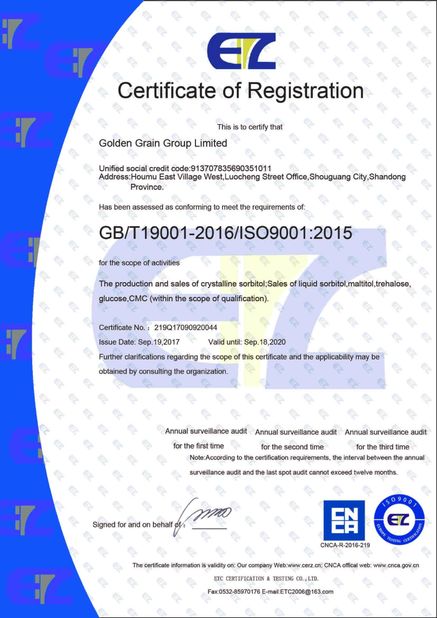
Our quality system and product certifications:
| Certificate | Scope |
|---|---|
| ISO 9001 | Quality management system |
| ISO 22000 | Food safety management system |
| Halal | Product and process, issued by an accredited certification body |
| Kosher | Product and process, issued by an accredited certification body |
Certificate copies, including the issuing body, certificate number and validity dates, are provided on request before an order — so your QA team can verify them independently.
Can we use sorbitol without sucrose?
Yes. Sorbitol alone at 6–8% protects the protein adequately, and it is the usual route for reduced-sugar or clean-label products. Re-check gel strength and taste after the swap — the protection mechanism is the same, but the texture contribution differs.
Which mesh should we specify?
20–60 mesh is the standard for surimi plants. Go to 60–80 or finer only if your line dissolves slowly or you need faster hydration, and be ready to handle the extra dust.
Is sorbitol permitted in surimi in our market?
Sorbitol is E420 in the EU and is used as a cryoprotectant in surimi in most major markets. Labelling and permitted-use rules vary — confirm with your local regulatory advisor before finalising the label.
Does sorbitol change the gel strength of the finished product?
It protects gel strength through frozen storage rather than adding to it. Over-addition above roughly 10% total cryoprotectant starts to soften texture and add sweetness.
What is the minimum order?
It depends on grade and destination. One pallet is a common starting quantity for a trial, and full container loads are the normal commercial volume. Send us your port and we will quote both.
Can you supply a sample before a container order?
Yes. Samples and COA/MSDS are issued before commercial orders, so your lab can run a trial batch first.
Tell us the grade, the mesh, the volume, and the destination port — we will come back with price, packing options and lead time.
Send us your current cryoprotectant blend and target gel strength, and we will match the grade and mesh to your line rather than the other way round.