 |
| Place of Origin: | China |
| Brand Name: | Golden Grain |
| Certification: | ISO9001, COA,SDS |
| Model Number: | GLMA-01369121 |
| Minimum Order Quantity: | 100kg |
|---|---|
| Price: | USD850-USD950/MT FOB QINGDAO, CHINA |
| Packaging Details: | 25kg/Bag with Paper Drum and PE Inner |
| Delivery Time: | 7 - 10 working days |
| Payment Terms: | L/C, T/T, D/P, D/A |
| Supply Ability: | 1000MT per month |
| Taste: | Sweet | Molecularweight: | 182.17 G/mol |
|---|---|---|---|
| Phvalue: | 5.0 - 7.0 (10% Solution) | Storagecondition: | Store In A Cool, Dry Place |
| Chemical Name: | D-Sorbitol | Molecular Weight: | 182.17 G/mol |
| Density: | 1.33 G/cm³ (approximate) | Food Additive: | Sweetener |
| Meltingpoint: | 95 - 100°C | Chemicalformula: | C6H14O6 |
| Solubility: | Soluble In Water | Moisture Content: | 0.5% Max |
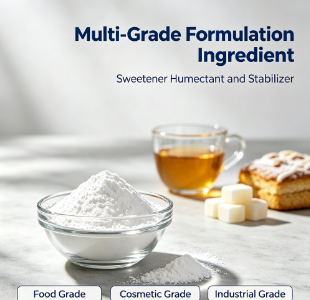
Our Sorbitol Powder (D-Glucitol, CAS 50-70-4, INS No. 420(i)) is a food-grade sugar alcohol produced by catalytic hydrogenation of glucose. It is a white, hygroscopic, crystalline powder with a faint sweet taste, approximately 50–60% as sweet as sucrose. This grade is specifically controlled for low moisture content, making it suitable for applications where minimal water introduction is critical to formulation stability, shelf life, and powder flow.
Sorbitol functions as both sweetener and humectant. JECFA lists its functional uses as sweetener, humectant, sequestrant, texturizer, stabilizer, and bulking agent . As a humectant, it absorbs and retains moisture, preventing products from drying out—yet in its powder form, the starting moisture content must be kept low to avoid introducing unwanted water into dry mixes, tableting formulations, and moisture-sensitive systems.
The JECFA specification for sorbitol sets water content at not more than 1% (Karl Fischer method) . This low-moisture grade is processed and controlled to meet this limit consistently, ensuring predictable performance in dry blending, direct compression, and applications where every fraction of a percent of moisture matters. It is packed in 25 kg PP bags and available for bulk supply.

| Parameter | Specification |
|---|---|
| Product name | Sorbitol Powder, low moisture |
| CAS number | 50-70-4 |
| E number | E420 |
| Appearance | White crystalline powder, free flowing |
| Assay (dry basis) | 99.0% min |
| Mesh | 80-120 |
| Moisture (Karl Fischer) | 0.2% max |
| Water activity | 0.15 max |
| Grade | Food Grade |
| Packaging | 25kg PP woven bag with PE inner liner |
The certificate of analysis issued for each shipment is the governing document.
| Test item | Typical result | Method |
|---|---|---|
| Assay (D-Glucitol) | 99.4% | HPLC |
| Appearance | White crystalline powder | Visual |
| Mesh distribution (80-120) | 96% pass | Sieve analysis |
| Moisture | 0.09% | Karl Fischer |
| Water activity | 0.08 | Chilled mirror |
| Reducing sugars | 0.04% | Titrimetric |
| Residue on ignition | 0.02% | Gravimetric |
| Total heavy metals (as Pb) | < 5 mg/kg | Colorimetric |
| Arsenic (as As) | < 2 mg/kg | AAS |
| Total plate count | < 1000 cfu/g | Plate count |
| Yeast and mould | < 100 cfu/g | Plate count |
A certificate of analysis is issued for every batch, and a safety data sheet is available on request.
Formulation Stability
In dry mix applications—baking premixes, beverage powders, seasoning blends—excess moisture from ingredients can trigger caking, promote microbial growth, and accelerate degradation of moisture-sensitive actives. Low-moisture sorbitol minimizes this risk while still delivering sweetness and humectancy where needed.
Tableting Performance
In direct compression and wet granulation, moisture content affects powder flow, compressibility, and tablet hardness. A consistent ≤1.0% moisture specification provides a reliable starting point for reproducible tablet formulations.
Shelf Life Extension
Even though sorbitol is hygroscopic and will absorb moisture from the environment over time, starting with low moisture means the product has greater capacity to absorb ambient moisture before reaching problematic levels. In sealed packaging, this translates to a longer window of free-flowing performance.
Compatibility with Moisture-Sensitive Ingredients
When blended with ingredients that degrade in the presence of water—certain vitamins, enzymes, probiotics, or hygroscopic salts—low-moisture sorbitol reduces the total water activity of the blend, protecting sensitive components.
Sweetener
Sorbitol provides a mild, clean sweetness at roughly 50–60% the intensity of sucrose. It is suitable for sugar-free and reduced-calorie formulations. Its negative heat of solution produces a cooling sensation on the palate, valued in chewing gum, mints, and oral care products.
Humectant
As a non-volatile polyol, sorbitol absorbs and retains moisture, preventing products from drying out, cracking, or losing texture during storage. This function is critical in baked goods, confectionery, toothpaste, and cosmetic creams.
Bulking Agent, Stabilizer, and Crystallization Inhibitor
Sorbitol contributes body and mouthfeel without excessive sweetness. It inhibits sugar crystallization in syrups and confections, maintaining smooth texture and appearance.
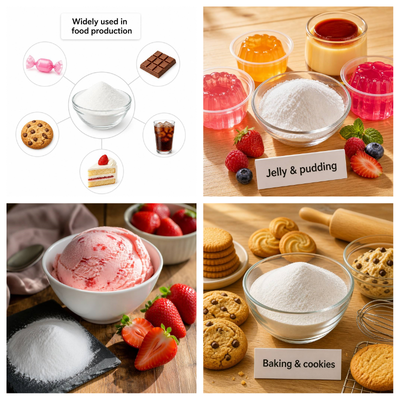
Food & Beverage
• Dry mixes: Baking premixes, beverage powders, dessert mixes—low moisture ensures flowability and extended shelf life
• Sugar-free confectionery: Chewing gum, candies, mints—sweetness, bulk, cooling effect
• Bakery & desserts: Sugar-free cakes, fillings, frostings—humectancy and crystallization inhibition
• Beverages & spreads: Sugar-free syrups, no-sugar-added jams and jellies
Pharmaceutical & Oral Care
• Tableting: Direct compression and wet granulation—low moisture supports consistent compressibility
• Chewable tablets and lozenges: Pleasant mouthfeel and sweetness
• Sugar-free syrups and elixirs: Palatability and solution stability
• Toothpaste and mouthwash: Humectant, plasticizer, non-cariogenic sweetness
Personal Care
• Cosmetic creams, lotions, and hair care: humectant and skin conditioning agent
In blends built around an acid, a vitamin or a hydrocolloid, the low starting moisture keeps the equilibrium water activity of the mixture below the level where the sensitive component begins to lose potency. Typical addition is 5-20%, adjusted against the water content of the other components and the headspace of the pack.
At 2-8% in a reduced-sugar coating mass, the powder introduces very little water, so the mass keeps its viscosity and the temper or gloss is not disturbed. Moisture in a coating is what produces the dull, grainy surface that shows up after the product has been in distribution.
An acid and a carbonate sitting side by side react as soon as water is available. Low moisture sorbitol extends the shelf life of an effervescent or instant powder by removing one of the water sources from the blend, and it dissolves without leaving undissolved particles in the glass.
Where a blend carries a sensitive active, holding the carrier at 0.2% moisture reduces the water available for hydrolysis and limits the caking that makes a stick pack hard to empty. The rate is normally 10-30% as a bulking and sweetening phase.
Salt and acidulants pull water from any component that has it. A low moisture carrier removed from the blend gives the salt less to take up, which keeps a seasoning sachet free flowing through humid storage.
Moisture is the defining test for this grade, so it is measured by Karl Fischer on the dried material and again on the packed powder, with water activity checked by chilled mirror as a second indicator of how the material will behave in a blend. Assay by HPLC, particle size by sieve analysis, reducing sugars and residue on ignition are tested alongside, and heavy metals, arsenic and microbiological counts are released to the food grade limits.
The dryer is run to a tighter endpoint than for the standard grade, and any lot that finishes above 0.2% is returned to the dryer instead of being blended down. Samples are taken at the dryer outlet and at the packing head, and retained samples are kept per lot for re-test.
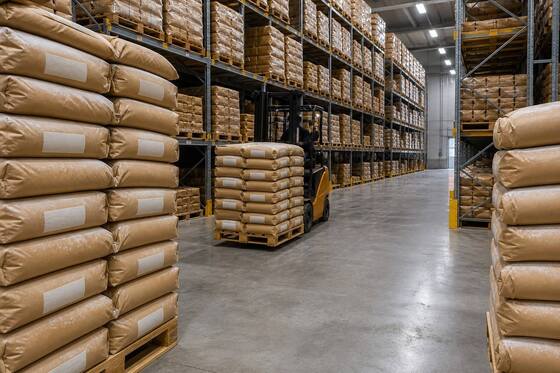
The powder is packed in 25kg PP woven bags with a PE inner liner, heat-sealed immediately at the filling head, and the pallet is stretch-wrapped to limit moisture exchange in transit. Neutral or buyer-labelled print is available for bulk orders. Container loading is planned per order against the destination port and pallet pattern, and full container, LCL and mixed shipments are handled with the certificate of analysis issued before dispatch.
Store in a cool, dry, ventilated warehouse away from sunlight, with the bags closed, off the floor and away from walls that condense. The grade starts below the moisture of ambient air in most climates, so an opened bag will pick up water; reseal it the same shift and use the contents within the current production run. Avoid storage above 40°C and keep the pallets away from strong odours. In unopened original packaging the specification holds for 24 months.
Controlled Moisture for Demanding Formulations
The ≤1.0% moisture specification is not merely a compliance limit—it is a process control target. Each batch is tested and released against this parameter, giving formulators a reliable, low-variability input for moisture-sensitive applications.
Dual Function, One Ingredient
Sweetener and humectant in a single low-moisture powder. Simplify your formulation and reduce raw material count without sacrificing functionality.
25 kg PP Bag, Bulk Supply Ready
Standard 25 kg PP bag packaging suits trial runs and production-scale purchasing. Bulk supply capacity supports repeat orders and contract volumes.
Documented Compliance
Full JECFA specification compliance with batch-specific COA documentation supports your quality audits and regulatory filings.
Contact us for samples, COA, and bulk pricing.