 |
| Place of Origin: | China |
| Brand Name: | Golden Grain |
| Certification: | ISO9001, COA,SDS |
| Model Number: | GLMA-007913 |
| Minimum Order Quantity: | 100kg |
|---|---|
| Price: | USD850-USD950/MT FOB QINGDAO, CHINA |
| Packaging Details: | 25kg/Bag with Paper Drum and PE Inner |
| Delivery Time: | 7 - 10 working days |
| Payment Terms: | L/C, T/T, D/P, D/A |
| Supply Ability: | 1000MT per month |
| Usage: | Sweetener, Humectant | Molecularweight: | 182.17 G/mol |
|---|---|---|---|
| E‑Number: | 420 | Chemical Name: | D-Sorbitol |
| Food Additive: | Sweetener, Humectant | Molecularformula: | C₆H₁₄O₆ |
| Active Ingredient: | Sorbitol | Chemical Formula: | C6H14O6 |
| Shelf Life: | 2 Years | Particlesize: | 40-120 Mesh |
| Storage Conditions: | Store In A Cool, Dry Place |
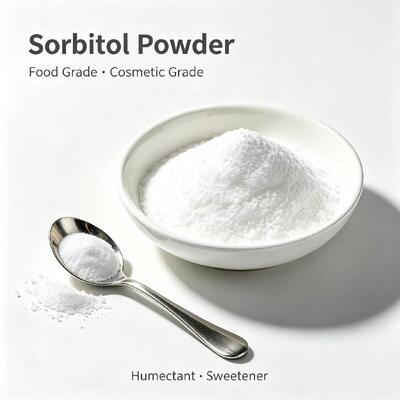
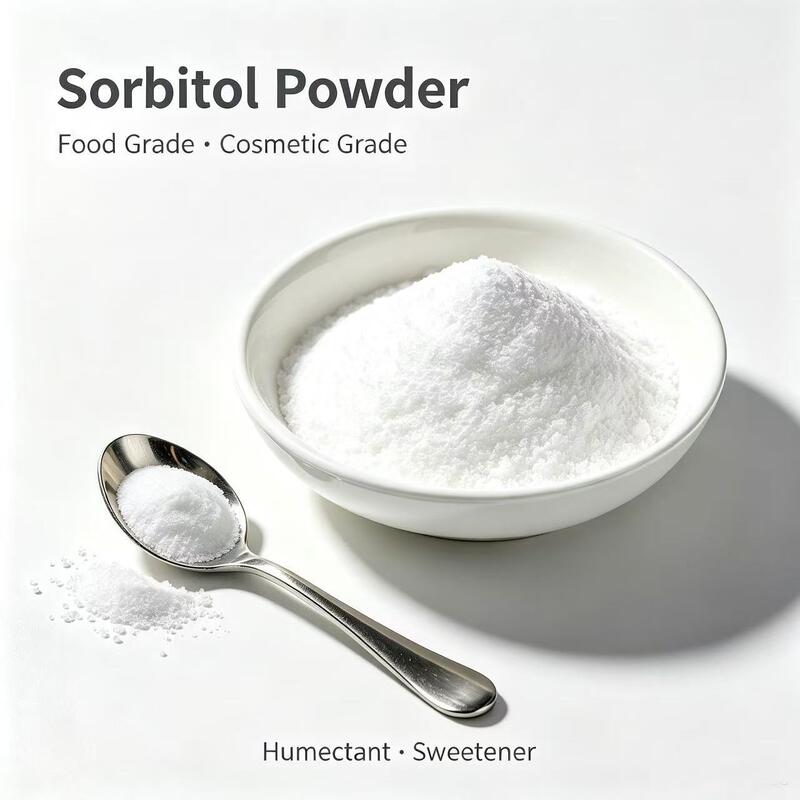
Our Sorbitol Powder (D-Glucitol, CAS 50-70-4, INS No. 420(i)) is a food-grade sugar alcohol produced by catalytic hydrogenation of glucose. It is a white, crystalline powder with a faint sweet taste, approximately 50–60% as sweet as sucrose. This grade is supplied in 80–400 mesh particle size range, designed to offer flexibility across multiple applications requiring different powder fineness levels.
Sorbitol functions as a sugar alcohol humectant, absorbing and retaining moisture to prevent products from drying out during storage. JECFA lists its functional classes as sweetener, humectant, sequestrant, texturizer, stabilizer, and bulking agent. The 80–400 mesh range spans from relatively coarse (80 mesh, approximately 177 μm) to fine (400 mesh, approximately 37 μm) particles , allowing formulators to select or blend fractions according to flowability, mouthfeel, and processing requirements.
In pharmaceutical tableting, sorbitol particle size significantly affects flow behavior. Research on directly compressible sorbitol fractions in the 0.080–0.400 mm range found that flow function values varied with particle size, with the 0.245 mm fraction showing optimal flow characteristics . The 80–400 mesh range covers approximately 0.037–0.177 mm, providing a broad window for tailoring powder performance. This grade is packed in 25 kg PP bags and available for bulk supply.
| Parameter | Specification |
|---|---|
| Product name | Sorbitol Powder, multi grade |
| CAS number | 50-70-4 |
| E number | E420 |
| Appearance | White crystalline powder, free flowing |
| Assay (dry basis) | 99.0% min |
| Mesh range | 80-400 |
| Cut options | 80-100, 100-200, 200-400 |
| Moisture | 0.5% max |
| Grade | Food Grade |
| Packaging | 25kg PP woven bag with PE inner liner |
The certificate of analysis issued for each shipment is the governing document.
| Test item | Typical result | Method |
|---|---|---|
| Assay (D-Glucitol) | 99.3% | HPLC |
| Appearance | White powder, free flowing | Visual |
| Mesh distribution (cut specific) | 95% within nominated cut | Sieve analysis |
| Fines below bottom screen | 4% | Sieve analysis |
| Bulk density | 0.48-0.62 g/cm3 | Tapped cylinder |
| Moisture | 0.20% | Karl Fischer |
| Reducing sugars | 0.05% | Titrimetric |
| Residue on ignition | 0.02% | Gravimetric |
| Total heavy metals (as Pb) | < 5 mg/kg | Colorimetric |
| Total plate count | < 1000 cfu/g | Plate count |
| Yeast and mould | < 100 cfu/g | Plate count |
A certificate of analysis is issued for every batch, and a safety data sheet is available on request.
An 80-100 cut is normally the choice for a dry blend that will be packed and stored before use: it flows, dusts less than a 200 mesh material and resists segregation against sugar or starch of similar size. Addition rates in such blends usually run 5-20%, set against the sweetness target and the moisture the formula can carry.
Moving to 100-200 mesh shortens the dissolution time in a stirred tank without creating the dust cloud of a 400 mesh powder. For a slurry that is pumped to a filler, this is often the practical compromise between batch time and clean handling.
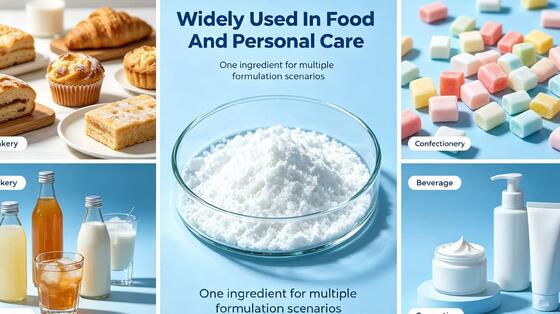
A 200-400 cut gives a thin, even film on a confectionery or bakery surface and stays suspended in a coating syrup. The same fineness is used where a small quantity of sorbitol has to be distributed through a large batch, since the particle count per gram is high and the coverage is uniform.
Where a fine functional ingredient has to be carried through a powder, matching the sorbitol cut to the carrier size limits the separation that occurs when a coarse diluent sits beside a fine active. The multi grade range allows that match to be made without changing supplier.
Plants running several products can hold a single material approval and draw different cuts from it, which simplifies supplier audits and keeps the certificate format consistent across the site.
Each cut is released against its own sieve specification: the passing percentage at the upper screen, the proportion retained on the lower screen and the fines fraction are reported per lot, alongside assay by HPLC, moisture by Karl Fischer and bulk density. Heavy metals, arsenic, residue on ignition and microbiological counts are tested to the food grade limits.
Because the range is produced by classification from one crystallisation stream, the screening deck settings are recorded for each campaign and checked against the certificate. Samples are taken at the mill and at packing, and retained samples are held per cut so that a customer comparing two deliveries is comparing like with like.
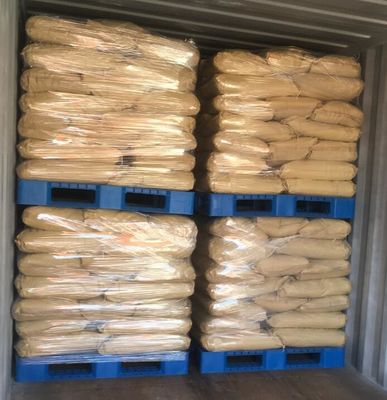
All cuts ship in 25kg PP woven bags with a PE inner liner, heat-sealed at the filling head, with palletisation and stretch wrapping available on request. Bags can be printed neutral or with buyer labelling for bulk orders. Container loading is confirmed against the destination port and pallet pattern, and full container, LCL and mixed shipments are arranged with the certificate of analysis issued before dispatch.
Store in a cool, dry, ventilated warehouse, off the floor, away from condensing walls and from goods with a strong smell. Finer cuts in the range take up moisture faster, so the stack should be arranged by cut and part-used bags resealed promptly. Avoid storage above 40°C and respect the stack height on the bag print. Shelf life is 24 months in unopened original bags.
One range, several cuts. 80-100, 100-200 and 200-400 are classified from the same crystallisation stream, so colour, taste and impurity profile stay consistent across the grades you buy.
Cut defined by numbers. Each lot reports the passing percentage, the retained fraction and the fines level, so the specification describes a distribution rather than a single sieve number.
Consistent from bag to bag. Screen settings are recorded per campaign and checked against the certificate, which keeps the dissolution rate stable between deliveries.
Food grade release testing. Assay, moisture, heavy metals, arsenic and microbiological counts are tested before each cut is released.
Factory direct supply. Crystallised, classified and packed at our plant, with no trading layer between the screen and your warehouse.
Packing and documents in order. 25kg PP woven bags with PE liner, palletised on request, with certificate of analysis and safety data sheet issued before dispatch.
Support on cut selection. If a process needs a dissolution rate or a dust level that sits between two standard cuts, our technical team will review the sieve data with your process side.