 |
| Place of Origin: | China |
| Brand Name: | Golden Grain |
| Certification: | ISO 9001, ISO 22000, HALAL, KOSHER |
| Model Number: | GLMA-G2 |
| Minimum Order Quantity: | 100kg |
|---|---|
| Price: | USD1.39/KG FOB QINGDAO ‑6.94 USD/KG FOB QINGDAO |
| Packaging Details: | 25kg/Bag with Kraft Bag and PE Inner |
| Delivery Time: | 7 - 10 working days |
| Payment Terms: | L/C, T/T, D/P, D/A |
| Supply Ability: | 1000MT per month |
| Appearance: | White Crystalline Powder | Particle Size: | 30-80 Mesh |
|---|---|---|---|
| Assay / Purity: | 99.0% - 101.0% (HPLC, Typical 99.3%) | CAS No.: | 585-88-6 |
| INS No.: | 965 | E Number: | E965 |
| Standard: | BP, USP, EP, FCC | Grade: | Food Grade |
| Sweetness: | About 90% Of Sucrose | Energy: | 2.1 Kcal/g |
| Moisture: | 0.5% Max (typical 0.16%) | Melting Point: | 148-151 °C |
| Solubility: | Readily Soluble In Water | Hygroscopicity: | Low |
| Heavy Metals: | 10 Ppm Max (as Pb) | Lead / Arsenic / Nickel: | 0.5 Ppm Max Each |
| Application: | Chocolate, Compound Coating, Candy Filling, Bakery, Dairy, Beverage | Packaging: | 25kg Kraft Bag With PE Inner |
| Port Of Loading: | Qingdao, China |
At a glance

The sweetness drops when the sugar goes. Cutting sucrose out of a chocolate or filling recipe usually leaves the product tasting thin, not just less sweet, because the missing bulk changes how flavour is released. Maltitol brings body back with it: at around 90% of sucrose sweetness, the dosage adjustment is small enough that the rest of the recipe rarely needs to be rebalanced.
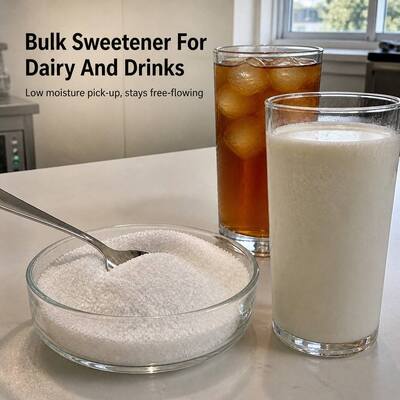
Coatings go tacky in warm storage. Compound coatings and enrobed products pick up surface moisture and start sticking in the box. Maltitol powder takes up very little moisture from ambient air, so finished pieces stay dry to the touch and the powder itself stays free-flowing in the silo instead of bridging over the feed.
Colour and flavour drift from batch to batch. Sucrose browns when it meets heat and protein, and in a dark chocolate line that shows up as variation between runs. Maltitol is not a reducing sugar, so it does not enter the Maillard reaction. Colour and flavour come out consistent, which shortens the adjustment work at the start of each production run.
| Where it is used | What it typically replaces | What the line gains |
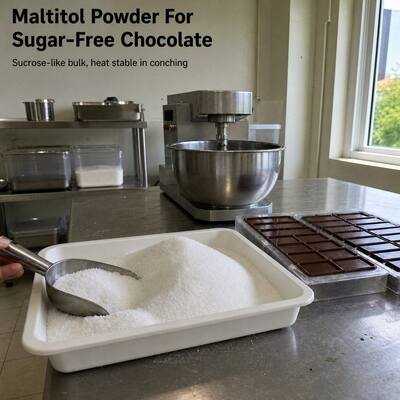
| Moulded and enrobed chocolate | Part or all of the sucrose solids | Sucrose-like bulk with reduced sugar and calories; stable gloss and snap |
| Compound coating and enrobing | Sucrose in the coating powder | Less surface tackiness, fewer caking problems in the feed system |
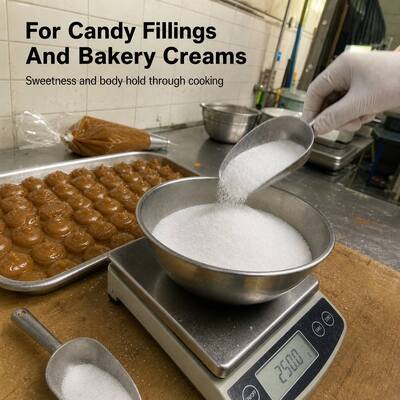
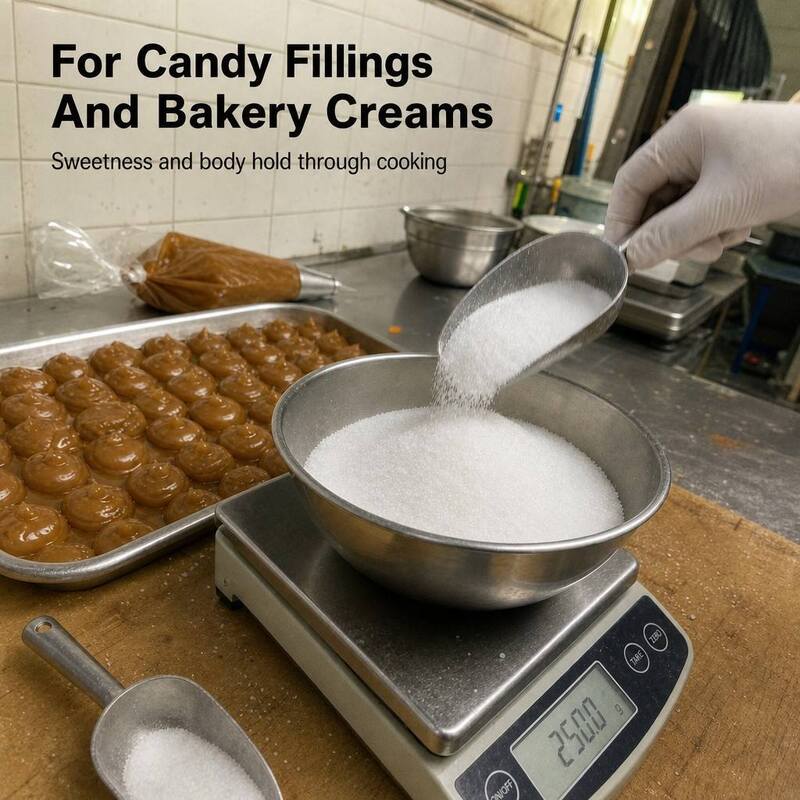
| Fondant, nougat and caramel centres | Sucrose in the cooked centre | Sweetness and body hold through high-temperature cooking without turning bitter |
| Hard candy and deposited sweets | Sucrose in the boiled mass | Clear, glassy texture with a small dosage correction |
| Biscuit cream and bakery filling | Sucrose in the cream | Cream stays soft and non-sticky across shelf life |
| Chewing gum and tableted confectionery | Sucrose or other polyols | Free-flowing powder that compresses and blends cleanly |
| Ice cream, flavoured milk and fruit prep | Sucrose as bulk sweetener | Body and mouthfeel kept in reduced-sugar recipes |
Because sweetness sits at about 90% of sucrose, a first trial usually starts by lifting the sweetener level by roughly a tenth and leaving the fat, emulsifier and flavour load untouched. In chocolate work the powder is milled or refined together with the other solids, so particle size has a direct effect on mouthfeel; tell us the target fineness and we match the lot to it. For cooked centres, the powder is added with the other dry ingredients before the cook, which keeps dispersion even and avoids lumps in the fondant. If the application is a coating rather than a bar, ask for the low-moisture lot so the coating powder stays dry in the feed hopper.
These are the limits this grade is produced against. Measured results for the delivered lot come on the certificate of analysis that travels with the shipment, and a sample certificate or specification sheet can be sent before you confirm an order.
| Test item | Basis | Value |
| Identification | IR / HPLC | A, B, C, D |
| Assay (maltitol, dry basis) | HPLC | 99.0% – 101.0% |
| Water | Loss on drying | ≤ 0.5% |
| Reducing sugars | Titrimetric | ≤ 0.1% |
| Related substances | HPLC | ≤ 1% |
| Specific optical rotation | Polarimetry | +105.5 – +108.5 |
| Melting point | Capillary method | 148 °C – 151 °C |
| Sulphates | Turbidimetric | ≤ 0.01% |
| Chloride | Turbidimetric | ≤ 50 ppm |
| Conductivity | Conductivity meter | ≤ 20 µS·cm-1 |
| Sulfated ash | Gravimetric | ≤ 0.10% |
| Heavy metals (as Pb) | AAS / ICP | ≤ 10 ppm |
| Lead | AAS / ICP | ≤ 0.5 ppm |
| Nickel | AAS / ICP | ≤ 0.5 ppm |
| Arsenic | AAS / ICP | ≤ 0.5 ppm |
| Total bacteria count | Plate count | ≤ 20 pcs/g |
| Molds and yeasts | Plate count | ≤ 10 pcs/g |
| Escherichia coli | Plate count | Negative |
| Salmonella | Plate count | Negative |
| Particle size | Sieve analysis | On request; mesh agreed at order |
| Standard applied | Monograph | BP, USP, EP and FCC |
| CAS No. | Reference | 585-88-6 |
| INS No. | Reference | 965 |
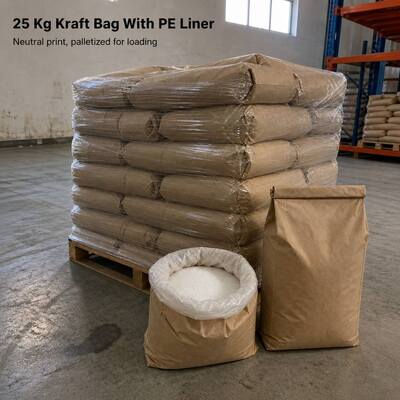
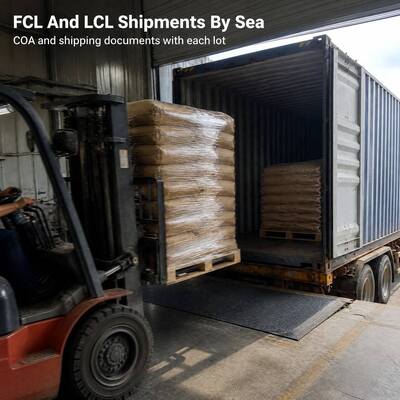
Bags are 25 kg kraft paper with an inner food-grade PE liner, neutral print as standard, stretch-wrapped on pallets for container loading. Bag size, pallet pattern and private label printing can be adjusted to your requirement. Both full container and less-than-container loads ship by sea, with shipping marks to your instruction. Each shipment carries the commercial invoice, packing list, bill of lading and lot certificate of analysis; a health certificate is added where the destination asks for one. Production scheduling and lead time are confirmed when the order quantity and destination port are fixed.
How do I know the lot matches your specification sheet? Every lot is tested and released against its own certificate of analysis, and a retained sample from the same batch is kept at the plant, so a query on a delivered bag can be traced back to the production record.
Can I trial it before committing to a container? Yes. Send the application (chocolate, filling, candy) and the target fineness, and a sample with the matching COA goes out first.
Will it behave differently in my existing tempering or cooking line? It runs on the same equipment with the same process temperatures. The two settings worth reviewing are dosage (about a tenth higher than sucrose for equal sweetness) and, in chocolate, refinement time if you change particle size.
What certifications come with the product? The plant operates under ISO 9001 and ISO 22000, and the product is Halal and Kosher certified. Certificate copies are provided with quotations.
Can packaging be adapted to our market? Bag size, pallet pattern and private label print are all adjustable; tell us the requirement at the enquiry stage so it is priced into the offer.
Send the application, the annual or trial quantity, the fineness or mesh you need, the destination port and any packaging requirement. With those five points we can quote a matched lot rather than a generic offer.