 |
| Place of Origin: | China |
| Brand Name: | Golden Grain |
| Certification: | ISO9001, COA,SDS |
| Model Number: | GLMA-01771 |
| Minimum Order Quantity: | 100kg |
|---|---|
| Price: | USD850-USD950/MT FOB QINGDAO, CHINA |
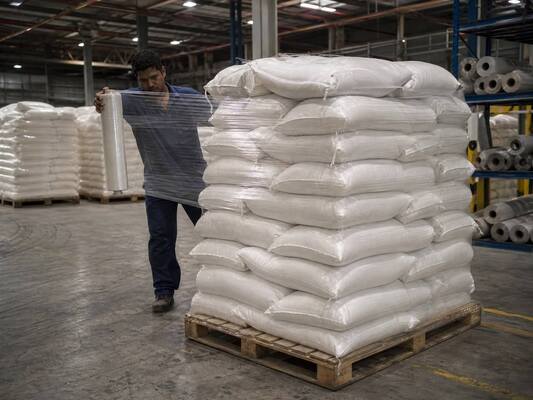
| Packaging Details: | 25kg/Bag with Paper Drum and PE Inner |
| Delivery Time: | 7 - 10 working days |
| Payment Terms: | L/C, T/T, D/P, D/A |
| Supply Ability: | 1000MT per month |
| Chemical Name: | D-Sorbitol | Solubility: | Soluble In Water |
|---|---|---|---|
| Taste: | Sweet | Molecular Weight: | 182.17 G/mol |
| Bulkdensity: | 0.6 - 0.8 G/cm³ | Apperance: | White Crystailline Or Powder |
| Moisture Content: | ≤ 0.5% | Type: | Pharmaceutical Grade, BP, USP, EP |
| Melting Point: | 95-100°C | Purity: | 99% Min |
Sorbitol Powder (chemical name D-Glucitol) is a white, crystalline sugar alcohol. It is made by hydrolysing refined starch to glucose, hydrogenating that glucose to sorbitol under controlled pressure and temperature, then purifying, crystallising, drying and sieving the hydrogenated liquor. The result is the same substance that appears in China's national food-additive standard GB 1886.187, in the EU food-additive specification E 420 (i) and in the FCC; it carries INS 420 / E 420 (i) and CAS No. 50-70-4.
This page is written around the three supply grades we hold for that one crystal:
| Food Grade | Cosmetic & Daily-Chemical Grade | Pharmaceutical Grade | |
| Goes into | Confectionery, chewing gum, bakery, beverages and drink powders, frozen desserts, jams and fillings, seafood and meat processing | Oral care (toothpaste, mouthwash) and personal care / cosmetic formulations | Pharmaceutical and nutraceutical products whose quality file cites a pharmacopoeia |
| Documented against | GB 1886.187 · FCC · EU E 420 (i) · INS 420 | The same release specification, issued for cosmetic and daily-chemical use | A pharmacopoeia-orientated specification — USP, BP or EP, per the monograph your market requires |
| Cut we normally ship | 20–60 mesh · 60–80 mesh · 60–120 mesh | 60–80 mesh · 60–120 mesh | 20–60 mesh |
One crystal, one line, three grades. All three are crystallised on the same production line and released against one and the same release specification. What changes between the grades is not the material itself, but three practical things a purchasing team actually negotiates about: the market framework the batch is documented against, the particle cut chosen for your process, and the document pack that travels with the container. A confectionery buyer, a toothpaste producer and an excipient buyer can therefore read one page and each find the entry that matches their own compliance file — from a single supplier, on a single quality panel.
Why formulators specify it. Sorbitol tastes sweet, cool and clean at roughly 50–70% of the sweetness of sucrose while carrying about one third fewer calories. It is very soluble in water, it is not a reducing sugar — so it takes no part in Maillard browning and keeps colour and flavour through heat and acid — and it is non-cariogenic, which is why oral-care formulators use it. In a recipe it works as four things at once: a bulk sweetener, a humectant that holds moisture in the crumb, paste or cream, a texturizing agent that limits starch staling, and a chelating agent that helps protect colour and flavour. It is also hygroscopic and thermally stable, which is precisely why it performs as a humectant — and why it must be kept sealed in store.

| Item | Value |
| Commodity name | Sorbitol Powder |
| Chemical name | D-Glucitol |
| Synonyms | D-Glucitol; D-Sorbitol; Sorbit; Sorbol |
| CAS No. | 50-70-4 |
| EINECS No. | 200-061-5 |
| INS No. | 420 |
| EU additive number | E 420 (i) |
| Molecular formula | C₆H₁₄O₆ |
| Molecular weight | 182.17 / 182.2 |
| Appearance | White or almost white crystalline powder; odourless; hygroscopic |
| Colour of aqueous solution | Clear |
| Solubility | Very soluble in water (≈ 1 g / 0.45 mL); slightly soluble in alcohol; soluble in methanol, isopropanol |
| Taste | Sweet, cool and pleasant; sweetness about 50–70% of sucrose |
| Melting range | Release limit ≥ 95 °C (reference batch 98.5 °C); the EU specification quotes 88 – 102 °C |
| Relative density | about 1.47 – 1.49 (MSDS specific gravity 1.489) |
| pH, 10% aqueous solution | 3.5 – 7.0 |
| H.S. Code | 29054400 |
| Inventory status | CAS 50-70-4 is listed on the U.S. TSCA 8(b) inventory |
Sorbitol is produced by catalytic hydrogenation of dextrose / glucose syrup obtained from starch. Depending on the glucose grade used, the fraction that is not D-sorbitol consists of related glycitols such as mannitol and iditol — the specification below is written to keep that fraction controlled from lot to lot.
| Item | Specification |
| Appearance | White, or almost white, crystal powder |
| Identification | A, B, C |
| Solubility | Very soluble in water; slightly soluble in alcohol |
| Thin layer chromatography | Passes test |
| Assay | ≥ 98.0% |
| Loss on drying | ≤ 1.0% |
| Total sugar | ≤ 1.0% |
| Reducing sugar | ≤ 0.20% |
| Specific rotation | + 4.0° to + 7.0° |
| pH value (10% solution) | 3.5 – 7.0 |
| Residue on ignition | ≤ 0.1% |
| Heavy metals (as Pb) | ≤ 5 ppm |
| Nickel | ≤ 1 ppm |
| Lead | ≤ 0.5 ppm |
| Arsenic | ≤ 1 ppm |
| Chlorides | ≤ 0.005% |
| Sulphates | ≤ 0.01% |
| Melting range | ≥ 95 °C |
| Ash insoluble in acid | ≤ 1.5% |
| Ethylene glycol | Absence |
| Diethylene glycol | Absence |
| Total plate count | ≤ 1000 pcs/g |
| Moulds and yeasts | ≤ 100 pcs/g |
| Coliforms at 35 °C | ≤ 2 cfu/g |
| E. coli | Negative |
| Salmonella sp. | Negative in 25 g |
| Dead mites | ≤ 5 / 25 g |
| Particle size | Released against the cut ordered — see 2.5 |
Two groups of lines in this panel are worth a technical buyer's attention, because neither can be "corrected" after crystallisation:
Food Grade. Released to the panel above and documented against the food-additive frameworks — GB 1886.187, FCC and EU E 420 (i). This is the grade used in sugar-free confectionery and gum, bakery and biscuit recipes, beverages and drink premixes, frozen desserts, jams and fillings, and in seafood and meat processing where cryoprotection and moisture retention are wanted. We normally ship the coarse 20–60 mesh cut where the powder is dry-blended or dosed, and the finer 60–80 / 60–120 mesh cuts where faster wetting shortens the batch.
Cosmetic & Daily-Chemical Grade. The same crystal, released to the same specification, issued for oral-care and personal-care use. Toothpaste and mouthwash makers take the fine cuts: 60–80 mesh or 60–120 mesh give more surface area per gram, so the powder wets quickly and disperses uniformly into a paste, cream, lotion or gel. Statements for cosmetic and personal-care use can be added to the document pack on request.
Pharmaceutical Grade. Supplied for pharmaceutical and nutraceutical applications whose quality file cites a pharmacopoeia. This grade is produced and documented against a pharmacopoeia-orientated specification — USP, BP or EP — and the batch carries its own Certificate of Analysis. Because test panels differ between monographs, tell us at enquiry stage which pharmacopoeia your market requires; we will confirm the matching grade, the test panel and the document pack in writing before you commit to a quantity. We normally ship this grade as 20–60 mesh: free-flowing, low-dust, and it meters consistently on a filling or blending line.
| Parameter | GB 1886.187 (China food additive) | FCC | EU E 420 (i) |
| Assay / content, dry basis | Sorbitol ≥ 91.0% | 91.0 – 100.5% | Total glycitols ≥ 97% and D-sorbitol ≥ 91% |
| Water / loss on drying | ≤ 1.5% | ≤ 1.0% | ≤ 1.5% (Karl Fischer) |
| Reducing sugars (as glucose) | ≤ 0.3% | ≤ 0.3% | ≤ 0.3% |
| Total sugars (as glucose) | ≤ 4.4% | ≤ 1.0% | ≤ 1% |
| Residue on ignition / sulphated ash | ≤ 0.1% | ≤ 0.1% | — |
| Chloride | ≤ 50 mg/kg | ≤ 0.005% | — |
| Sulphate | ≤ 100 mg/kg | ≤ 0.01% | — |
| Nickel | ≤ 2.0 mg/kg | ≤ 2 mg/kg | ≤ 2 mg/kg |
| Lead | ≤ 1.0 mg/kg | ≤ 1 mg/kg | ≤ 1 mg/kg |
| Arsenic | — | — | ≤ 3 mg/kg |
| Heavy metals (as Pb) | — | ≤ 5 mg/kg | — |
| Conductivity | — | — | ≤ 20 μS/cm (20% dry-solids solution, 20 °C) |
| Melting range | — | — | 88 – 102 °C |
Read that table against section 2.2 and the point becomes concrete: our release limits sit well inside the mandatory national minimum — assay ≥ 98.0% against a ≥ 91.0% requirement, reducing sugar ≤ 0.20% against ≤ 0.3%, total sugar ≤ 1.0% against ≤ 4.4% — and released lots also satisfy the FCC and EU E 420 (i) profiles, so one specification sheet and one document set will usually cover several destination markets at once. For the Pharmaceutical Grade the same crystal is documented against the pharmacopoeia you name (USP, BP or EP); the monograph test set is confirmed with you before order.
Sieve openings used for the conversion below:
| Mesh | Opening (µm) | Mesh | Opening (µm) |
| 40 mesh | 420 | 80 mesh | 180 |
| 60 mesh | 250 | 120 mesh | 125 |
Cuts held in the product specification: 20–60 mesh, 50 mesh, 60–80 mesh, 60–120 mesh. Further cuts — including 20–40 mesh, 40–60 mesh, 80–120 mesh, 40–100 mesh and 10–20 mesh — are produced to order.
Particle-size release limits, expressed as passing percentage:
| Cut | Specification (passing) |
| 20–40 mesh | more than 90% |
| 40–60 mesh | more than 95% |
| 80–120 mesh | more than 95% |
Reference sieve profile measured on the 20–60 mesh cut, expressed as cumulative oversize (percentage retained on each sieve):
| Sieve opening | Cumulative oversize |
| Coarser than 840 µm (20 mesh) | 3 – 5% |
| Coarser than 590 µm (30 mesh) | 30 – 35% |
| Coarser than 420 µm (40 mesh) | 60 – 65% |
| Coarser than 300 µm (50 mesh) | 80 – 85% |
| Coarser than 250 µm (60 mesh) | 88 – 93% |
| Finer than 180 µm (through 80 mesh) | 2 – 4% |
Choosing a cut by grade:
Measured on sorbitol powder fractions (static = poured, dynamic = tapped):
| Fraction | Static bulk density (g/mL) | Dynamic bulk density (g/mL) |
| 40 mesh and above | 0.640 | 0.748 |
| 60 mesh and above | 0.637 | 0.726 |
| 80 mesh and above | 0.641 | 0.758 |
| 100 mesh and above | 0.627 | 0.769 |
| 120 mesh and above | 0.602 | 0.769 |
Practical working range: about 0.60 – 0.64 g/mL poured and 0.73 – 0.77 g/mL tapped. Use these figures for bag volumes, silo and mixer fill factors, and container payload planning.
Do not confuse bulk density with the solid specific gravity quoted in section 2.1 (about 1.47 – 1.49; MSDS 1.489). They are different properties used for different calculations.
How to read this section. Sorbitol is one crystal and one release panel (section 2.2), so instead of publishing a single batch we publish three reference batches from different cuts and different production runs. That lets you judge lot-to-lot consistency — the property a buyer is really underwriting when they qualify a second source. Every shipment still travels with its own batch-specific COA, and that COA is the governing document.
Reference batch 1 — 20–60 mesh cut, 19 MT
| Item | Specification | Result |
| Characteristics | White crystalline granule or powder | Complied |
| Assay | ≥ 99.0% | 99.5% |
| Sorbitol | ≥ 98.0% | 98.5% |
| Reducing sugars | ≤ 0.15% | 0.09% |
| Total sugars | ≤ 0.5% | 0.2% |
| pH (50% aqueous solution) | 5.0 – 7.0 | 5.4 |
| Residue on ignition | ≤ 0.1% | Complied |
| Heavy metals (as Pb) | ≤ 5 ppm | Complied |
| Nickel | ≤ 1 ppm | Complied |
| Lead | ≤ 1 ppm | Complied |
| Arsenic | ≤ 1 ppm | Complied |
| Chloride | ≤ 50 ppm | Complied |
| Sulphate | ≤ 50 ppm | Complied |
| Total plate count | ≤ 100 p/g | Complied |
| Coliform bacillus | Absent in 1 g | Complied |
| Conclusion | — | Complied |
Reference batch 2 — 20–40 mesh cut, 17.5 MT
| Item | Specification | Result |
| Appearance | White crystal powder | Conforms |
| Assay | ≥ 99.0% | 99.5% |
| Moisture content | ≤ 1.0% | 0.5% |
| Sorbitol purity | ≥ 98.5% | 98.8% |
| Total sugar | ≤ 0.30% | 0.20% |
| Reducing sugar | ≤ 0.10% | 0.05% |
| Density (specific gravity) | ≥ 1.45 | 1.48 |
| Specific rotation | 4.0 – 7.0 | 4.7 |
| pH (50% solution) | 5.0 – 7.0 | 6.5 |
| Residue on ignition | ≤ 0.1% | Conforms |
| Heavy metals (as Pb) | ≤ 5 ppm | Conforms |
| Nickel | ≤ 1 ppm | Conforms |
| Lead | ≤ 0.5 ppm | Conforms |
| Chlorides | ≤ 10 ppm | Conforms |
| Sulphates | ≤ 20 ppm | Conforms |
| Arsenic | ≤ 1 ppm | Conforms |
| Total plate count | ≤ 1000 pcs/g | 63 pcs/g |
| Moulds and yeasts | ≤ 100 pcs/g | 10 pcs/g |
| E. coli | Negative | Negative |
| Conclusion | — | Conforms |
Reference batch 3 — 20–60 mesh cut, 19.5 MT
| Item | Specification | Result |
| Appearance | White, or almost white, crystal powder | Conforms |
| Identification | A, B, C | Conforms |
| Thin layer chromatography | Passes test | Conforms |
| Assay | ≥ 98.0% | 99.10% |
| Loss on drying | ≤ 1.0% | 0.32% |
| Total sugar | ≤ 1.0% | 0.15% |
| Reducing sugar | ≤ 0.20% | 0.10% |
| Specific rotation | + 4.0° to + 7.0° | + 4.75° |
| pH value (10%) | 3.5 – 7.0 | 6.1 |
| Residue on ignition | ≤ 0.1% | 0.03% |
| Nickel | ≤ 1 ppm | 0.01 ppm |
| Lead | ≤ 0.5 ppm | 0.001 ppm |
| Melting range | ≥ 95 °C | 98.5 °C |
| Ash insoluble in acid | ≤ 1.5% | 0.001% |
| Total plate count | ≤ 1000 pcs/g | Conforms |
| Moulds and yeasts | ≤ 100 pcs/g | Conforms |
| Coliforms at 35 °C | ≤ 2 cfu/g | Negative |
| E. coli | Negative | Negative |
| Salmonella sp. | Negative in 25 g | Negative |
| Dead mites | ≤ 5 / 25 g | Conforms |
| Ethylene glycol | Absence | Absence |
| Diethylene glycol | Absence | Absence |
| Conclusion | — | Conforms to specification |
What the three batches say together. Assay landed in a 99.10 – 99.50% band against a ≥ 98.0% limit. Residual moisture held between 0.32% and 0.5% against ≤ 1.0%. Reducing sugar came in at 0.05%, 0.09% and 0.10% and total sugar at 0.15%, 0.20% and 0.2% — every lot comfortably inside the ≤ 0.20% / ≤ 1.0% release limits. On reference batch 3 the metals sat two orders of magnitude inside their limits: nickel 0.01 ppm, lead 0.001 ppm. Read these figures as evidence of margin and batch-to-batch consistency, not as a promise that a future lot will reproduce those exact numbers. The COA in your shipping pack governs.
Typical usage levels below are given on the dry product and are for orientation. Always confirm the final figure against your own recipe, your process and your local labelling rules.
Food Grade
| Application | Typical dosage | What it does |
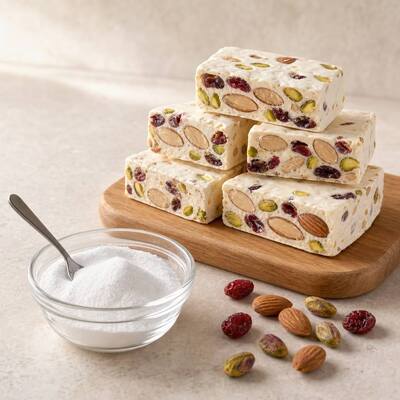
| Confectionery (all types) and chewing gum | 3 – 15% | Bulk sweetener and bodying agent; pleasant mouthfeel, moisture retention, protects against drying, oxidation and flavour loss; supports a sugar-free concept |
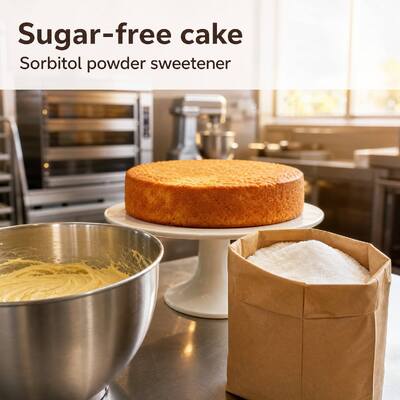
| Cakes, biscuits, pastries | 2 – 10% | Carries the bulk of the sweetness with less cracking, better shape retention and longer shelf life; pale doughs stay pale |
| Jams and fillings | 5 – 10% | Holds moisture at low sweetness; sugar-free formulations |
| Beverages and drink powders | 3 – 5% | Very soluble; flavour enhancement and carrier function in reduced-calorie and sugar-free systems |
| Ice cream, juices, jellies | 3 – 6% | Low sweetness, suppresses crystallisation and holds body through freeze–thaw |
| Fish and meat products | 3 – 8% | Protects tissue during freezing, retains moisture, low sweetness, less browning |
| Frozen minced fish | 5 – 8% | Moisture retention and cryoprotection |
Cosmetic & Daily-Chemical Grade
| Application | Typical dosage | What it does |
| Oral care — toothpaste | 25 – 30% | Principal humectant and vehicle: keeps the paste smooth, stops it drying at the crimp and holds the required viscosity; contributes mild, non-cariogenic sweetness |
| Oral care — mouthwash and rinses | as required | Humectant and mild sweetener in aqueous systems |
| Creams, lotions, gels | as required | Mild, low-irritation humectant that holds moisture at the skin surface and improves spread |
| Soaps, shampoos, shower products | as required | Moisture retention and texture improvement; used where a mild humectant is preferred over glycerin |
Pharmaceutical Grade
| Application | Typical dosage | What it does |
| Excipient in oral solid dosage forms | per your formulation | Bulk excipient, sweetener and humectant where a pharmacopoeia-orientated grade and its document pack are required |
| Oral liquid preparations and syrups | per your formulation | Sweetener, humectant and vehicle; very soluble and chemically stable |
| Nutraceutical and oral-care dosage systems | per your formulation | Carries bulk and sweetness where a non-cariogenic sugar alcohol with a controlled metal and microbial panel is wanted |
Other outlets. Beyond the three grades, sorbitol powder is also taken as a polyol feedstock in chemical synthesis — for example as the starting polyol for Span / Tween surfactants, alkyd resins, polyethers and plasticisers. Tell us the end use and we will confirm the suitable cut.
The crystal is identical in all three grades. What a formulator is really choosing between is the document framework and the particle cut — which is why we ask for the target application and the destination market at enquiry stage. It usually settles the grade and the cut in one step.
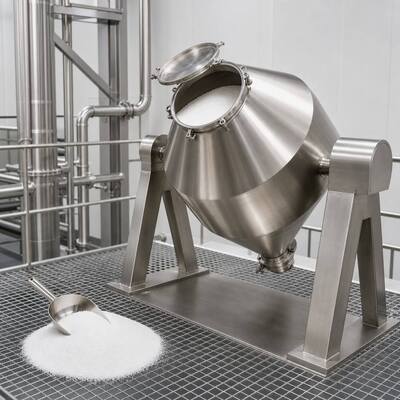
Production route. The plant runs corn starch through to finished sorbitol on one continuous line: corn starch slurry → liquefaction → cooling and pH adjustment → protein pre-treatment → saccharification → ion exchange → slurry allotment → decolourising → concentration → separation → decolourising → drying → cooling and crystallisation → sieving / separation → packed product. Because the sugar liquor is purified by ion exchange and decolourising before crystallisation, colour and residual sugar are controlled upstream of the sieve rather than corrected afterwards. That is also the reason one release panel can serve the food, cosmetic and pharmaceutical grades at the same time.
Release testing on every batch.
No batch is packed for delivery until it has been released against the specification in section 2.2 and issued with its own Certificate of Analysis. Retained samples and full batch records are kept, so a delivered lot can be re-tested against the agreed specification on request.
Microbiological certificate held on file.
| Parameter | Limit |
| Total plate count | ≤ 1000 pcs/g |
| Moulds and yeasts | ≤ 100 pcs/g |
| Coliforms | Negative |
| E. coli | Negative |
| Salmonella sp. | Negative |
What travels with each grade. Tell us at the ordering stage which grade you are buying and which documents your customs broker or QA department needs; we will build the pack accordingly.
| Document | Food Grade | Cosmetic & Daily-Chemical Grade | Pharmaceutical Grade |
| Batch Certificate of Analysis | Included | Included | Included |
| Product specification sheet | Included | Included | Included |
| MSDS | Included | Included | Included |
| Cosmetic / personal-care use statement | On request | Included on request | On request |
| Pharmacopoeia-referenced COA (USP / BP / EP) | — | — | On request, against the monograph you name |
| Plant certificates — ISO 9001, ISO 22000 | Available | Available | Available |
| HALAL, KOSHER | Available | Available | Available |
| Manufacturing licence | Available | Available | Available |
Manufacturing route. The material is made from refined starch along a documented route — starch liquefaction and saccharification to glucose, decolourising and ion exchange, catalytic hydrogenation under controlled pressure and temperature, a second decolourising / ion-exchange step, vacuum evaporation, crystallisation, centrifugation, drying and sieving, then packing. Residual sugar in the hydrogenated liquor is held below the release limit before crystallisation.
| Item | Details |
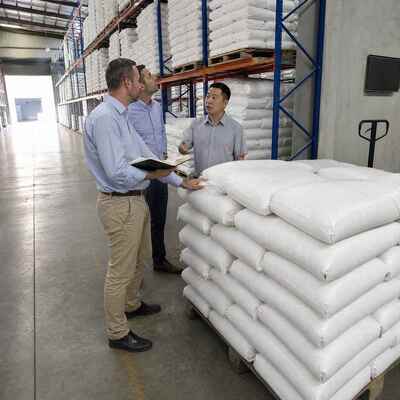
| Standard packing | 25 kg net per bag — white PP woven outer bag with a food-grade PE inner liner (unprinted) |
| Alternative packing | Kraft-paper outer bag, other bag weights, larger or smaller formats, palletising and private-label printing can be arranged to order |
| Marking | Neutral export marking as standard; buyer-specific marking on request |
| Documentation per shipment | Batch Certificate of Analysis; product specification sheet; MSDS and further statements on request |
| Container loading | Advise the destination port and the required cut, and we will confirm the loading plan |
All three grades are packed on the same line and to the same format, so a mixed programme — food grade for one market, cosmetic grade for another — travels under a single packing standard and one set of packing documents.
Storage.
Shelf life:
Handling. Normal dust-control practice applies at filling and weighing points. For bulk handling, use splash goggles, gloves, a lab coat and an approved dust respirator.
Safety profile (per the MSDS).
| Property | Value |
| Hazard rating — HMIS (U.S.) | Health 2 · Fire 1 · Reactivity 0 · Personal protection E |
| Hazard rating — NFPA (U.S.) | Health 2 · Flammability 1 · Reactivity 0 |
| Acute oral toxicity | LD50 15,900 mg/kg (rat) |
| Hazard summary | Irritating to eyes; hazardous if ingested; slightly hazardous on skin contact or inhalation of dust |
| Fire behaviour | May be combustible at high temperature; combustion products are carbon oxides (CO, CO₂); small fire — dry chemical powder; large fire — water spray, fog or foam (not a water jet) |
| Stability | Stable; does not polymerise; non-corrosive in the presence of glass |
First aid at a glance.
| Route | Immediate measure |
| Eye contact | Remove contact lenses; flush with running water for at least 15 minutes with the eyelids held open; seek medical attention |
| Skin contact | Wash immediately with plenty of water and non-abrasive soap; wash contaminated clothing before reuse |
| Inhalation | Move to a well-ventilated area; seek medical attention if symptoms persist |
| Ingestion | Do not induce vomiting; loosen tight clothing; seek immediate medical attention |
Transport status. This product is not a dangerous good for transport: it is not a DOT-controlled material (U.S.), is not regulated under the IMDG Code, and is not controlled under WHMIS (Canada). Standard containerised sea freight applies, which keeps the shipping documentation straightforward. The MSDS supplied with the shipment governs all transport and handling decisions.
Q1. Which of the three grades should I order? A. Choose by where the product goes. Food Grade for anything eaten or drunk; Cosmetic & Daily-Chemical Grade for oral care and personal care; Pharmaceutical Grade where your quality file cites a pharmacopoeia and you need the matching document pack. Send the application, the cut you need and the destination market, and we will confirm the grade in writing.
Q2. Is the material actually different between the grades, or only the paperwork? A. All three grades come off the same line and are released against one specification (section 2.2), so the purity panel is identical. What differs is the framework the batch is documented against, the particle cut we recommend for your process, and the documents that ship with it. Where a market requires tighter grade-specific limits — a microbial limit, for example — tell us the monograph or specification and we will confirm against it.
Q3. Can you supply against the USP, BP or EP monograph? A. Yes — the Pharmaceutical Grade is produced and documented against a pharmacopoeia-orientated specification. Name the monograph your market requires at enquiry stage and we will confirm the matching grade, the test panel and the document pack in writing before order.
Q4. What is the purity? A. The release limit is assay ≥ 98.0%. Our three published reference batches tested at 99.50%, 99.50% and 99.10%. Identity is confirmed by identification A, B, C, by TLC and by specific rotation.
Q5. How much moisture does it carry? A. Loss on drying is limited to ≤ 1.0%; the reference batches measured 0.32% and 0.5%.
Q6. How low are the sugars? A. Reducing sugars are limited to ≤ 0.20% and total sugars to ≤ 1.0% on release; the reference batches measured 0.05%, 0.09% and 0.10% reducing sugar and 0.15%, 0.20% and 0.2% total sugar.
Q7. How do I know it is genuine D-glucitol and not a blend? A. Two specification lines answer this directly: specific rotation + 4.0° to + 7.0° with TLC identification A, B, C; plus ethylene glycol and diethylene glycol specified as absolute absence and melting range ≥ 95 °C. All were confirmed on the reference batches.
Q8. Which particle size should I order? A. In practice: 20–60 mesh for dry blending, dosing and pharmaceutical handling; 60–80 / 60–120 mesh where fast wetting and uniform dispersion into a paste, cream or gel matter. Other cuts — including 20–40, 40–60, 80–120, 40–100 and 10–20 mesh — are produced to order.
Q9. Will it brown when I heat or bake it? A. No. Sorbitol is not a reducing sugar, so it takes no part in Maillard browning, and it tolerates a wide temperature range.
Q10. Does it cake or dust? A. Sorbitol is hygroscopic, so keep the bag sealed. A coarse cut is less prone to compaction than a fine powder, and a fine cut carries a smaller airborne-dust load than a flour-grade material. The powder may set firm in storage, which does not affect performance.
Q11. Is it suitable for sugar-free and oral-care products? A. It is a sugar alcohol used as a bulk sweetener in sugar-free and reduced-calorie formulations, and it is non-cariogenic — which is why oral-care formulators use it. Whether a finished product may carry a "sugar-free" claim depends on your local labelling rules: we supply the data, you make the claim.
Q12. How is it packed? A. Standard packing is 25 kg net per bag, white PP woven outer bag with a food-grade PE inner liner (unprinted). Alternative bag types, bag weights, palletising and private-label printing can be arranged to order.
Q13. What documents come with the goods? A. Standard: the batch Certificate of Analysis, the product specification sheet and the MSDS. Plant-level documents available include ISO 9001, ISO 22000, HALAL, KOSHER and the manufacturing licence. For the Pharmaceutical Grade, tell us the monograph your market cites so the document pack can be matched to it.
Q14. Is it a dangerous good for shipping? A. No. It is not DOT-controlled, not regulated under the IMDG Code and not WHMIS-controlled; standard containerised sea freight applies.
Q15. What are the MOQ, lead time, price and payment terms? A. Send the grade, the cut, the required quantity, the destination port and the packing preference, and we will confirm MOQ, lead time, price and payment terms for that specific shipment.
Qingdao Golden Grain Chemical Co., Ltd, invested by Golden Grain Group Limited, one professional manufacturer and exporter since 2000, is devoted to supplying products and solutions to food & beverage, medicine, animal feed & nutrition, personal care & household, construction, agriculture.
Golden Grain Group Limited have professional staff, advanced production lines and complete lab equipment, pass GMP, HACCP, ISO, HALAL, KOSHER, BRC, GMP-Free, and other necessary certificates, which ensure our quality to be international standard. For many years' experience, we are exporting our products to more than 60 countries in the world.
"Quality Products", "Efficient Service", Golden Grain Group Limited hope to enter good business cooperation with customers at home and abroad for long.