 |
| Place of Origin: | China |
| Brand Name: | Golden Grain |
| Certification: | ISO9001, COA,SDS |
| Model Number: | GLMA-01771 |
| Minimum Order Quantity: | 100kg |
|---|---|
| Price: | USD850-USD950/MT FOB QINGDAO, CHINA |
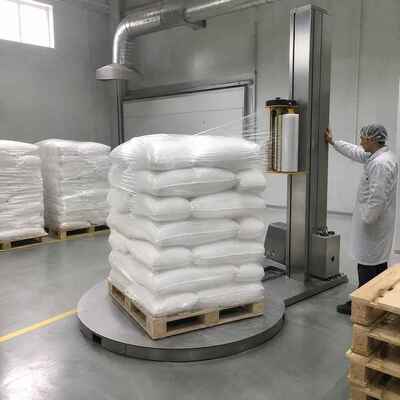
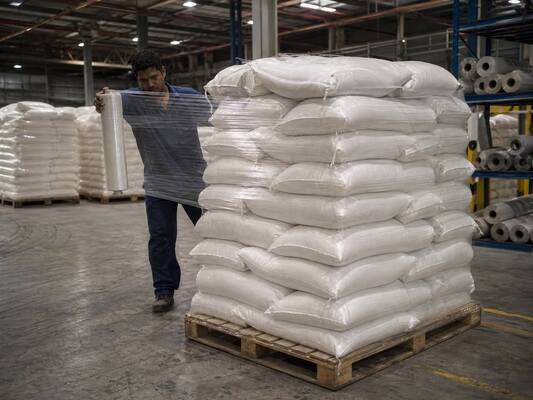
| Packaging Details: | 25kg/Bag with Paper Drum and PE Inner |
| Delivery Time: | 7 - 10 working days |
| Payment Terms: | L/C, T/T, D/P, D/A |
| Supply Ability: | 1000MT per month |
| Cas No: | 50-70-4 | Type: | Food Grade |
|---|---|---|---|
| Flash Point: | Non-flammable | Food Additive: | Humectant |
| Moisture Content: | 0.5% Max | Productname: | Sorbitol Powder |
| Usage: | Food Industry, Bakery, Confectionery, Seafood Preservation | Molecular Weight: | 182.17 G/mol |
| Shelflife: | 2 Years | Appearance: | White Crystalline Powder |
| Storageconditions: | Store In A Cool, Dry And Sealed Place, Keep Away From Moisture | Sorbitol Content: | 99% Min |
Sorbitol Powder (D-Glucitol) is a white crystalline polyol — a sugar alcohol — made by converting starch into glucose and then hydrogenating that glucose under catalysis, after which the liquor is refined, concentrated, crystallised, dried and sieved. Our plant runs the full route in house, starting from corn starch slurry, so particle size, residual sugar and colour are controlled at the crystallisation and sieving stages rather than bought in.
This listing is offered as a mesh matrix, not a single cut. The standard cuts we hold in the specification are 20–60 mesh, 50 mesh, 60–80 mesh and 60–120 mesh, and we also produce 20–40 mesh, 40–60 mesh and 80–120 mesh against a customer's own particle-size requirement. That means one supplier and one document set can cover a chewing-gum line asking for a coarse granule and a toothpaste plant asking for a fine, fast-wetting powder.
Sorbitol is roughly 60% as sweet as sucrose with about one third fewer calories, has a smooth mouthfeel and a sweet, cool, pleasant taste, and is very soluble in water. It is not a reducing sugar, so it does not take part in browning reactions, and it is stable across a wide temperature range and chemically non-reactive. Functionally it works as a humectant, texturizing agent, anti-crystallising agent and nutritive sweetener; it is non-cariogenic, and it is affirmed as GRAS by the US FDA and approved for use in the European Union and in other markets including Canada, Australia and Japan.
Typical users are confectionery, chewing-gum, frozen-dessert and bakery plants, beverage and drink-powder producers, oral-care (toothpaste and mouthwash) manufacturers and cosmetics / personal-care formulators. Every shipment travels with a batch-specific Certificate of Analysis, and the plant holds food-safety and halal/kosher documentation on file.

| Item | Value |
| Commodity name | Sorbitol Powder |
| Chemical name | D-Glucitol |
| Synonyms | D-Glucitol; D-Sorbitol; Sorbit; Sorbol |
| CAS No. | 50-70-4 |
| EINECS No. | 200-061-5 |
| INS No. | 420 |
| Molecular formula | C₆H₁₄O₆ |
| Molecular weight | 182.2 |
| Appearance | White, or almost white, crystal powder |
| Solubility | Very soluble in water; slightly soluble in alcohol |
| Sweetness | About 60% of sucrose |
| Caloric value | About one third fewer calories than sucrose |
| H.S. Code | 29054400 |
| Identification | A, B, C |
Sorbitol is obtained by catalytic hydrogenation of dextrose and glucose syrups sourced from starch. Depending on the glucose grade used, the fraction that is not D-sorbitol consists of related glycitols such as mannitol and iditol.
| Item | Specification |
| Appearance | White, or almost white, crystal powder |
| Identification | A, B, C |
| Solubility | Very soluble in water; slightly soluble in alcohol |
| Thin layer chromatography | Passes test |
| Assay | ≥ 98.0% |
| Loss on drying | ≤ 1.0% |
| Total sugar | ≤ 1.0% |
| Reducing sugar | ≤ 0.20% |
| Specific rotation | + 4.0° to + 7.0° |
| pH value (10% solution) | 3.5 – 7.0 |
| Residue on ignition | ≤ 0.1% |
| Heavy metals (as Pb) | ≤ 5 ppm |
| Nickel | ≤ 1 ppm |
| Lead | ≤ 0.5 ppm |
| Chlorides | ≤ 0.005% |
| Sulphates | ≤ 0.01% |
| Arsenic | ≤ 1 ppm |
| Melting range | ≥ 95 °C |
| Ethylene glycol | Absence |
| Diethylene glycol | Absence |
| Ash insoluble in acid | ≤ 1.5% |
| Salmonella sp. | Negative in 25 g |
| Dead mites | ≤ 5 / 25 g |
| Total plate count | ≤ 1000 pcs/g |
| Molds and yeasts | ≤ 100 pcs/g |
| Coliforms at 35 °C | ≤ 2 cfu/g |
| E. coli | Negative |
| Particle size | 20–60 mesh, 50 mesh, 60–80 mesh, 60–120 mesh |
Two lines here are worth flagging for technical buyers, because they are the ones that separate a controlled crystallisation plant from a re-packer:
Reference conversion for our sieves; the micron figure is the opening of the corresponding mesh:
| Mesh | Opening (µm) | Mesh | Opening (µm) |
| 40 mesh | 420 | 80 mesh | 180 |
| 60 mesh | 250 | 120 mesh | 125 |
Particle-size specification, expressed as passing percentage (through the stated mesh):
| Particle size | Specification (pass) | Result |
| 20–40 mesh | More than 90% | Conforms |
| 40–60 mesh | More than 95% | Conforms |
| 80–120 mesh | More than 95% | Conforms |
Cuts held in the product specification: 20–60 mesh, 50 mesh, 60–80 mesh, 60–120 mesh. Additional cuts are produced to order.
Which cut to choose:
Declared values for the granular (60–80 mesh) cut, per 100 g:
| Nutrient | Value | Unit |
| Energy | 375 / 1570 | kcal / kJ |
| Protein | 0 | g |
| Moisture | 0.5 | g |
| Fat | 0 | g |
| — of which saturates | 0 | g |
| — of which monounsaturated | 0 | g |
| — of which polyunsaturated | 0 | g |
| — of which trans fatty acids | 0 | g |
| Carbohydrates (digestible) | 93.4 | g |
| — of which sugar | 93.0 | g |
| Sodium | 0 | mg |
| Calcium | 0 | mg |
| Potassium | 0 | mg |
| Fibre | 0 | g |
| Salt (as NaCl) | 0 | g |
The values above are reproduced exactly as declared on the manufacturer's nutrition sheet for the 60–80 mesh cut. Because sorbitol is a polyol, the way the carbohydrate fraction is split between "sugars" and "polyols" differs between labelling regimes — tell us your destination market and we will supply the layout your labelling authority expects.
Reference batch of the 20–60 mesh cut, quantity 19.5 MT, packed 25 kg per bag. The results below illustrate typical performance; the batch-specific Certificate of Analysis accompanying your shipment carries the full batch identification.
| Item | Specification | Result |
| Appearance | White, or almost white, crystal powder | Conforms |
| Identification | A, B, C | Conforms |
| Solubility | Very soluble in water; slightly soluble in alcohol | Conforms |
| Thin layer chromatography | Passes test | Conforms |
| Assay | ≥ 98.0% | 99.10% |
| Loss on drying | ≤ 1.0% | 0.32% |
| Total sugar | ≤ 1.0% | 0.15% |
| Reducing sugar | ≤ 0.20% | 0.10% |
| Specific rotation | + 4.0° to + 7.0° | + 4.75° |
| pH value (10%) | 3.5 – 7.0 | 6.1 |
| Residue on ignition | ≤ 0.1% | 0.03% |
| Heavy metals (as Pb) | ≤ 5 ppm | Conforms |
| Nickel | ≤ 1 ppm | 0.01 ppm |
| Lead | ≤ 0.5 ppm | 0.001 ppm |
| Chlorides | ≤ 0.005% | Conforms |
| Sulphates | ≤ 0.01% | Conforms |
| Arsenic | ≤ 1 ppm | Conforms |
| Melting range | ≥ 95 °C | 98.5 °C |
| Ash insoluble in acid | ≤ 1.5% | 0.001% |
| Total plate count | ≤ 1000 pcs/g | Conforms |
| Molds and yeasts | ≤ 100 pcs/g | Conforms |
| Coliforms at 35 °C | ≤ 2 cfu/g | Negative |
| E. coli | Negative | Negative |
| Salmonella sp. | Negative in 25 g | Negative |
| Dead mites | ≤ 5 / 25 g | Conforms |
| Ethylene glycol | Absence | Absence |
| Diethylene glycol | Absence | Absence |
| Particle size | 20–60 mesh | 20–60 mesh |
| Storage conditions | In a dry place at room temperature | — |
| Conclusion | — | Conforms to specification |
Read the reference batch as a statement about margin above the limit, not as a claim about every future lot: assay landed at 99.10% against a ≥ 98.0% limit, reducing sugar at 0.10% against ≤ 0.20%, and the metals — nickel 0.01 ppm and lead 0.001 ppm — came in two orders of magnitude inside their limits.
Sorbitol's humectancy and moisture-stabilising action, its anti-crystallising behaviour and its cool, clean taste put it to work in several different directions.
| Field | How sorbitol is used |
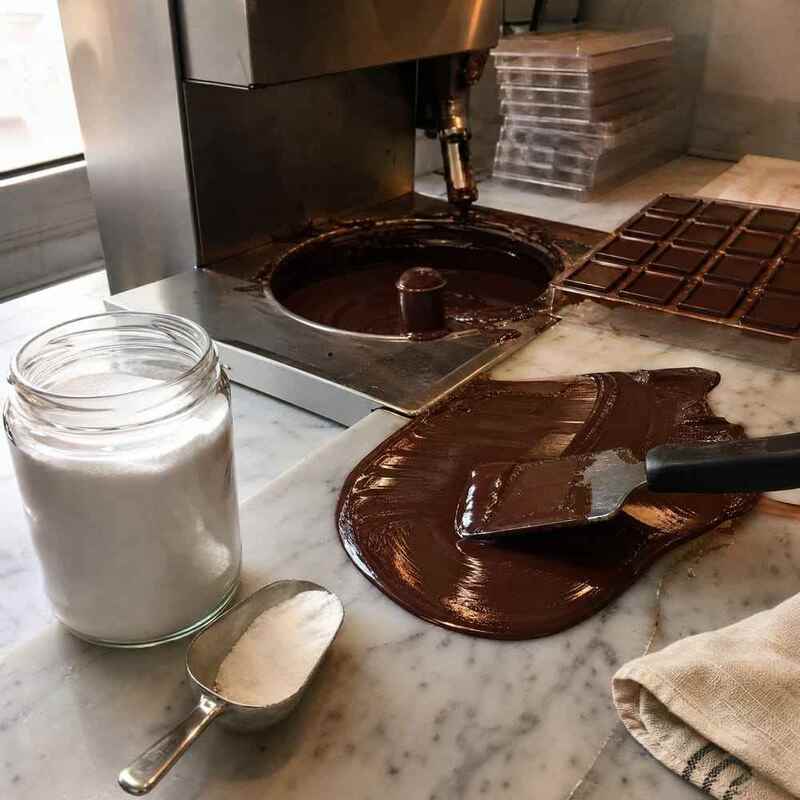
| Confectionery, chewing gum & frozen desserts | Bulk sweetener and bodying agent; anti-crystallising agent that keeps texture even through freezing and thawing; non-reducing, so colours and flavours stay true instead of browning. |
| Bakery & cereals — cookies, cakes, icings, fillings | Humectant that holds moisture and keeps crumb soft; protects finished goods from drying out and hardening, so they stay fresh longer on the shelf. |
| Beverages & drink powders | Very soluble in water and compatible with gelling agents, proteins and vegetable fats; used to build mouthfeel in sugar-free and reduced-calorie systems. |
| Oral care — toothpaste & mouthwash | Humectant that stops the paste drying out and holds the required viscosity; contributes a cooling effect when diluted and is non-cariogenic. |
| Cosmetics & personal care | Skin-conditioning and moisture-retaining ingredient in creams, lotions and aqueous formulations; also used as a flavouring agent. |
| Dry blends, seasonings & premixes | Selected mesh cut disperses evenly and resists segregation; coarse cuts keep airborne dust low at the filling and mixing stations. |
Production route. Our plant converts corn starch through to finished sorbitol on one continuous line: corn starch slurry → liquefaction → cooling and pH adjustment → protein pre-treatment → saccharification → ion exchange → slurry allotment → decolourising → concentration → separation → decolourising → drying → cooling and crystallisation → sieving / separation → packed product. Because the sugar liquor is purified by ion exchange and decolourisation before crystallisation, colour and residual sugar are controlled upstream of the sieve rather than corrected afterwards.
Testing on release. Every batch is released against the specification in section 3.1 and is supported by:
Microbiological control. The plant certifies the microbiological profile of its sorbitol powder as follows:
| Parameter | Limit |
| Total plate count | ≤ 1000 pcs/g |
| Molds and yeasts | ≤ 100 pcs/g |
| Coliforms | Negative |
| E. coli | Negative |
| Salmonella sp. | Negative |
Documentation and certification held on file. A shipment can be supported with the batch Certificate of Analysis, the product specification sheet, the MSDS, and certificates covering ISO 9001, ISO 22000, HALAL and KOSHER together with the manufacturing licence. Tell us at the ordering stage which documents your customs broker or QA department needs, and we will include them in the shipping pack.
| Item | Details |
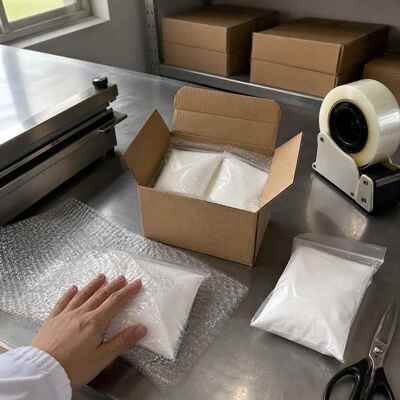
| Standard packing | 25 kg / bag, with PE inner liner |
| Outer bag | Kraft paper bag as standard |
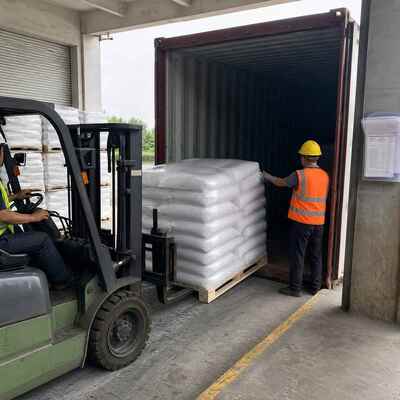
| Customised packing | Available to the customer's requirement — bag type, inner liner, palletising and private-label printing |
| Documentation per shipment | Batch Certificate of Analysis; product specification sheet; MSDS and further statements on request |
| Container loading | Advise the destination port and we will confirm the loading plan |
Q1. Which mesh cut should I order? A. It depends where the powder has to perform. 20–40 / 20–60 mesh for dry blends and low-dust filling lines; 40–60 mesh as the general-purpose middle cut; 60–80 / 60–120 mesh where fast wetting and uniform dispersion matter. Send us your target or your own particle-size spec and we will confirm which cut matches.
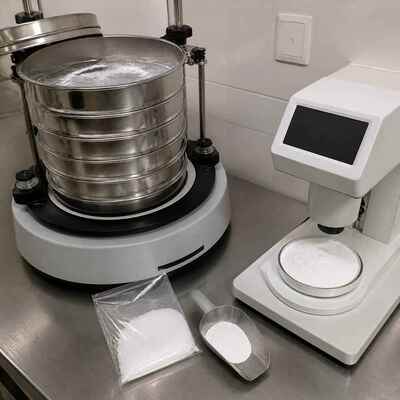
Q2. Is the particle size tested, or only stated? A. It is tested and released. Our reference specification requires more than 90% to pass 20–40 mesh and more than 95% to pass 40–60 mesh and 80–120 mesh, and the tested particle size is printed on the batch COA.
Q3. What is your assay, and how does it compare with the limit? A. The specification limit is ≥ 98.0%; the reference batch tested at 99.10%. Identity is confirmed by identification A, B, C, thin-layer chromatography and specific rotation (+ 4.0° to + 7.0°; reference batch + 4.75°).
Q4. How much moisture does the powder carry? A. Loss on drying ≤ 1.0%; the reference batch measured 0.32%.
Q5. How low are the sugars? A. Total sugar ≤ 1.0% and reducing sugar ≤ 0.20%; the reference batch measured 0.15% and 0.10% respectively.
Q6. Can you guarantee the material is not adulterated with other glycols? A. Yes — the specification requires ethylene glycol: absence and diethylene glycol: absence, and both were confirmed absent on the reference batch. Melting range ≥ 95 °C (reference batch 98.5 °C) is a further physical confirmation.
Q7. What is the microbiological profile? A. Total plate count ≤ 1000 pcs/g, molds and yeasts ≤ 100 pcs/g, coliforms and E. coli negative, and Salmonella sp. negative in 25 g. The plant issues a standing microbiological certificate to this effect.
Q8. Do you control foreign matter? A. Our specification sets dead mites ≤ 5 / 25 g and ash insoluble in acid ≤ 1.5%; the reference batch measured 0.001% on the ash-insoluble line.
Q9. Will the powder brown when I bake or heat it? A. No. Sorbitol is not a reducing sugar, so it does not participate in browning reactions, and it tolerates a wide temperature range. That is why it is used in pale baked goods, icings and fillings.
Q10. How sweet is it, and how do I replace sucrose? A. About 60% as sweet as sucrose, with roughly one third fewer calories. Replacement is normally worked out on a solids-and-sweetness basis rather than 1:1 by weight — tell us your finished-product target and we will suggest a starting ratio.
Q11. Is it suitable for sugar-free, reduced-calorie and oral-care products? A. Yes — it is used as a bulk sweetener in sugar-free and reduced-calorie formulations, and it is non-cariogenic, which is why toothpaste and mouthwash formulators use it. Whether your finished product may carry a "sugar-free" claim depends on your local labelling rules: we supply the data, you decide the claim.
Q12. What documents come with the goods? A. The batch Certificate of Analysis and the product specification sheet as standard; MSDS and additional statements on request. Plant-level documents available include ISO 9001, ISO 22000, HALAL, KOSHER and the manufacturing licence.
Q13. What are the MOQ, lead time, price and payment terms? A. Send your required quantity, mesh cut, destination port and packing preference and we will confirm MOQ, lead time, price and payment terms for that specific shipment.
Q14. Can you supply to my own specification? A. Yes. We produce additional mesh cuts to order, and we can work to a customer's own specification sheet. Send your specification and we will confirm feasibility, the sample plan and the lead time.
Qingdao Golden Grain Chemical Co., Ltd, invested by Golden Grain Group Limited, one professional manufacturer and exporter since 2000, is devoted to supplying products and solutions to food & beverage, medicine, animal feed & nutrition, personal care & household, construction, agriculture.
Golden Grain Group Limited have professional staff, advanced production lines and complete lab equipment, pass GMP, HACCP, ISO, HALAL, KOSHER, BRC, GMP-Free, and other necessary certificates, which ensure our quality to be international standard. For many years' experience, we are exporting our products to more than 60 countries in the world.
"Quality Products", "Efficient Service", Golden Grain Group Limited hope to enter good business cooperation with customers at home and abroad for long.