 |
| Place of Origin: | China |
| Brand Name: | Golden Grain |
| Certification: | ISO9001, COA,SDS |
| Model Number: | GLMA-0136903 |
| Minimum Order Quantity: | 100kg |
|---|---|
| Price: | USD1.00-USD1.65/KG FOB QINGDAO, CHINA |
| Packaging Details: | 25kg/Bag with Paper Drum and PE Inner |
| Delivery Time: | 7 - 10 working days |
| Payment Terms: | L/C, T/T, D/P, D/A |
| Supply Ability: | 1000MT per month |
| Ins No: | E965 | Usage: | Sugar Substitute In Food Industry |
|---|---|---|---|
| Particle Size: | 30-80mesh | Uses: | Sugar Substitute In Food And Beverages |
| Cas No: | 585-88-6 | Solubility: | Highly Soluble In Water |
| Tasteprofile: | Sweet With Cooling Effect | Shelflife: | 2 Years When Stored Properly |
| Meltingpoint: | 148-152°C | Allergen Information: | GRAS, Non‑allergenic |
| Source: | Hydrogenation Of Maltose | Sweetness Level: | Approximately 75-90% Of Sucrose |
| Taste: | Sweet, Similar To Sugar | Appearance: | White Crystalline Powder |
| Melting Point: | Approximately 148-152°C |
Maltitol Powder Food Grade (INS 965) - the Polyol That Acts Like Sugar in Your Recipe
Maltitol powder is the crystalline, hydrogenated-maltose sweetener that confectionery and bakery R&D teams reach for when a sugar-free formula still has to taste and feel like the sugar version. This handbook explains what it is, the six formulation behaviours that matter in practice, and the certificate numbers behind the clean claims.
Grade & documentation: supplied as food grade per FCC V specification (per the specification sheet); the reference COA is issued against BP/USP/EP/FCC quality criteria. Not marketed as a pharmaceutical grade; no therapeutic claims are made. All figures below come from the two accompanying documents.

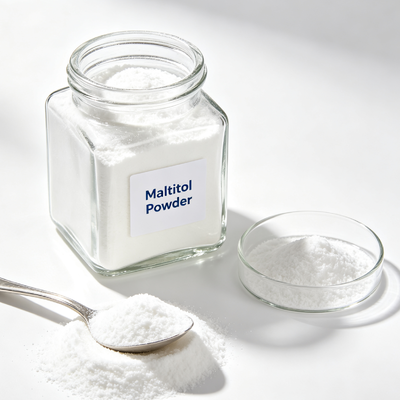
Maltitol is a disaccharide polyol made by hydrogenating maltose obtained from starch. The product arrives as a white, crystalline powder that, like most commercial maltitol, carries small amounts of sorbitol and related polyhydric alcohols. It is very soluble in water and slightly soluble in ethanol - which makes it easy to dose into syrups, batters and fondants alike.
| Identity card | Value |
| Product name | Maltitol Powder |
| Chemical family | Disaccharide sugar alcohol (polyol); hydrogenated maltose |
| Molecular formula / weight | C12H24O11 / 344.31 |
| CAS number | 585-88-6 |
| INS / E number | INS 965 (EU listing E965) |
| H.S. code | 3824 9099 |
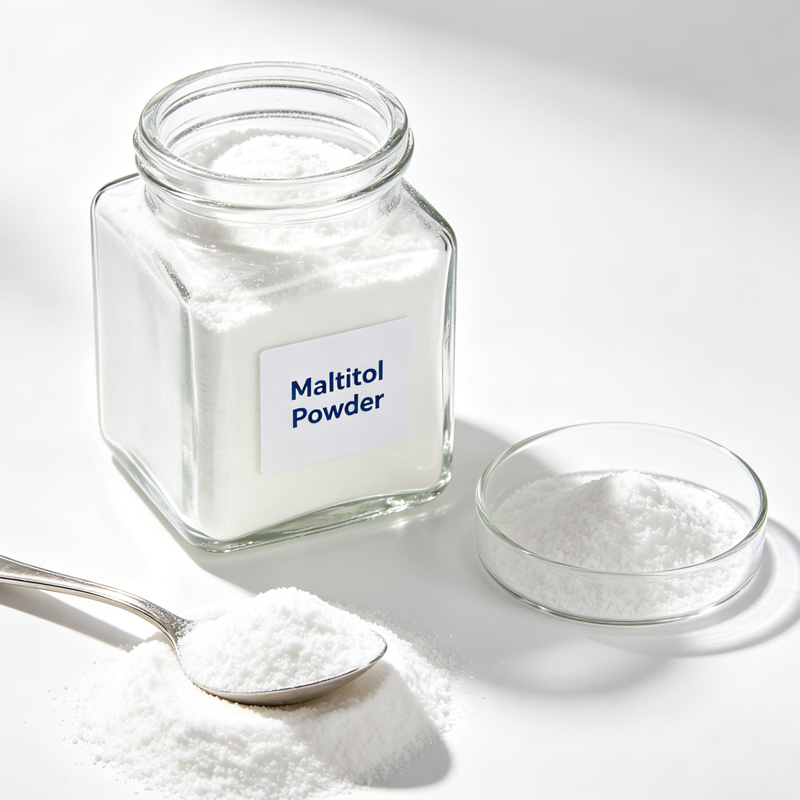
| Appearance | White, crystalline powder |
| Solubility | Very soluble in water; slightly soluble in ethanol |
| Specification | Food Grade FCC V (per specification sheet) |
| Particle size | 30-80 mesh and 80-400 mesh |
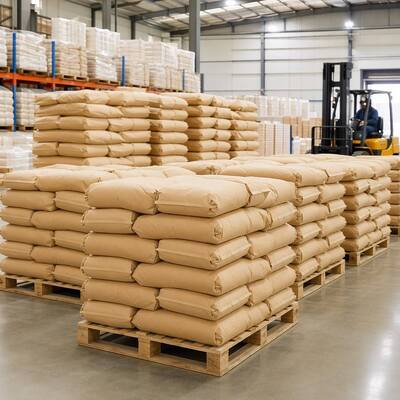
| Standard packing | 25 kg kraft bag with PE inner liner |
Sugar alcohols are not interchangeable - each one brings a different mouthfeel, browning and crystal behaviour to the batch. These are the six behaviours that define this particular powder:
· 1. Sweet enough to stand alone. The specification notes maltitol's high sweetness allows it to be used without blending with other sweeteners - one ingredient doing the whole sweetening job.
· 2. Negligible cooling effect. Unlike some polyols that taste cold on the tongue, maltitol exhibits a negligible cooling effect (positive heat of solution), very similar to the subtle cooling profile of sucrose - the detail that keeps chocolate and sweets tasting 'normal'.
· 3. A clean browning story. With reducing sugars at 0.02% (limit 0.1%), there is almost no reducing sugar available to drive Maillard browning - which is why cooked sweets keep their colour and flavour cleaner through processing.
· 4. Sucrose-like behaviour in syrups. Its similarity to sucrose allows use in syrups where crystallization - the kind that makes bottle caps stick - is less likely.
· 5. A precise crystalline fingerprint. Assay inside the tight 99.0% - 101.0% window (measured 99.42%) and a melting point of 149.5°C against the documented 148 - 151°C range give QC a fast, repeatable identity check.
· 6. Four jobs on one label. The specification registers it as humectant, texturizing agent, stabilizer and sweetener - and, in cosmetics-style formulations, as an emollient and humectant.
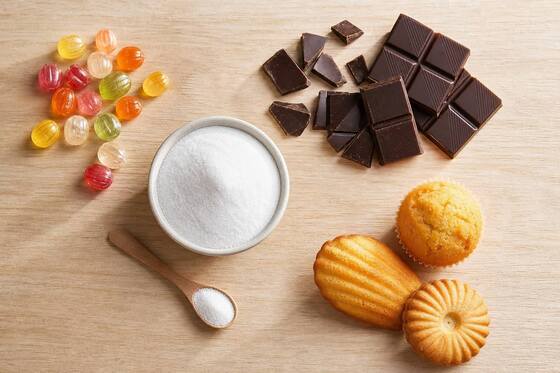
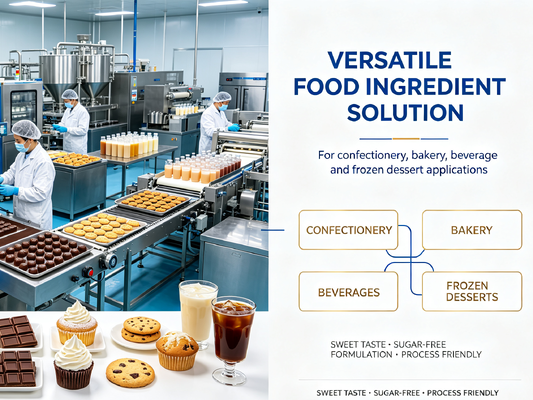
| Application area | Typical products | What maltitol contributes |
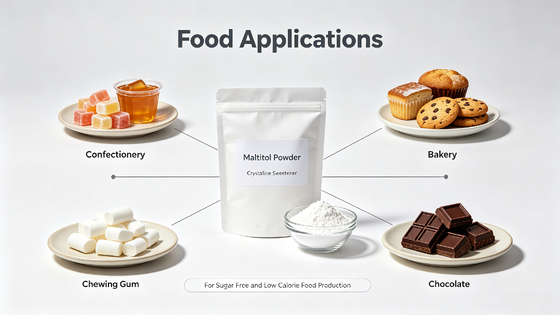
| Sugar-free confectionery | Sugarless hard candies, chewing gum | Sucrose-like sweetness, clean cooking behaviour, low browning |
| Chocolate | Chocolate and coated confections | Bulk sweetness with negligible cooling - close to real-chocolate mouthfeel |
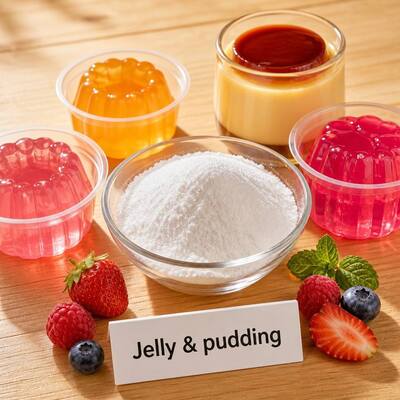
| Bakery & desserts | Baked goods, cookies, dessert mixes | Humectant and texturizing support; stable dry blending |
| Frozen desserts | Ice cream and frozen novelties | Sweetness, body and texture control |
| Syrups & toppings | Syrups where caps must not stick | Lower crystallization risk thanks to sucrose-like behaviour |
| Personal care & daily-chemical | Creams, lotions and humectant systems | Emollient / humectant function beyond food |
Typical use directions per the specification. Final product claims must be validated against the rules of your target market.
Clean label starts with what is not in the product. The specification states the product contains none of the ingredients on the EC allergen list - one less paragraph of labelling fine print for sensitive markets.
Beyond the allergen statement, the reference COA reads like a washing certificate:
| Signature numbers | Limit | Reference COA |
| Assay | 99.0% - 101.0% | 99.42% |
| Related products | <= 1% | 0.58% |
| Reducing sugars | <= 0.1% | 0.02% |
| Water | <= 0.5% | 0.09% |
| Conductivity | <= 20 µS/cm | 4.8 µS/cm |
| Sulfated ash | <= 0.10% | 0.02% |
| Lead | <= 0.5 ppm | 0.01 ppm |
| Melting point | 148 - 151°C | 149.5°C |
Conductivity of 4.8 µS/cm against a 20 µS/cm ceiling and lead at 0.01 ppm are the two numbers formulators in sensitive segments ask for first.
| Test | Specification | Reference COA |
| Description | White, crystalline powder | Conforms |
| Identification | A, B, C, D | Conforms |
| Assay | 99.0% - 101.0% | 99.42% |
| Related products | <= 1% | 0.58% |
| Specific optical rotation | +105.5 to +108.5 | +106.5 |
| Reducing sugars | <= 0.1% | 0.02% |
| Water | <= 0.5% | 0.09% |
| Sulfated ash | <= 0.10% | 0.02% |
| Melting point | 148 - 151°C | 149.5°C |
| Particle size | 30-80 mesh / 80-400 mesh | - |
| Test | Limit | Reference COA |
| Heavy metals | <= 10 ppm | < 10 ppm |
| Sulphates | <= 0.01% | Conforms |
| Sulfate | <= 100 ppm | < 100 ppm |
| Chloride | <= 50 ppm | < 50 ppm |
| Conductivity | <= 20 µS/cm | 4.8 µS/cm |
| Lead | <= 0.5 ppm | 0.01 ppm |
| Nickel | <= 0.5 ppm | < 0.5 ppm |
| Arsenic | <= 0.5 ppm | < 0.5 ppm |
| Test | Limit | Reference COA |
| Total bacteria count | <= 20 pcs/g | < 10 pcs/g |
| Molds and yeasts | <= 10 pcs/g | < 10 pcs/g |
| Escherichia coli | Negative | Negative |
| Salmonella | Negative | Negative |
The COA closes with 'the results conform to the specification' and carries the three-level signature line - analyst, checker, supervisor - that documents the release review.
| Topic | Detail |
| Packing | 25 kg/bag, kraft bag with PE inner liner |
| Transport | In accordance with the requirements for general chemicals |
| Storage | Cool, dry, ventilated environment; keep bags sealed |
· Specification: Food Grade FCC V, per the specification sheet.
· Reference COA: issued against BP/USP/EP/FCC quality criteria; identification verified by four methods (A, B, C, D).
· Allergens: contains none of the ingredients on the EC allergen list.
· Scope: food, confectionery, bakery, frozen dessert, cosmetics/daily-chemical use.
· Each shipment carries its own current COA plus the product specification; export documents are confirmed in writing per order.
Q: Can maltitol powder replace sugar in hard candy? - It is a documented choice for sugarless hard candies: high sweetness usable alone, negligible cooling effect close to sucrose, and virtually no reducing sugar to drive browning.
Q: Does maltitol powder taste cold like other sugar alcohols? - The specification describes a negligible cooling effect very similar to the subtle cooling of sucrose - noticeably different from strongly cooling polyols.
Q: Is this powder allergen-free? - Per the specification it contains none of the ingredients on the EC allergen list.
Q: Which particle size should I order? - Two documented cuts: 30-80 mesh for standard blending and 80-400 mesh for fine-texture work. Tell us your process and we will confirm the matching cut.
Q: What is the HS code? - 3824 9099 as stated on the specification sheet.
Q: How is it packed? - 25 kg kraft bags with PE inner liner, shipped as general chemicals.
Supplied per the documentation issued by Golden Grain Group Limited (No. 9, Fulong Road, Qingdao, Shandong Province, China). The COA evidence shown above is a reference lot; every order ships with a current, lot-specific COA.
Request a quotation: quantity, target mesh and destination port - a current COA, specification and written pricing will follow.
Qingdao Golden Grain Chemical Co., Ltd, invested by Golden Grain Group Limited, one professional manufacturer and exporter since 2000, is devoted to supplying products and solutions to food & beverage, medicine, animal feed & nutrition, personal care & household, construction, agriculture.
Golden Grain Group Limited have professional staff, advanced production lines and complete lab equipment, pass GMP, HACCP, ISO, HALAL, KOSHER, BRC, GMP-Free, and other necessary certificates, which ensure our quality to be international standard. For many years' experience, we are exporting our products to more than 60 countries in the world.
"Quality Products", "Efficient Service", Golden Grain Group Limited hope to enter good business cooperation with customers at home and abroad for long.