 |
| Place of Origin: | China |
| Brand Name: | Golden Grain |
| Certification: | ISO9001, COA,SDS |
| Model Number: | GLMA-abe8 |
| Minimum Order Quantity: | 100kg |
|---|---|
| Price: | USD1.39/KG FOB QINGDAO ‑6.94 USD/KG FOB QINGDAO |
| Packaging Details: | 25kg/Bag with Paper Drum and PE Inner |
| Delivery Time: | 7 - 10 working days |
| Payment Terms: | L/C, T/T, D/P, D/A |
| Supply Ability: | 40000MT per month |
| Place Of Origin: | China (Shandong, Qingdao) | Certification: | ISO 9001, ISO 22000, HACCP, Halal, Kosher |
|---|---|---|---|
| Product Name: | Maltitol Powder (D-Maltitol, E965) | Category: | Food Additives / Sweeteners / Sugar Alcohol |
| Grade: | Food Grade / FCC / BP / USP / EP, Non-GMO | Application / End Use: | Ice Cream, Frozen Dessert, Frozen Yogurt, Dairy-Free Frozen Dessert, Sugar-Free Chocolate, Chewing Gum, Hard Candy, Bakery, Protein Bar |
| Also Used In: | Ice Cream Coating, Variegate, Flavored Milk, Drinking Yogurt, Chewable Tablet | Claim Support: | Sugar-Free, No Added Sugar, Reduced Sugar, Keto Friendly, Diabetic Friendly, Vegan |
| Function: | Bulk Sweetener, Sugar Replacer, Sugar Substitute, Humectant, Bulking Agent, Carrier | Properties: | Low Calorie, Low Glycemic, Non-Cariogenic, Tooth-Friendly, Low Hygroscopicity, Negligible Cooling Effect, Heat Stable, Highly Soluble, Free Flowing, Non-Caking |
| Freezing Behaviour: | Sucrose-Like Freezing Curve, Suitable For Frozen Dessert | Particle Size: | 30-80 Mesh (Standard); 20-40 Mesh And 80-400 Mesh On Request |
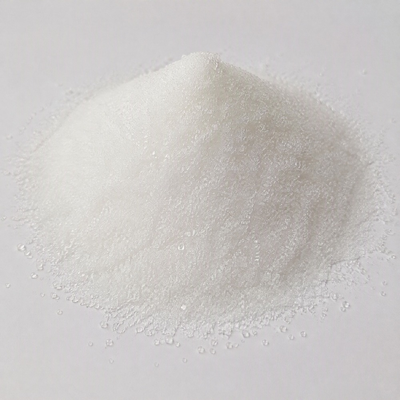
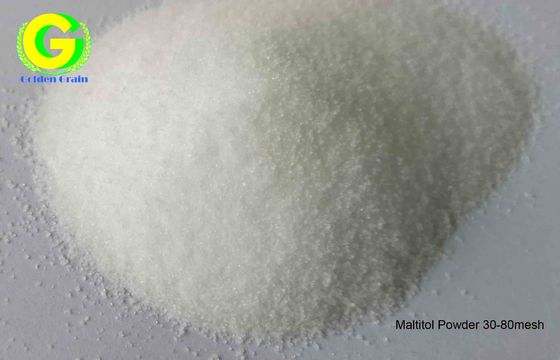
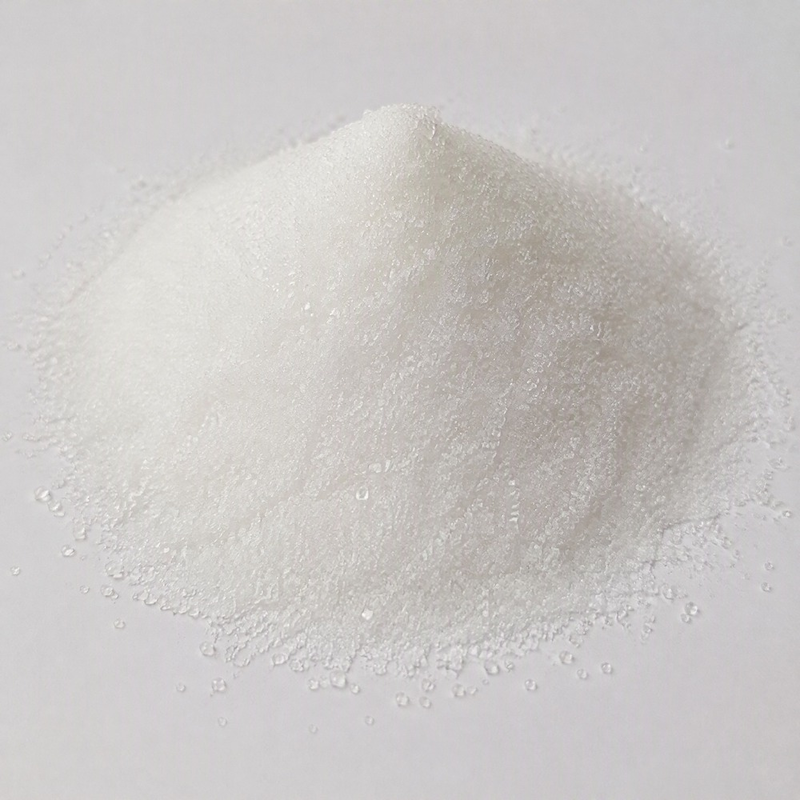
| Form & Appearance: | White Crystalline Powder, Free-Flowing, Non-Caking | Sweetness: | About 90% Of Sucrose; Energy 2.1 Kcal/g |
| Assay / Purity: | 99.0% - 101.0% (typical 99.3%, HPLC) | Moisture / Water Content: | 0.5% Max (typical 0.16%, Karl Fischer) |
| Solubility: | Highly Soluble, Complete Dissolution In Aqueous Mix | Synonyms / Other Names: | D-Maltitol, Maltitol, Hydrogenated Maltose, Sugar Alcohol, Polyol, Maltitol Sweetener |
| CAS No. / E-Number: | 585-88-6 / E965 (INS 965) | Molecular Formula: | C12H24O11 |
| HS Code: | 2940009090 |
Maltitol Powder (D-Maltitol, CAS 585-88-6, E 965 / INS 965) is a crystalline sugar alcohol made by hydrogenating high-maltose syrup obtained from starch. It is about 90% as sweet as sucrose, supplies roughly 2.1 kcal/g, and has a negligible cooling effect, so a sugar-free frozen mix built on it tastes like the sugar version rather than like a minted or metallic one.
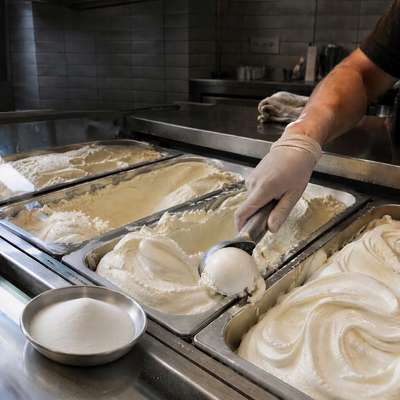
This listing is set up for the frozen side of the business — ice cream, frozen dessert and frozen yogurt — because that is where maltitol separates itself from the other polyols. Freezing point depression is driven by the number of dissolved molecules, not by weight, and maltitol sits unusually close to sucrose in molar mass. A mix reformulated with maltitol therefore keeps a freezing curve close to the one it had with sugar, which means the freezer, the hardening tunnel and the draw temperature do not all have to be re-set around a new ingredient. Erythritol and sorbitol, whose molecules are far smaller for the same gram, push the freezing point down much harder and soften or slush the product unless the dose is cut and the solids rebuilt elsewhere.
The practical consequences show up on the line and in the tub. Maltitol contributes solids that hold the unfrozen phase concentrated, which restricts ice crystal growth and gives the finished product better resistance to heat shock between the cold chain and the display cabinet. Mouthfeel stays creamy because the material dissolves completely in the mix and does not leave the sandy residue that poorly milled polyols do. It does not take part in Maillard browning, so vanilla, cream and white mixes keep their intended colour through pasteurisation and ageing.
For buyers working to a sugar-free, no-added-sugar or reduced-sugar claim, maltitol also carries the supporting properties: it is non-cariogenic, so oral bacteria cannot ferment it into the acids that demineralise enamel, and it produces a lower glycemic response than sucrose. Because it is plant-derived from starch and contains none of the allergens on the EC list, it fits vegan and dairy-free frozen dessert formulations as readily as dairy ones.
Supply is backed by ISO 9001, ISO 22000 and HACCP systems together with Halal and Kosher certification. A batch-specific COA and the MSDS are issued before shipment, so incoming inspection and customs filing are covered before the container leaves.

| Parameter | Specification |
| Product name | Maltitol Powder (D-Maltitol) |
| Chemical name | 4-O-alpha-D-glucopyranosyl-D-glucitol |
| CAS No. | 585-88-6 |
| E No. / INS No. | E 965 / INS 965 |
| HS Code | 2940009090 |
| Molecular formula | C12H24O11 |
| Molecular weight | 344.31 |
| Appearance | White crystalline powder, free flowing, no visible foreign matter |
| Assay (D-maltitol, dry basis) | 99.0% – 101.0% |
| Particle size | 30–80 mesh as standard; 20–40 mesh and 80–400 mesh to order |
| Sweetness | About 90% of sucrose |
| Cooling effect | Negligible |
| Energy value | About 2.1 kcal/g |
| Water content | 0.5% max |
| Reducing sugars | 0.1% max |
| Specific optical rotation | +105.5° to +108.5° |
| Conductivity | 20 µS/cm max |
| Sulphated ash | 0.10% max |
| Chloride | 50 ppm max |
| Sulphate | 100 ppm max |
| Heavy metals (as Pb) | 10 ppm max |
| Lead / Arsenic / Nickel | 0.5 ppm max each |
| Melting point | 148 °C – 151 °C |
| Total plate count | Released against the BP / USP / EP limit, result stated on the batch COA |
| Moulds and yeasts | 10 cfu/g max |
| Escherichia coli / Salmonella | Negative |
| Grade | Food grade; meets BP, USP, EP and FCC monograph requirements |
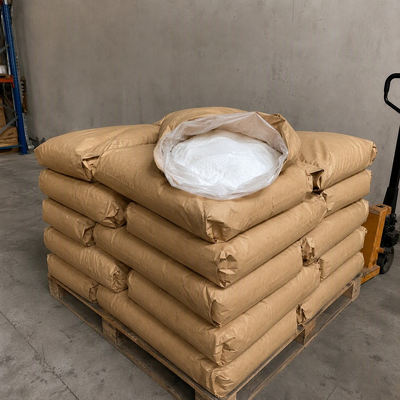
| Packaging | 25 kg kraft paper bag with PE inner liner |
| Shelf life | 24 months, unopened, dry storage |
Particle size is the specification that decides how fast the powder goes into solution in a mix room. The 80–400 mesh cut disperses and dissolves quickest and is the grade normally specified for ice cream mixes, variegates and rework, where any undissolved crystal shows up later as a gritty defect in the mouth. The 30–80 mesh cut is the general-purpose food grade and works in most batch pasteurised mixes given normal agitation and ageing time. The 20–40 mesh cut is coarse and free flowing, used where the powder is dosed into a dry blend with stabilisers and emulsifiers before it meets water. Cuts between these grades can be produced to order against an agreed particle size distribution.
Every shipment is released against a batch-specific COA that reports the measured result next to the release limit, so incoming inspection can be checked line by line instead of against a generic datasheet. The COA number is printed on the bag and matches the certificate issued with the shipment. A sample COA and the MSDS can be sent before the order so your QA team can approve the material in advance.
| Test item | Typical result | Method |
| Assay (D-maltitol) | 99.3% | HPLC |
| Appearance | White crystalline powder, free flowing | Visual |
| Water content | 0.16% | Karl Fischer |
| Reducing sugars | 0.04% | Titrimetric |
| Residue on ignition | 0.02% | Gravimetric |
| Specific optical rotation | Conforms | Polarimetry |
| Total heavy metals (as Pb) | < 5 mg/kg | Colorimetric |
| Total plate count | < 500 cfu/g | Plate count |
| Moulds and yeasts | < 10 cfu/g | Plate count |
| Escherichia coli / Salmonella | Negative | Enumeration |
Water content is the line worth watching in a frozen application. A powder near the 0.5% limit carries free moisture into the mix, and in a product that is already fighting ice crystal growth that moisture is the difference between a smooth body and an icy one after a few weeks in the cabinet. Our typical result sits near 0.16%, and the figure on your batch COA is the one to compare against your own incoming limit rather than the specification maximum.
Halal and Kosher certificates, including the issuing body, certificate number and validity dates, are provided on request so your compliance team can verify them with the certifier directly instead of taking our word for it.
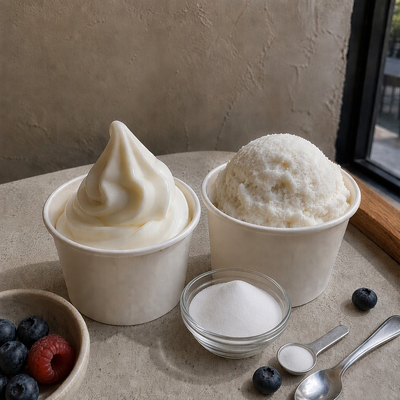
Reduced-sugar and sugar-free ice cream. The entry point for most dairies is a partial replacement — 5 to 10% of the mix as a starting figure, then set against your own trial data. At that level maltitol brings solids and body while the sucrose load drops, so a reduced-sugar claim can be made without the mix losing the mouthfeel that a high-intensity sweetener alone strips out. Because the freezing curve barely shifts, the ageing time, draw temperature and overrun settings from the sugar recipe stay broadly usable instead of needing a full re-engineering pass.
Full sugar replacement with powder plus syrup. Where the target is no added sugar rather than less sugar, the powder alone is rarely the whole answer: the mix needs solids and freezing point control balanced against each other, and that is normally built as a powder-and-syrup system. Maltitol powder supplies the bulk solids and body, maltitol syrup supplies the freezing point depression and the anti-sandiness effect, and the ratio between them is set on trial.
Frozen dessert and dairy-free frozen dessert. Maltitol is plant-derived from starch, contains none of the allergens on the EC list, and involves no animal-derived processing aids in crystallisation or drying, which is what makes it usable in vegan, oat-base, coconut-base and almond-base frozen desserts. In these systems the base carries less inherent body than dairy solids, so the bulking contribution of maltitol matters more than in an ice cream — it fills the solids gap that the plant base leaves while keeping the sweetness profile close to a dairy reference.
Frozen yogurt and yogurt ice cream. In cultured frozen products the acidity sharpens the perception of any off-note, and the metallic or cooling tail that some polyols leave reads as sourness against a yogurt base. Maltitol's negligible cooling effect and clean finish keep the flavour system intact, while its resistance to fermentation by oral bacteria supports a tooth-friendly claim on a product largely bought by families. It also holds viscosity and body in a low-fat frozen yogurt where the fat that used to carry mouthfeel has been removed.
Ice cream coatings, variegates and inclusions. The same grade is used in the chocolate-flavoured coatings and ripple sauces that go into a frozen assembly, and in the enrobing of stick items, where the coating has to set hard against a cold core without cracking. The fine mesh cut is the one to specify here for dispersion in a small batch.
Frozen novelties and stick items. Bars and sandwiches are the hardest frozen format for a polyol system, because the product is eaten by biting rather than scooping and any excessive softening or hardening is immediately obvious. Keeping freezing point depression close to the sugar reference is what allows a novelty line to hold its shape on the stick without turning into a block.
Typical inclusion levels, to be confirmed against your own trial data:
| Application | Typical maltitol share | Comment |
| Ice cream, partial sugar replacement | 5 – 10% of mix | Starting figure; lowers sugar without rebuilding the freezing curve |
| Ice cream, full sugar replacement | Set against your own trial | Usually powder plus maltitol syrup; balance solids against freezing point |
| Frozen dessert, dairy-free | Set against your own trial | Powder fills the solids gap left by the plant base |
| Frozen yogurt | Set against your own trial | Check acidity against the sweetness profile |
| Coatings and variegates | Per your coating formula | Use the 80–400 mesh cut for dispersion |
| Frozen novelties | Set against your own trial | Hardness on the stick is the acceptance test |
The material is released against the specification on the batch COA, with assay, water content, reducing sugars and microbiological counts tested on every lot rather than periodically — those are the four parameters that change how maltitol behaves in a mix, a chocolate line or a gum base. Conformity to the BP, USP, EP and FCC monographs is declared on the same certificate, so a single document covers both the food and the excipient route.
Retention samples are kept from each batch, so a complaint can be traced back to the material actually shipped rather than to the lot record. The COA number printed on the bag matches the certificate issued with the shipment, which is what customs and incoming inspection check first.
The product contains none of the ingredients on the EC list of allergens. It is plant-derived from starch, non-GMO, and suitable for vegan and vegetarian formulations. No animal-derived processing aids are used in the crystallisation or drying stages.
| Certificate | Scope |
| ISO 9001 | Quality management system |
| ISO 22000 | Food safety management system |
| HACCP | Hazard analysis and critical control point system |
| Halal | Product and production process |
| Kosher | Product and production process |
Standard packing is a 25 kg kraft paper bag with a PE inner liner. The kraft outer layer takes printing and stacking load; the PE liner is the moisture barrier, and it is the part that matters for a product whose water content specification is 0.5% max — an unlined paper bag would pick up humidity in a container crossing the tropics and push the powder towards caking before it ever reaches a mix room.
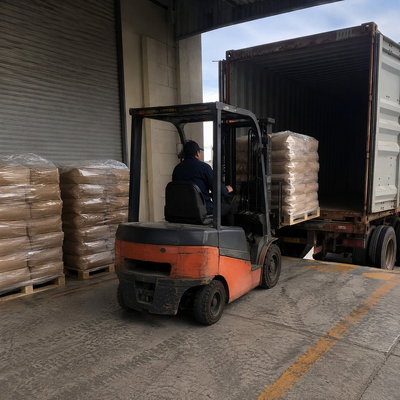
Bags are palletised and stretch wrapped for container loading. Minimum order quantity is 100 kg, and monthly capacity is 1000 MT, so a full container and a pallet-scale trial order are both workable. Lead time is 7 to 10 working days from order confirmation, FOB Qingdao, with L/C, T/T, D/P and D/A accepted.
For a frozen dessert line running both a powder portion and a syrup portion, the two can be shipped together and documented as one consignment, which keeps the receiving dock to a single inspection routine and a single customs filing.
Store in a cool, dry, well-ventilated warehouse, off the floor and away from walls, with the bag sealed. Shelf life is 24 months unopened. Refrigeration is not required and is not recommended, because moving the bags in and out of a cold store creates condensation on the powder surface.
Maltitol powder is not strongly hygroscopic, but it should still be kept away from strong odours. In a dairy or frozen dessert application the flavour system is deliberately bland, so any volatile note picked up in a shared warehouse — solvents, spices, cleaning chemicals — will carry straight through into a vanilla or cream base. Re-seal an opened bag, use it first under FIFO rotation, and keep it out of direct sunlight. Under these conditions the material stays free flowing for the whole shelf life, and any caking found on receipt should be treated as a moisture ingress issue in transit rather than a property of the grade.
Most maltitol you get quoted on comes from one of two places: a trading desk reselling someone else's powder, or a plant that runs a single grade in a single packing. This listing sits in a different position — maltitol powder and maltitol syrup are both produced on our own hydrogenation and crystallisation lines, alongside sorbitol and the other polyols, which is what makes the specification, the batch size and the lead time negotiable rather than fixed.
One supplier for the whole sweetener system. A frozen dessert that has to be sugar free normally needs a powder portion and a syrup portion from the same polyol family. Buying both from one plant means one COA format, one certificate set, one container, and a powder-to-syrup ratio you can shift between orders without qualifying a second supplier and running a second approval.
The specification is a production parameter, not a catalogue item. Mesh grade, particle size distribution, water content and packing are set on the line. If your mix room needs a cut between our standard grades, or a tighter moisture limit for a dry blend, that is a specification sheet and a trial batch — not a different product with a different price and a different lead time.
The documents arrive before the goods do. Sample COA, MSDS, Halal and Kosher certificates, and the allergen and non-GMO statements are issued at quotation stage, so QA and compliance can approve the material while the order is still being priced. Every shipment then carries a batch-specific COA whose number is printed on the bag and matches the certificate in the shipping documents.