Product Overview
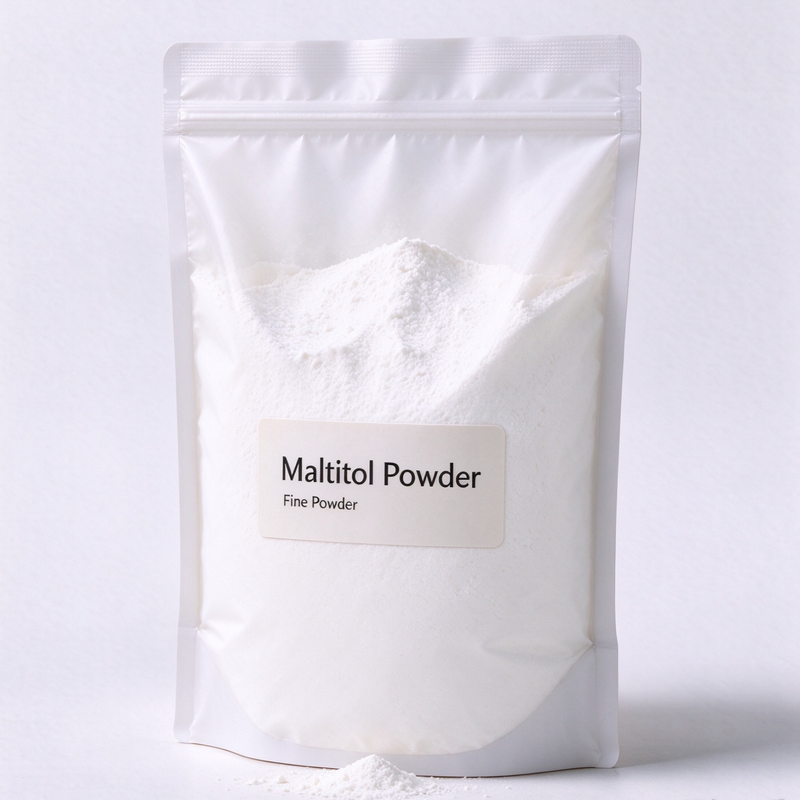
Maltitol Powder is a crystalline sugar alcohol with the chemical name 4-O-alpha-D-glucopyranosyl-D-glucitol, listed under CAS 585-88-6 and E965. It is a white, free-flowing powder with a molecular formula of C12H24O11 and a molecular weight of 344.31, roughly half the sweetness of sucrose at equal weight but with a sweetness profile close enough to sucrose that a chocolate formula can be built around it without stacking several high-intensity sweeteners.
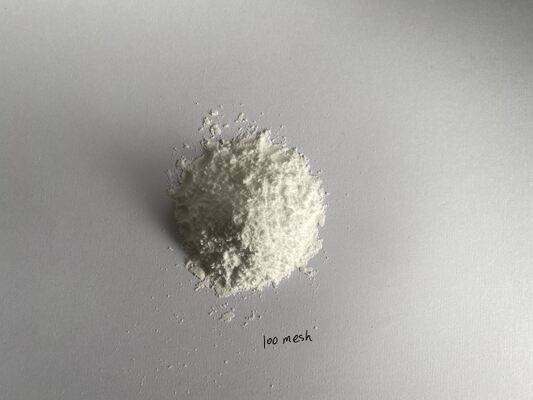
The grade matters most at the tempering stage. A 20-40 mesh cut behaves differently from a fine powder in the refiner and in the conche: oversize particles survive refining as grit that shows on the palate, while an excess of fines raises the plastic viscosity of the mass and forces extra cocoa butter or lecithin into the recipe. A controlled 20-40 mesh body lets the refiner reduce the sugar phase to a smooth particle size distribution while keeping the Casson yield value in a workable band, so the tempered mass still flows through the depositor and coats evenly at the enrobing curtain.
Maltitol is non-reducing, so it does not drive Maillard browning during conching and does not darken a milk chocolate base the way a reducing syrup would. That behaviour has to be paid back at the tempering unit: the seed and the cooling curve are usually re-set around a slightly higher temperature band, and the mass is held longer in the beta-V crystal zone so the finished bar snaps cleanly and releases from the mould without flexing at the demoulding station. Moisture control is the other point of failure. Maltitol takes up water readily when a warm mass is exposed to humid air, and every fraction of a percent absorbed lifts the viscosity and dulls the gloss. Powder packed in a heat-sealed PE liner keeps the incoming moisture low enough that the conche does not have to correct for it.

Technical Specification
| Parameter |
Specification |
| Product name |
Maltitol Powder |
| Chemical name |
4-O-alpha-D-glucopyranosyl-D-glucitol (D-Maltitol) |
| CAS number / E number |
585-88-6 / E965 |
| Molecular formula |
C12H24O11, MW 344.31 |
| Appearance |
White crystalline powder, free flowing, odourless |
| Assay (dry basis) |
99.0% min |
| Mesh / particle size |
20-40 mesh, 90% min within cut |
| Moisture |
0.5% max |
| Grade |
Food Grade |
| Packaging |
25kg PP woven bag with PE inner liner |
Typical specification. The certificate of analysis issued for each shipment is the governing document.
Typical Certificate of Analysis
| Test item |
Typical result |
Method |
| Assay (D-Maltitol, dry basis) |
99.3% |
HPLC |
| Appearance |
White crystalline powder, free flowing |
Visual |
| Mesh distribution (20-40) |
94% within cut |
Sieve analysis |
| Moisture |
0.16% |
Karl Fischer |
| Reducing sugars |
0.04% |
Titrimetric |
| Residue on ignition |
0.02% |
Gravimetric |
| Total heavy metals (as Pb) |
< 5 mg/kg |
Colorimetric |
| Arsenic (as As) |
< 1 mg/kg |
AAS |
| Total plate count |
< 500 cfu/g |
Plate count |
| Yeast and mould |
< 50 cfu/g |
Plate count |
| E. coli |
Absent |
Plate count |
A certificate of analysis is issued for every batch, and a safety data sheet accompanies each shipment on request.
Applications
Dark and milk chocolate bars
Maltitol carries the bulk of the sweetness in a no-added-sucrose bar, typically at 30-45% of the recipe. Because the powder is crystalline rather than a syrup, it can be dry-blended with cocoa powder and milk solids before refining, which keeps the refiner feed uniform and avoids the sticky build-up that a syrup addition leaves on the rolls.
Couverture and enrobing chocolate
At the enrobing curtain the mass has to hold a stable viscosity for the length of a shift. A 20-40 mesh cut with low fines keeps the Casson plastic viscosity steady, so coating weight per piece stays inside tolerance and the tailing on the belt does not thicken as the day runs on.
Compound coatings and cocoa butter replacers
Where lauric or non-lauric replacers replace part of the cocoa butter, maltitol is dosed slightly higher to rebuild the solids load, and the cooling tunnel is run a little colder at the entry zone so the coating sets before it reaches the packing station.
Praline and truffle fillings
In a water-based ganache the powder is dispersed into the warm cream phase before the fat is added. Its water activity is low, and the filling firms to a cuttable texture without the graininess that coarse sugar alcohols leave on the palate.
Moulded novelties and bars with inclusions
Maltitol has a mild cooling effect as it dissolves, which reads as freshness in a thin moulded shell. In bars with nut or crisp inclusions the powder is kept at the 20-40 mesh cut so the inclusion and the matrix shrink at comparable rates through the cooling tunnel.
Quality Control
Every lot is sampled at the crystalliser discharge and again after milling, because the particle cut is set at the mill and can drift if the classifier is not watched. Assay runs by HPLC against a maltitol standard, moisture by Karl Fischer, and the sieve stack is checked against the 20-40 mesh target before the lot is released to packing. Heavy metals, arsenic and microbiological counts are tested on the finished powder against the limits in the specification table.
Each bag carries a lot code that matches the pallet label and the certificate of analysis, so a bag pulled from a chocolate plant's stores can be traced to the crystallisation run that produced it. Retained samples from each lot are kept for re-test if a customer wants a second look at a delivery.
Packaging & Shipping
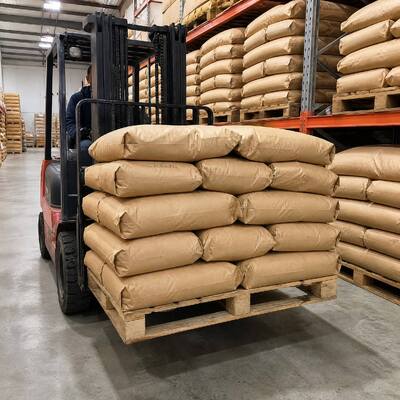
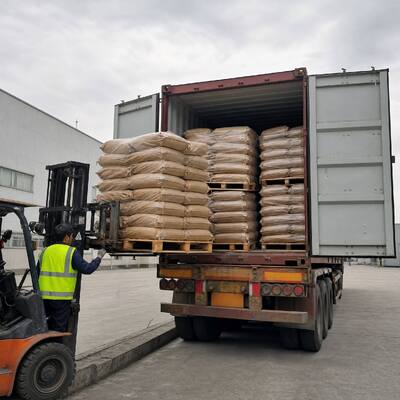
Powder ships in 25kg PP woven bags with a food-grade PE inner liner, heat-sealed at the throat so the bag is closed against humid air before it reaches the pallet. Bags can be palletised and stretch-wrapped for container loading, and neutral printed bags or buyer-labelled bags are available for bulk orders. Shipments are booked as full container, LCL or mixed loads depending on the order size, and the packing list and certificate of analysis are issued before the container leaves the plant.
Storage & Handling
Keep the bags in a cool, dry warehouse with air movement and no direct sun. Maltitol is hygroscopic once the liner is opened, so a part-used bag should be folded down, clipped and returned to the pallet rather than left open near a tempering line. Storage between 15 and 30°C is comfortable for the powder; do not stack bags against a wall that sweats, and keep them away from cocoa, solvents or any other material with a strong smell. Sealed original bags hold their specification for 24 months.
Why Choose Us
- Milling under our own control. The 20-40 mesh cut is produced on our own mill and classifier, so the particle band you approve in a sample is the band that arrives on the pallet, without a third party re-packing in between.
- Documents that travel with the load. Assay, moisture, mesh, heavy metals and microbiological results are released per lot, and the certificate of analysis is issued before dispatch rather than after the container sails.
- Chocolate-side technical support. If the tempering curve or the Casson viscosity needs re-balancing after a sugar swap, our technical team will review your conching and cooling parameters with your production staff.
- Low moisture at the bag. Karl Fischer testing runs lot by lot, which matters when a fraction of a percent of picked-up water can lift the viscosity of a chocolate mass.
- Flexible packing for bulk buyers. Standard 25kg PP woven bags with PE liner, palletised on request, with neutral or buyer-branded print available for larger orders.
- Export paperwork handled in house. Full container, LCL and mixed shipments are all arranged, with booking documents, packing list and COA prepared before the goods leave the yard.
- Consistent supply across grades. The same plant also supplies maltitol for hard candy, chewing gum, bakery and tablet use, so a buyer running several categories can consolidate documents and deliveries.