Product Overview
Maltitol Powder is a crystalline sugar alcohol, D-Maltitol, CAS 585-88-6, E965, milled to a 20-40 mesh cut for chewing gum use. Gum is a two-phase system: an elastomeric base that is chewed but not swallowed, and a water-soluble sweetener phase that dissolves out of it. The physical form of that sweetener decides how the piece tastes from the first bite to the tenth minute, and a crystalline powder with a defined particle band gives the formulator a lever that a syrup cannot.
In the mixer, the powder is folded into the softened gum base at 45-55°C along with the humectant and the flavour. Coarse particles stay intact through the mix and through sheeting, then dissolve gradually in saliva, so sweetness arrives in a long plateau rather than a single spike. Fine particles, by contrast, dissolve almost at once and leave the pellet tasting flat while the base is still being worked. The 20-40 mesh cut is chosen to sit in the middle of that behaviour and to survive the roll and the cut without shattering into dust.
Water is the enemy of gum base. A sweetener carrying free moisture softens the base during mixing and leaves the finished stick limp, and over storage it migrates and turns the piece hard and crumbly. Maltitol at 0.5% moisture maximum, sealed in a PE liner, keeps the water load in the mixer low and predictable. The same powder serves two other duties on a gum line. It is used as a sanding or dusting agent to keep pellets from sticking before panning, and it goes into the coating suspension for a sugar-free shell where a crisp, quick-breaking outer layer is wanted. Because it is non-cariogenic it keeps the whole piece, core and shell, inside a tooth-friendly claim.

Technical Specification
| Parameter | Specification |
|---|
| Product name | Maltitol Powder |
| Chemical name | 4-O-alpha-D-glucopyranosyl-D-glucitol (D-Maltitol) |
| CAS number / E number | 585-88-6 / E965 |
| Molecular formula | C12H24O11, MW 344.31 |
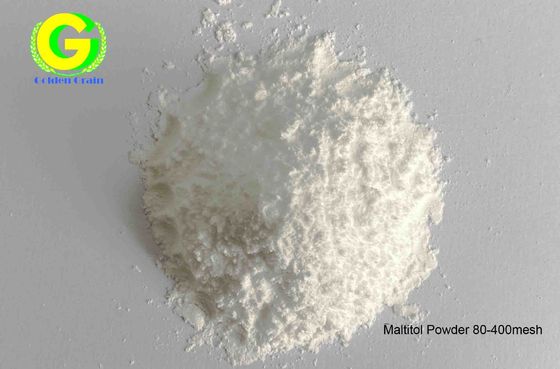
| Appearance | White crystalline powder, free flowing |
| Assay (dry basis) | 99.0% min |
| Mesh / particle size | 20-40 mesh, 90% min within cut |
| Moisture | 0.5% max |
| Grade | Food Grade |
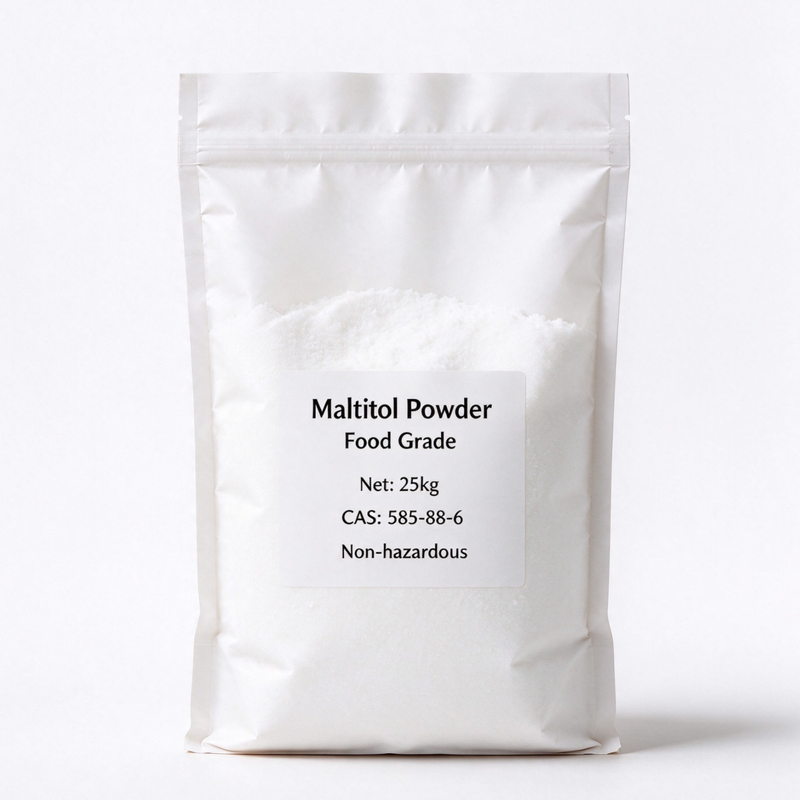
| Packaging | 25kg PP woven bag with PE inner liner |
Typical specification. The certificate of analysis issued for each shipment is the governing document.
Typical Certificate of Analysis
| Test item | Typical result | Method |
|---|
| Assay (D-Maltitol, dry basis) | 99.1% | HPLC |
| Appearance | White crystalline powder, free flowing | Visual |
| Mesh distribution (20-40) | 95% within cut | Sieve analysis |
| Moisture | 0.18% | Karl Fischer |
| Reducing sugars | 0.06% | Titrimetric |
| Residue on ignition | 0.03% | Gravimetric |
| Total heavy metals (as Pb) | < 5 mg/kg | Colorimetric |
| Arsenic (as As) | < 1 mg/kg | AAS |
| Total plate count | < 500 cfu/g | Plate count |
| Yeast and mould | < 50 cfu/g | Plate count |
| E. coli | Absent | Plate count |
A certificate of analysis is issued with every lot, and a safety data sheet is supplied on request.
Applications
Stick and slab chewing gum
Maltitol is blended into the base at 50-60% of the formula, sheeted and cut while warm. The coarser crystals survive the sheeting gauge without being crushed, which keeps the intended release profile and gives the stick a clean snap when it is broken.
Pellet and pillow-shaped gum
Compressed or extruded pellets are formed from a base blended with powdered maltitol and a small amount of binder. A tight particle band keeps the pellet weight uniform at the former and keeps fines from fouling the die face.
Pan coating and sanding
For a sugar-free shell, maltitol is suspended in the coating syrup and built up in thin layers with dry powder charges between them. The shell dries to a hard, glossy finish that breaks sharply under the tooth rather than flexing with the base.
Bubble gum and novelty gum
In bubble gum the sweetener has to leave the base elastic enough to blow a bubble after the initial sweetness fades. Dosing maltitol at the lower end of the range and holding the humectant back keeps the base from plasticising too far.
Functional gum with actives
Gum carrying vitamins, minerals or plant extracts needs a sweetener that does not react with the active. Maltitol is non-reducing, so it does not participate in browning or in the reactions that shorten the shelf life of sensitive actives.
Quality Control
Powder for gum is checked for particle distribution on every lot, because the release profile the formulator sets depends on that band holding. Moisture is run by Karl Fischer at the bagging head, assay by HPLC, and the powder is screened for foreign matter and for magnetic fragments before it reaches the packing line. Microbiological counts are run on the finished material against the limits in the specification.
Lot codes link the bag, the pallet label and the certificate of analysis. If a gum line reports a soft stick or an uneven coating, the retained sample from the lot can be re-examined and the result set against the mixer record before any conclusion is drawn.
Packaging & Shipping
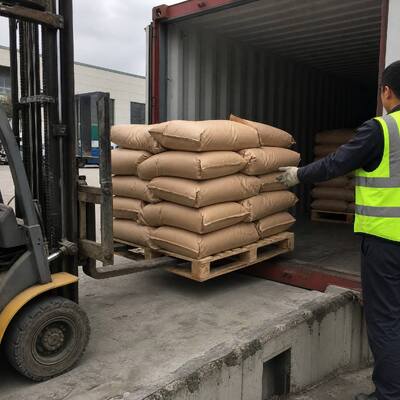
Bags are 25kg PP woven with a food-grade PE liner, heat-sealed and palletised for container loading. Neutral print or buyer-labelled bags are available for bulk orders. Loading plans are confirmed against the destination port and the pallet height the container accepts, with full container, LCL and mixed shipments all arranged. The packing list and the certificate of analysis are issued before dispatch.
Storage & Handling
Keep bags in a dry, cool store, sealed until the moment of use. Gum lines run in conditioned rooms, and a bag staged on the mezzanine for a shift will pick up moisture if it is left open; fold and clip it between additions. Do not store against a condensing wall or beside flavour drums, since the powder takes on odours. Sealed bags remain within specification for 24 months.
Why Choose Us
- Particle band held lot to lot. Gum sweetness release is sensitive to crystal size, so sieve results are part of the release test rather than a nominal figure on a data sheet.
- Low water at the bag. Moisture is measured at bagging, which protects the gum base from the softening that a wet sweetener causes in the mixer.
- One plant, several gum duties. Core sweetener, sanding powder and coating suspension can be drawn from the same production, so a gum maker keeps one supplier file and one specification.
- Traceable through the pallet. Lot codes on bag, pallet and COA allow a delivery to be traced back to its crystallisation run and a retained sample to be re-tested.
- Bulk packing to suit the line. 25kg PP woven bags with PE liner as standard, palletised on request, with neutral or buyer-branded print for larger contracts.
- Export experience. Full container, LCL and mixed loads are handled with booking documents and COA prepared ahead of the vessel cut-off.