Product Overview
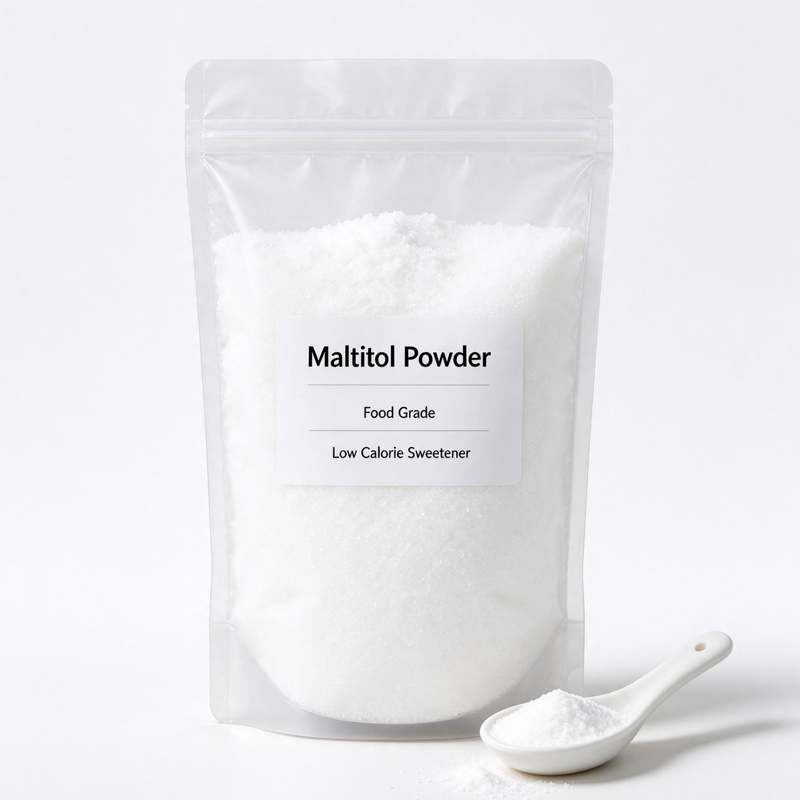
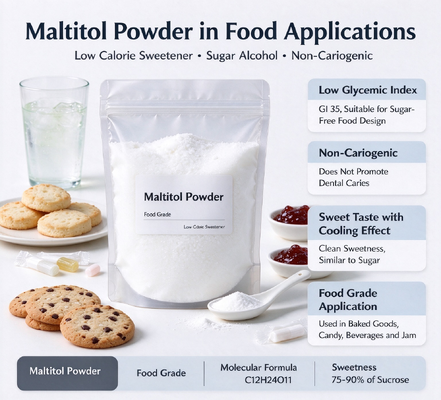
Maltitol Powder for hard candy is a crystalline sugar alcohol supplied at a 30-80 mesh cut, identified as D-Maltitol under CAS 585-88-6 and E965. Boiled sweets are a glass, not a crystal, and the whole process turns on driving water out of a sugar solution until the mass sets hard on cooling. Maltitol fits that process with a few adjustments, because its molecular weight of 344.31 is close to twice that of sucrose, so a given solids level produces a higher boil temperature and a firmer glass.
The cook runs hotter than a sucrose line. A maltitol batch is taken to roughly 165-170°C in the vacuum cooker so the residual moisture lands under 1.5%, which is the point where the glass transition sits safely above warehouse temperature. If the cook finishes short, the sweets arrive at the wrapping station slightly soft and the twist wrap creases instead of holding, and the pieces block together in the bag within days.
Hygroscopicity is where this grade earns its place. Once the glass is formed, maltitol picks up atmospheric moisture slowly compared with sorbitol or a fructose blend, so a wrapped sweet does not turn tacky on the shelf and a lozenge keeps its sharp edge in the tin. The 30-80 mesh powder dissolves into the cook water quickly and evenly, which shortens the dissolving stage and reduces the chance of undissolved crystal seeds that would trigger graining in the finished batch. Acid and flavour are added below 120°C, after the vacuum break, and the mass is then deposited or spun while it is still above its setting temperature. A powder with a tight particle band helps here as well, since coarse grains that survive the cook can leave hard specks in a transparent candy.

Technical Specification
| Parameter |
Specification |
| Product name |
Maltitol Powder |
| Chemical name |
4-O-alpha-D-glucopyranosyl-D-glucitol (D-Maltitol) |
| CAS number / E number |
585-88-6 / E965 |
| Molecular formula |
C12H24O11, MW 344.31 |
| Appearance |
White crystalline powder, free flowing |
| Assay (dry basis) |
99.0% min |
| Mesh / particle size |
30-80 mesh, 90% min within cut |
| Moisture |
0.5% max |
| Grade |
Food Grade |
| Packaging |
25kg PP woven bag with PE inner liner |
Typical specification. The certificate of analysis issued for each shipment is the governing document.
Typical Certificate of Analysis
| Test item |
Typical result |
Method |
| Assay (D-Maltitol, dry basis) |
99.4% |
HPLC |
| Appearance |
White crystalline powder |
Visual |
| Mesh distribution (30-80) |
93% within cut |
Sieve analysis |
| Moisture |
0.14% |
Karl Fischer |
| Reducing sugars |
0.05% |
Titrimetric |
| Residue on ignition |
0.03% |
Gravimetric |
| Total heavy metals (as Pb) |
< 5 mg/kg |
Colorimetric |
| Arsenic (as As) |
< 1 mg/kg |
AAS |
| Total plate count |
< 500 cfu/g |
Plate count |
| Yeast and mould |
< 50 cfu/g |
Plate count |
| E. coli |
Absent |
Plate count |
A certificate of analysis and a safety data sheet are available for every lot shipped.
Applications
Deposited hard candy
Maltitol is cooked with a small share of maltitol syrup to control graining, then deposited into metal or silicone moulds at 90-110°C. The powder dissolves cleanly in the pre-mix, so the cooker sees a uniform feed and the deposited pieces come out with consistent weight and a glossy face.
Rolled and stamped sweets
On a batch roller the mass has to stay plastic long enough to be sized and stamped without cracking at the shoulder. Slightly higher residual moisture than a depositing line is acceptable here, and the 30-80 mesh cut gives the batch a uniform pull through the roller.
Medicated-style lozenges and breath mints
A compressed lozenge built on maltitol holds a hard bite and dissolves slowly in the mouth, which suits mints and throat lozenges where the flavour has to last. Low hygroscopicity keeps the piece from sticking to the blister pocket in humid markets.
Sugar-free lollipops
Lollipops need a glass that resists cold flow on the stick. Cooked to the upper end of the range, maltitol sets hard enough that the head does not sag during wrapping, and the mild cooling effect on the tongue keeps the sweetness from reading as heavy.
Coated and panned centres
Hard candy cores can be given a maltitol-based panning coat, so the whole piece stays within one sweetener system and the label stays short. The powder is milled finer for the coating suspension, and the same lot can serve both the core and the shell.
Quality Control
Because a boiled sweet is unforgiving about moisture, the powder is tested for water content at the dryer outlet and again at the bagging head. Assay by HPLC confirms the maltitol content, reducing sugars are checked to keep the glass from discolouring during cooking, and the sieve stack verifies the 30-80 mesh band. Colour is judged against a standard white plate, since a yellow cast carries straight through into a clear candy.
Lots are numbered at crystallisation and the code follows the bag, the pallet and the certificate. If a candy plant reports graining or a soft centre, the retained sample from that lot can be re-tested to establish whether the powder or the cook profile is responsible.
Packaging & Shipping
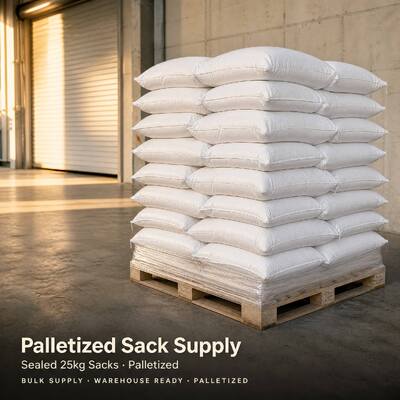
The standard pack is a 25kg PP woven bag with an inner PE liner sealed against moisture, and bags are stacked on pallets for forklift handling. Buyer-branded or neutral bags can be printed for bulk contracts. Container loading is planned around the destination port, with full container, LCL and mixed loads all available, and the certificate of analysis and packing list are ready before the truck leaves the plant.
Storage & Handling
Store under cover in a dry, ventilated area, away from steam lines, kettles and any wall that condenses. An opened bag should be closed within the shift; a bag left open beside a cooker will pick up enough water to affect the next batch. Keep the pallet off the floor on a slip sheet or pallet base and away from odorous goods. In unopened packaging at moderate temperature the powder holds its specification for 24 months.
Why Choose Us
- Candy-grade consistency. Assay and moisture are held in a narrow band from lot to lot, so the cook temperature that works on Monday still works on the following delivery.
- Direct from the crystalliser. No trader sits between the plant and your warehouse, which means the sample you approve and the bulk you receive come from the same process.
- Particle band you can plan around. Sieve analysis is run on each lot and the 30-80 mesh result is printed on the certificate, so dissolving time and dispersion behave predictably in the pre-mix.
- Paperwork completed before shipment. COA, packing list and booking documents are prepared before dispatch, which keeps customs clearance from stalling a production start-up.
- Process advice on request. Our technical staff can talk through cook temperature, syrup ratio and residual moisture with your candy makers when a new sugar-free line is being commissioned.
- Bulk packing options. 25kg PP woven bags with PE liner as standard, palletised or floor-loaded to suit the container plan, with neutral print for distributors.