 |
| Place of Origin: | China |
| Brand Name: | Golden Grain |
| Certification: | ISO9001, ISO22000, HALAL, KOSHER |
| Model Number: | GLMA-02130 |
| Minimum Order Quantity: | 1300kg |
|---|---|
| Price: | USD450-USD550/MT FOB QINGDAO, CHINA |
| Packaging Details: | 250kg/drum, 270kg/drum, 275kg/drum with new plastic drum, 1300kg IBC drum, flexible bag |
| Delivery Time: | 7 - 10 working days |
| Payment Terms: | L/C, T/T, D/P, D/A |
| Supply Ability: | 1000MT per month |
| Grade: | Industrial Grade, E420 | Application / End Use: | Sorbitan Ester, Span / Tween Surfactant, Vitamin C Synthesis, Polyurethane Polyol, Paper Coating, Detergent |
|---|---|---|---|
| Function: | Polyol Raw Material, Chemical Intermediate, Humectant | Form & Appearance: | Clear Colorless Syrupy Liquid |
| Concentration: | 70% Dry Solids | Synonyms / Other Names: | D-Glucitol, Sorbitol Solution, Sorbitol Syrup |
| CAS No. / E-Number: | 50-70-4 / E420 (INS 420) | Packaging: | 250kg / 275kg Plastic Drum, 1000kg IBC Tank |
| HS Code: | 38246000 | Certification: | ISO 9001, ISO 22000, Halal, Kosher |
| Dry Substance: | 70% Min | PH: | 5.0 - 7.5 |
| Reducing Sugars: | 0.15% Max | Water Content: | 30.0% Max |
| Heavy Metals: | 1.0 Ppm Max (as Pb); Arsenic 1.0 Ppm Max; Nickel 1.0 Ppm Max |
Sorbitol Solution 70% Industrial Grade is a clear, colorless, syrupy liquid polyol derived from corn, conforming to industrial-grade specifications with CAS number 50-70-4 (D-Glucitol) and E420 designation. It is supplied as a non-crystallizing polyol raw material for detergent formulation and other industrial chemical applications. Typical specification. The certificate of analysis issued for each shipment is the governing document. A certificate of analysis is issued for each lot against the drum number, and the safety data sheet is supplied with the shipping documents. Detergent formulation: Humectant, solubilizer, and functional additive in powder and liquid detergent systems. Non-crystallizing: Remains stable and pumpable in tanks and pipelines, reducing handling issues. Polyol raw material: Multiple hydroxyl groups support esterification and other chemical reactions in derivative production. Humectant function: Controls moisture in adhesives, paper, textiles, and other industrial formulations. Plasticizer and conditioner: Used in leather fatliquors and synthetic leather for flexibility and softness. Non-volatile: Does not evaporate from formulations, providing lasting performance. Easy to handle: Liquid form pumps directly from the drum, eliminating dust and dissolution steps. 250kg drum: Suitable for forklift handling and industrial-scale production logistics. In detergent formulation, sorbitol acts as a humectant, solubilizer, and functional additive in powder and liquid detergent systems, helping control moisture, prevent caking, and keep incompatible ingredients evenly dispersed. In leather fatliquors and synthetic leather, it serves as a plasticizer and moisture conditioner, contributing to flexibility and softness. In adhesives and paper, it functions as a humectant and moisture control agent. In textile processing, it supports moisture retention and conditioning. As a polyol building block, it is used in chemical synthesis as a raw material for surfactants, emulsifiers, and specialty chemicals. In industrial cleaning, it serves as a functional additive in surfactant systems. Hand dishwash liquid. It moderates viscosity in a high-surfactant formula, keeps the product clear and reduces the dry after-feel on the hands. Laundry liquid. It improves electrolyte tolerance so a builder-heavy formula stays single phase at the active level the market expects. Hard surface and degreaser. Stable in alkaline systems where a sugar syrup would degrade, so a high-pH cleaner keeps its colour and its clarity. Toilet and bathroom cleaner. It holds the water phase stable in a formula that carries acid, surfactant and perfume together. Concentrated refill formats. The freeze-thaw stability keeps a concentrate pourable after cold distribution and reduces the gelling that blocks a dispensing cap. Typical use is 1-5% of the formula, adjusted against the electrolyte load and the target viscosity.Product Overview
In detergent formulation, sorbitol functions as a multi-purpose component. As a humectant, it helps control moisture within the formulation, preventing powders from caking and keeping liquid products stable during storage. As a polyol, it contributes to the solubilizing and coupling of ingredients, helping incompatible components remain evenly dispersed in the finished product. It also serves as a builder and functional additive in surfactant systems, supporting the performance of the primary cleaning agents. Sorbitol is non-volatile and remains stable in the formulation, so its contribution does not fade over time.
Beyond detergents, this industrial-grade solution is used in leather fatliquors and synthetic leather as a plasticizer and moisture conditioner, in adhesives and paper as a humectant, in textile processing for moisture control, and as a polyol building block in the production of emulsifiers, surfactants, and specialty chemicals. Its multiple hydroxyl groups support esterification and other chemical reactions, making it a useful intermediate in derivative manufacturing.
The non-crystallizing behavior of this grade ensures smooth handling in tanks, pipelines, and mixing equipment, reducing the risk of clogs and inconsistent product texture. The 70% aqueous solution is easy to pump and meter, and the 250kg drum format supports industrial-scale production and efficient warehouse logistics.
Technical Specification
Parameter
Specification
Product name
Sorbitol Solution 70%
Chemical name / CAS number
D-Glucitol / 50-70-4
E number
E420
Appearance
Clear, colourless to pale straw viscous liquid
Assay (D-Glucitol, dry basis)
70.0% min
Dry substance / water
69.0-71.0% / 29.0-31.0%
pH (25 °C)
5.0-7.5
Conductivity
25 µS/cm max
Colour (ICUMSA)
30 IU max
Grade
Industrial Grade
Typical Certificate of Analysis
Test item
Typical result
Method
Assay (D-Glucitol)
70.3%
HPLC
Appearance
Clear, colourless
Visual
Colour
12 IU
ICUMSA
Dry substance
70.1%
Refractometric
Water content
29.9%
Karl Fischer
pH (25 °C)
6.5
pH meter
Conductivity
11 µS/cm
Conductivity meter
Reducing sugars
0.06%
Titrimetric
Ash
< 0.05%
Gravimetric
Iron (Fe)
< 1 mg/kg
ICP-MS
Key Benefits
Applications
Detergent raw materials are checked for the things that disturb a surfactant system. Conductivity and ash indicate ionic load that can shift a cloud point or split a phase, colour is read on the ICUMSA scale because a tinted syrup shows in a clear bottle, and pH is recorded since it affects compatibility with an acidic or alkaline base.
Assay, dry substance and water are confirmed by HPLC, refractometer and Karl Fischer, and the solids figure is reported so the water contribution to the formula can be deducted from the batch water. Reducing sugars are held low, since they are the fraction that reacts in an alkaline system, and iron and heavy metals are released against specification. Each lot is retained under its drum number for traceability into a finished batch.
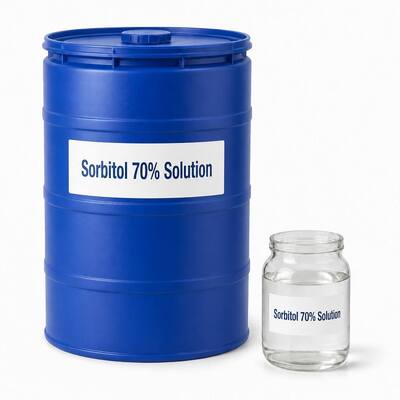
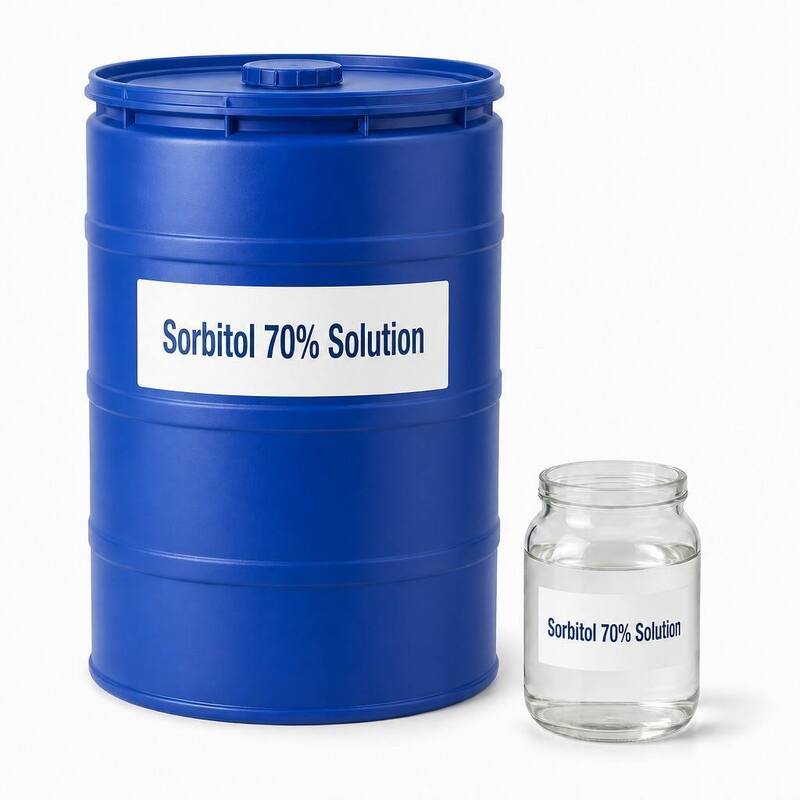
Blenders receive the syrup in 250 kg blue tight-head drums, food-grade lined, both bungs sealed, with product, grade, net weight and lot number on the label. A pallet carries four drums and a 20 ft container carries 80, which suits a plant without a bulk tank; 1000 kg IBC tanks with a bottom valve are quoted for sites that dose from a header tank. Buyer-branded or neutral labels are applied before the container is sealed, and the loading plan is confirmed against the port.
Store between 15 °C and 30 °C in a closed, dry warehouse, upright and away from oxidisers, acids and caustic drums. Cold thickens the syrup and can seed crystals that would not redissolve easily in a cold blending tank; warm the drum to room temperature and roll it before use. Warm storage slowly darkens the product. Keep bungs closed to prevent dilution, which would change both the solids and the water balance of the formula.
Industrial Grade, corn-derived sorbitol solution
• Non-crystallizing polyol for detergent formulation and industrial applications
• Humectant, solubilizer, and functional additive in surfactant systems
• Polyol raw material for chemical synthesis and derivative production
• Non-crystallizing for reliable handling and storage
• 250kg drum for industrial-scale production
• Certificate of Analysis available with each shipment
Alkali stable, unlike a sugar syrup. The polyol backbone survives a high-pH builder load without browning, which keeps a clear cleaner clear.
Low ionic load. Conductivity and ash are held low so the cloud point of a surfactant blend does not shift between deliveries.
Consistent viscosity behaviour. Dry substance is reported per drum, so the thickener balance in the formula stays where it was set.
Freeze-thaw support. Our technical team can advise on the addition rate for a distribution chain that sees cold winters.
Drum and IBC supply. 250 kg sealed drums for a blending line, 1000 kg IBC tanks for a bulk raw material tank.
Documentation for the file. Certificate of analysis, safety data sheet and packing list are issued before dispatch, with loading confirmed per order.