 |
| Place of Origin: | China |
| Brand Name: | Golden Grain |
| Certification: | ISO9001, COA,SDS |
| Model Number: | GLMA-0136903 |
| Minimum Order Quantity: | 100kg |
|---|---|
| Price: | USD850-USD950/MT FOB QINGDAO, CHINA |
| Packaging Details: | 25kg/Bag with Paper Drum and PE Inner |
| Delivery Time: | 7 - 10 working days |
| Payment Terms: | L/C, T/T, D/P, D/A |
| Supply Ability: | 1000MT per month |
| Chemical Name: | D-Sorbitol | Molecular Weight: | 182.17 G/mol |
|---|---|---|---|
| Moisturecontent: | 0.5% Max | Shelflife: | 24 Months |
| Melting Point: | 95-100°C | Appearance: | White Crystalline Powder |
| Chemicalname: | D-Glucitol | Usage: | Food Additive, Cosmetic Ingredient |
| Odor: | Odorless | Taste: | Sweet |
| Casnumber: | 50-70-4 | Storage Conditions: | Store In A Cool, Dry Place |
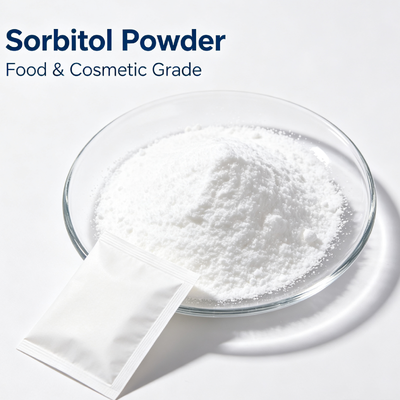
A white, free-flowing sugar alcohol powder for sugar-free confectionery, oral care, cosmetics, personal care and food processing — supplied asfood gradeandcosmetic (daily-chemical) grade, not pharmaceutical grade.
Why buyers keep this ingredient on repeat order:Sorbitol powder delivers the sweetness and bulk of sugar without feeding tooth decay, keeps finished products moist without turning sticky, and stays chemically stable through high-temperature processing. Our documented quality starts at the crystal itself: every reference lot tests at99.5% assaywith total sugar of only0.20%and a total plate count of just63 pcs/g.
Every shipment is released with a signed Certificate of Analysis (COA), the full Specification and an MSDS — the three documents your QC, purchasing and compliance teams will ask for anyway.
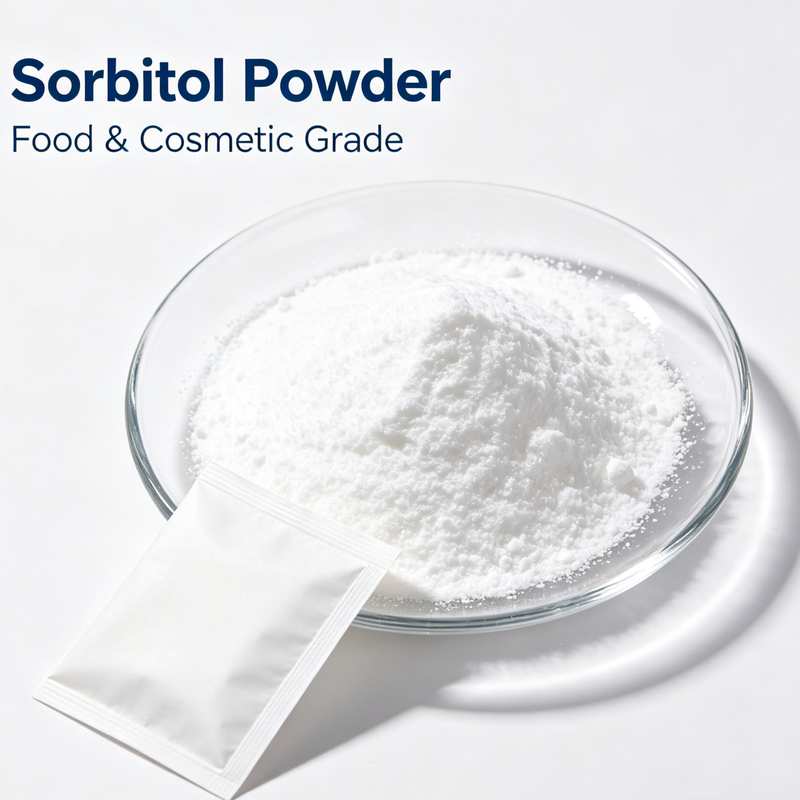
FORM: White, crystalline free-flowing powder
SWEETNESS PROFILE: ~60% as sweet as sucrose, ~1/3 fewer calories
VERIFIED ASSAY: 99.5% (limit ≥ 99.0%) per COA
GRADE OPTIONS: Powder mesh: 10–120 mesh available
STANDARDS: FCC V (Food Chemicals Codex) · FDA GRAS · EU E420
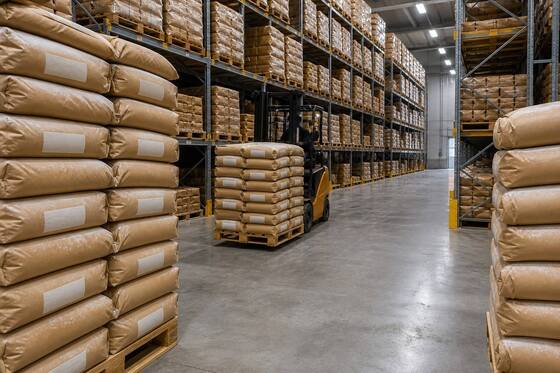
PACKING: 25 kg kraft bag with PE inner liner

Sorbitol, also written asD-glucitol,D-sorbitol,sorbitorsorbol, is the polyol (sugar alcohol) with the molecular formula C6H14O6. It is produced by hydrogenation of glucose and crystallised into a white powder that behaves like sugar in many recipes — without the sugar’s fermentable carbohydrate load.
| Item | Data |
| Product name | Sorbitol Powder (crystalline form) |
| Chemical synonyms | D-Glucitol · D-Sorbitol · Sorbit · Sorbol |
| Molecular formula / weight | C6H14O6 / 182.2 g/mol |
| CAS number | 50-70-4 (listed on the U.S. TSCA 8(b) inventory) |
| INS / E number | INS 420 (food additive, EU listing E420) |
| H.S. code | 2905 4400 |
| Grade / application | Food grade & cosmetic (daily-chemical) grade; purity requirements per FCC V (Food Chemicals Codex) |
| Appearance | White or almost-white crystal powder |
| Taste / mouthfeel | Smooth mouthfeel with a sweet, cool and pleasant taste |
| Solubility | Very soluble in water; slightly soluble in alcohol |
Every polyol has a personality, and sorbitol’s is defined by three physical facts worth knowing before you reformulate:
1. It sweetens at 60% of sucrose strength with about one-third fewer calories.That sweetness ratio is high enough to act as themainsweetener in most sugar-free systems, which is why sorbitol is the classic bulking partner in chewing gum and hard candy rather than just a trace sweetener.
2. It is a humectant by nature.The hydroxyl groups in C6H14O6 bind and hold water, so sorbitol actively manages water activity in the finished product — keeping toothpaste paste, creams and soft confectionery from drying out or crystallising prematurely. One ingredient, two jobs: bulk sweetenerandmoisture manager.
3. It is non-cariogenic.Sorbitol does not promote tooth decay the way sucrose does, which is why oral-care and “sugar-free” product lines lean on it. Combined with its approval history — nearly half a century of safe use in processed foods, affirmed GRAS by the U.S. FDA and approved in the EU, Australia, Canada and Japan — it is one of the most defensible sugar substitutes you can put on a label.
| Attribute | Sorbitol powder (this product) | Sucrose (table sugar) |
| Relative sweetness | About 60% of sucrose | Reference (100%) |
| Calorie contribution | About one-third fewer calories | 4 kcal/g reference |
| Cariogenic potential | Non-cariogenic per documentation | Fermentable, cariogenic |
| Moisture behaviour | Humectant — attracts and holds moisture | Less hygroscopic control |
| Physical form stability | Stable crystalline powder, free-flowing | Crystalline, readily recrystallises |
| Solubility | Very soluble in water | Very soluble in water |
Nutritional positioning claims (sweetness %, calorie reduction, non-cariogenic) are reproduced from the product Specification and are stated as product data, not as medical advice. Always verify label claims against your target market’s food-law rules.
This product is supplied asfood gradeand forcosmetic / daily-chemical applications(oral care, personal care and related industries); The compliance picture below is what a food or cosmetics QA team checks first.
| Recognition / listing | Status (per documentation) |
| Food Chemicals Codex (purity requirements) | Conforms to FCC V (Food Chemicals Codex) |
| U.S. FDA | Affirmed as GRAS (Generally Recognized As Safe) for sorbitol |
| European Union | Approved food additive (INS/E420) |
| Australia · Canada · Japan | Approved for use in food products |
| U.S. TSCA | CAS 50-70-4 listed on TSCA 8(b) inventory |
| Transport classification | Not a DOT-controlled material (U.S.); not regulated under the IMDG Code; not controlled under WHMIS (Canada) |
Because one crystal performs as sweetener, humectant, texturising agent and nutritive bulking agent at once, sorbitol powder shows up across surprisingly different production lines. Use the guide below to match the function to your process.
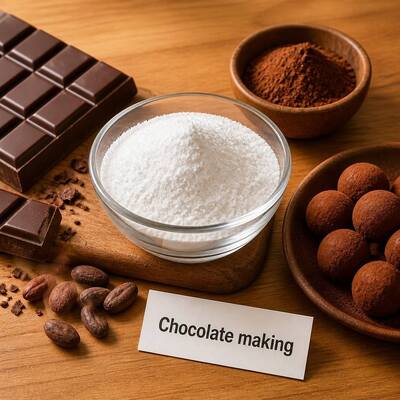
The best-known home of crystalline sorbitol. In gum and candy base it contributes the cool, clean sweetness and the bulk that sucrose would normally supply — and because the crystalline form keeps its structure through high-temperature cooking, it behaves predictably in hard candy and deposited confectionery. The low reducing-sugar content (0.05–0.20% per COA) also means less Maillard browning and fewer colour/flavour shifts in boiled sweets.
Function it serves:bulk nutritive sweetener · cooling mouthfeel · crystallisation control · sugar-free label support.
In compound chocolate, biscuits and sugar-free dessert mixes, sorbitol powder pulls double duty: sweetness plus moisture management that keeps the crumb soft and extends perceived freshness. Its free-flowing crystalline particles blend evenly into dry premixes and re-hydrate predictably, which simplifies scaling from lab batch to production line.
Function it serves:texturising agent · humectant · bulk sweetener in dry blends.
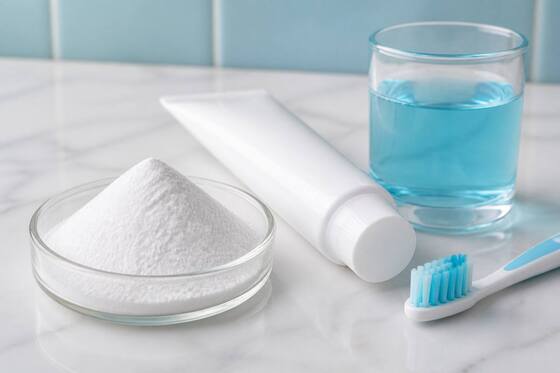
Sorbitol is one of the most established humectants in oral care. In toothpaste it maintains paste body and prevents the tube content from drying out at the crimp, while contributing a mild sweetness that consumers read as “clean”. Its non-cariogenic status matters here more than anywhere else: the sweetener in oral-care products should not feed the very problem the product solves.
Function it serves:humectant · texture / rheology control · mild non-cariogenic sweetness.
Formulators value sorbitol powder as a mild, low-irritation humectant for creams, lotions, gels and body-care products. It helps hold moisture at the skin surface, supports product feel, and adds little to the sensory “weight” of a formula — a clean, neutral building block for personal-care and daily-chemical lines.
Function it serves:humectant · moisture-retention · skin-conditioning support.
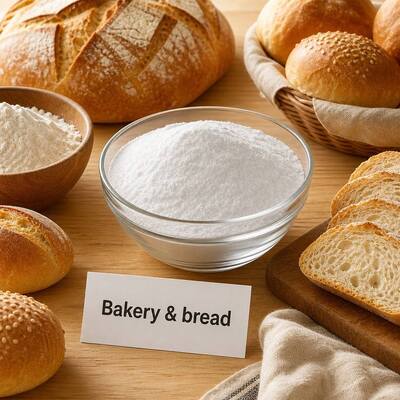
Food processors use sorbitol powder wherever sweetness, humectancy or water-activity control is wanted without sucrose — from sugar-free glazes and coatings to semi-moist and processed food systems. Its low reducing-sugar profile (0.05–0.20% per COA) also protects colour and flavour in heat-treated products.
Function it serves:water-activity control · texturising agent · bulk sweetener.
Outside food and personal care, the same humectant and crystallisation-inhibition behaviour is used in technical and daily-chemical (industrial) formulations where moisture must be managed or crystallisation prevented — a practical humectant building block for non-food production lines.
Function it serves:humectant · crystallisation inhibitor · water-activity management.
Numbers below combine the full specification sheet (documented specification limits) with the measured results of a reference certificate of analysis. Your shipment’s own COA is the governing document; treat the COA column as a demonstration of the typical quality level.
| Test item | Specification limit | Reference COA result |
| Appearance | White or almost-white crystal powder | White crystal powder — conforms |
| Identification | A, B, C | — |
| Thin layer chromatography | Passes test | — |
| Assay | ≥ 98.0% | 99.5% (COA limit ≥ 99.0%) |
| Sorbitol purity | — | 98.8% (COA limit ≥ 98.5%) |
| Loss on drying / moisture | ≤ 1.0% | 0.5% |
| Total sugar | ≤ 1.0% | 0.20% (COA limit ≤ 0.30%) |
| Reducing sugar | ≤ 0.20% | 0.05% (COA limit ≤ 0.10%) |
| Specific rotation | +4.0° to +7.0° | 4.7 (range 4.0–7.0) |
| pH value | 3.5–7.0 (10% solution) | 6.5 (COA: 5.0–7.0, 50% solution) |
| Density | — | 1.48 (COA limit ≥ 1.45) |
| Residue on ignition | ≤ 0.1% | Conforms |
| Melting range | ≥ 95°C | — |
| Solubility | Very soluble in water; slightly soluble in alcohol | — |
| Particle size | 20–60 mesh / 60–120 mesh | Tested: 20–40 mesh (available: 10–20 / 20–40 / 40–60 / 40–100 mesh) |
Sources: product specification (GG) and reference COA of sorbitol powder.
| Test item | Specification limit | Reference COA result |
| Heavy metals (as Pb) | ≤ 5 ppm | Conforms |
| Lead | ≤ 0.5 ppm | Conforms |
| Arsenic | ≤ 1 ppm | Conforms |
| Nickel | ≤ 1 ppm | Conforms |
| Chlorides | ≤ 0.005% | Conforms (COA limit ≤ 10 ppm) |
| Sulphates | ≤ 0.01% | Conforms (COA limit ≤ 20 ppm) |
| Ash insoluble in acid | ≤ 1.5% | — |
| Test item | Specification limit | Reference COA result |
| Total plate count | ≤ 1,000 pcs/g | 63 pcs/g |
| Moulds and yeasts | ≤ 100 pcs/g | 10 pcs/g |
| Coliforms (35°C) | ≤ 2 cfu/g | — |
| E. coli | Negative | Negative |
| Salmonella sp. | Negative in 25 g | — |
| Dead mites | ≤ 5 / 25 g | — |
| Property | Value |
| Melting point | 111.5°C (232.7°F) |
| Boiling behaviour | Decomposes before boiling |
| Specific gravity | 1.489 (water = 1) |
| Molecular weight | 182.17 g/mol |
| Solubility | Easily soluble in cold and hot water |
| Stability | Stable product; does not polymerise; non-corrosive in presence of glass |
Purchasing departments rarely ask for one document; they ask for the whole file. Each delivery of this sorbitol powder is released with a complete documentation set:
| Document | What it contains |
| Certificate of Analysis (COA) | Lot-specific measured results for assay, purity, moisture, sugars, rotation, pH, density, impurities, particle size and microbiology, concluded with “the results conform to the specification” and signed by analyst, checker and supervisor |
| Product Specification | Full test-method limits (food-grade QC panel) incl. identification, thin-layer chromatography, melting range, coliforms, Salmonella, dead mites and acid-insoluble ash |
| MSDS / SDS | 16-section safety sheet covering composition (100% sorbitol, CAS 50-70-4), first aid, fire fighting, handling, storage and transport status |
The three-level signature line on the COA (analyst → checker → supervisor) reflects the release discipline behind the numbers: no lot leaves without independent review at each stage of testing.
For logistics teams, the headline is simple: this product isnot a dangerous goodfor transport. It is not a DOT-controlled material (U.S.), is not regulated under the IMDG Code, and is not controlled under WHMIS (Canada). That keeps sea-freight documentation straightforward.
| Hazard rating / property | Value (per MSDS) |
| HMIS (U.S.) | Health 2 · Fire 1 · Reactivity 0 · Personal protection E |
| NFPA (U.S.) | Health 2 · Flammability 1 · Reactivity 0 |
| Acute oral toxicity | LD50 15,900 mg/kg (rat) |
| Hazard summary | Irritating to eyes (DSCL R36); hazardous if ingested; slightly hazardous on skin contact or inhalation of dust |
| Fire behaviour | May be combustible at high temperature; combustion products are carbon oxides (CO, CO2) |
| Fire fighting | Small fire — dry chemical powder; large fire — water spray, fog or foam (do not use water jet) |
| Storage conditions | Cool, dry, well-ventilated; keep container tightly closed; store away from heat, ignition sources and strong oxidising agents |
| Route | Immediate measure (per MSDS) |
| Eye contact | Remove contact lenses; flush with running water at least 15 minutes, eyelids open; seek medical attention |
| Skin contact | Wash immediately with plenty of water and non-abrasive soap; wash contaminated clothing before reuse |
| Inhalation | Move to well-ventilated area; seek medical attention if symptoms persist |
| Ingestion | Do not induce vomiting; loosen tight clothing; seek immediate medical attention |
Protective equipment for handling large quantities: splash goggles, gloves, lab coat and a dust respirator (approved/certified). Spilled powder should be collected into a waste container and the surface rinsed with water.
| Item | Detail |
| Standard packing | 25 kg per bag — kraft paper bag with PE inner liner |
| Custom packing | Available on request (private label, alternative bag weights and materials per customer specification) |
| HS code | 2905 4400 (sorbitol powder) |
| Transport status | Not regulated as dangerous goods — DOT / IMDG / WHMIS clear |
| Storage before use | Keep in a cool, dry, ventilated environment with containers closed; reseal partially used bags to protect the powder from humidity |
Lead times, container loading plans and freight quotes depend on your destination and order size — send your port and quantity and we will confirm the current options in writing.
Q: Is sorbitol powder the same as E420 and INS 420?
Yes. INS 420 is the international food-additive number for sorbitol and E420 is the EU listing of the same additive. This product is the crystalline powder form (CAS 50-70-4).
Q: Is sorbitol powder sugar-free?
Sorbitol is a sugar alcohol, not sucrose. It provides sweetness with about one-third fewer calories than sugar, and this grade’s total sugar content is tightly controlled — specification ≤ 1.0%, with reference lots measuring as low as 0.20%.
Q: Does sorbitol cause tooth decay?
No — sorbitol is documented as non-cariogenic, which is why it is a standard sweetener in sugar-free chewing gum and oral-care products.
Q: Which particle sizes are available?
The specification sheet covers 20–60 mesh and 60–120 mesh; the COA reference range includes 10–20, 20–40, 40–60 and 40–100 mesh. Tell us your process — granulation, blending or fine mixing — and we will confirm the available cut for your batch.
Q: What quality standards does this powder meet?
As a food-grade and cosmetic (daily-chemical) grade product it conforms to FCC V (Food Chemicals Codex) purity requirements. Sorbitol is affirmed as GRAS by the U.S. FDA and approved for use in the EU (E420), Australia, Canada and Japan. This product is not a pharmaceutical-grade excipient.
Q: What documents are provided with shipment?
A lot-specific, three-level signed Certificate of Analysis, the full product Specification, and the 16-section MSDS/SDS.
Q: Is sorbitol powder classified as dangerous goods for shipping?
No. It is not a DOT-controlled material, is not regulated under the IMDG Code and is not controlled under WHMIS (Canada). Standard containerised sea freight applies.
Q: How should we store sorbitol powder?
Store in a cool, dry, well-ventilated area with containers tightly closed, away from heat, ignition sources and strong oxidising agents. Reseal opened bags to keep the powder free-flowing.
Q: Why choose powder over a sorbitol solution?
The crystalline powder suits dry blending and moisture-sensitive systems where adding water is undesirable. It also offers the longest practical shelf control in bagged form. If your line is liquid-based, ask about our liquid sorbitol grades.
This sorbitol powder is exported byGolden Grain Group Limited, Luocheng Sub-district, Shouguang City (Shandong Province), China — a region long associated with sugar-alcohol production. We supply crystalline sorbitol powder with complete documentation, stable quality from lot to lot, and packing options from standard 25 kg bags to customer-specific formats.
To request a quote:tell us your quantity, target mesh size and destination port. A current COA sample, specification and pricing will follow in writing.
Keywords: sorbitol powder | crystalline sorbitol | E420 | food grade sorbitol | cosmetic grade sorbitol | sugar alcohol powder | sorbitol for toothpaste | sorbitol for cosmetics | 25kg sorbitol bag | sorbitol manufacturer China
Qingdao Golden Grain Chemical Co., Ltd, invested by Golden Grain Group Limited, one professional manufacturer and exporter since 2000, is devoted to supplying products and solutions to food & beverage, medicine, animal feed & nutrition, personal care & household, construction, agriculture.
Golden Grain Group Limited have professional staff, advanced production lines and complete lab equipment, pass GMP, HACCP, ISO, HALAL, KOSHER, BRC, GMP-Free, and other necessary certificates, which ensure our quality to be international standard. For many years' experience, we are exporting our products to more than 60 countries in the world.
"Quality Products", "Efficient Service", Golden Grain Group Limited hope to enter good business cooperation with customers at home and abroad for long.