Sorbitol is the humectant most toothpaste formulators reach for first — it holds moisture inside the tube, sweetens without cariogenic sugar, and carries fluoride and actives evenly through the paste. For oral care production, the working grade is almost always a non-crystallizing sorbitol solution at 70% dry substance, not the powder.
This page covers what the grade actually is, how much to use, which specification points matter in oral care, and how to verify a supplier before you commit to a container.
Toothpaste is roughly 20–35% humectant by weight. That humectant does four jobs at once:
1. Keeps the paste from drying out in the tube. Sorbitol is strongly hygroscopic, so it holds free water and stops the paste hardening at the nozzle between uses. A glycerin-only formula tends to feel drier on the shelf over a 24-month shelf life.
2. Sweetens without sugar. Sorbitol is about 60% as sweet as sucrose and is not fermented by oral bacteria, so it contributes sweetness without being cariogenic. This is why it pairs so well with a “sugar-free” or “non-cariogenic” claim.
3. Gives body and smooth mouthfeel. It raises viscosity and gives the paste a translucent, gel-like clarity that consumers associate with a clean product — a real advantage over opaque glycerol-only bases.
4. Carries actives. Sorbitol solution dissolves fluoride salts, sweeteners and some actives cleanly, and its low water activity helps keep the formula microbiologically stable without extra preservative load.
A secondary benefit is cost: sorbitol 70% is consistently cheaper per unit of humectancy than refined glycerin, which is why most mid-market oral care brands blend the two rather than using glycerin alone.
| Grade | Typical use in oral care | Notes |
|---|---|---|
| Sorbitol 70% solution, non-crystallizing, cosmetic / oral care grade | Mainstream toothpaste, gel, mouthwash | The default choice. Non-crystallizing means it will not throw crystals in cold storage or in the finished paste |
| Sorbitol 70% solution, BP / USP | Toothpaste made under pharma-adjacent quality systems, medicated or fluoride-heavy formulas | Full pharmacopoeia documentation; tighter release testing. This is our standard oral care release grade |
| Sorbitol powder, 20–60 / 40–60 / 60–80 mesh, FCC IV | Chewing gum, tablet, dry-mix oral care, some anhydrous paste bases | Not typical for standard paste — powders re-dissolve and add process steps |
Practical rule: if the finished product is a water-based paste or gel, buy the 70% solution. Powder belongs in anhydrous or solid-dose applications.
Plain 70% sorbitol will crystallize at low temperature — in winter transit, in an unheated warehouse, or inside a paste stored below 10 °C. Crystals show up as grit on the tongue and as visible specks in a translucent gel.
Non-crystallizing grades are made by keeping a controlled level of sorbitan and higher polyols in the syrup, which suppresses crystal nucleation. Insist on this on the specification, not just in the product name: ask for the crystallization test result and the storage temperature range the supplier guarantees.
Limits below are the release specification for our non-crystalline 70% solution, with a recent batch result alongside. The batch COA issued with your shipment always governs.
| Parameter | Limit | Batch result |
|---|---|---|
| Appearance | Colourless, syrupy liquid | Conforms |
| Dry substance | ≥ 70 % | 70.61 % |
| Water content | ≤ 30 % | 29.2 % |
| Total sugars | ≤ 8.0 % | 4.1 % |
| Reducing sugars | ≤ 0.30 % | 0.13 % |
| D-Sorbitol (as dry substance) | ≥ 50 % | 66.67 % |
| D-Mannitol (as dry substance) | ≤ 6.0 % | 4.40 % |
| Resistivity | ≤ 10 µS/cm | 6.4 µS/cm |
| Refractive index (20 °C) | ≥ 1.4575 | 1.4605 |
| Specific gravity (20 °C) | 1.285 – 1.315 | 1.304 |
| pH (50 % solution) | 5.0 – 7.0 | 5.5 |
| Chloride | ≤ 10 ppm | < 10 ppm |
| Iron | ≤ 1.0 ppm | < 1.0 ppm |
| Nickel | ≤ 1.0 ppm | < 1.00 ppm |
| Arsenic (as As2O3) | ≤ 1.0 ppm | < 1.0 ppm |
| Sulphated ash | ≤ 0.10 % | < 0.10 % |
| Sulphate | ≤ 20 ppm | < 20 ppm |
| Heavy metals (as Pb) | ≤ 1.0 ppm | < 1.0 ppm |
| Mould and yeast | ≤ 100 cfu/ml | Conforms |
| Crystallization test | 18 °C / 48 h, non-crystallizing | Conforms |
Four of these matter most in oral care:
For dry-mix, chewing gum and tablet applications we supply powder to FCC IV. Limits and a recent batch result:
| Parameter | FCC IV limit | Batch result |
|---|---|---|
| Appearance | White powder, granules or crystalline masses | Conforms |
| Identification | A, B | Conforms |
| Assay | 91.0 – 100.5 % | 99.60 % |
| Water | ≤ 1.5 % | 0.42 % |
| Total sugar | ≤ 0.30 % | 0.20 % |
| Reducing sugar | ≤ 0.30 % | 0.05 % |
| Density | ≥ 1.45 | 1.48 |
| Specific rotation | 4.0 – 7.0 | 4.6 |
| pH (10 % solution) | 3.5 – 7.0 | 6.0 |
| Residue on ignition | ≤ 0.1 % | Conforms |
| Heavy metals (as Pb) | ≤ 5 ppm | Conforms |
| Nickel | ≤ 1 ppm | Conforms |
| Lead | ≤ 2 ppm | ≤ 0.5 ppm |
| Chlorides | ≤ 10 ppm | Conforms |
| Sulphates | ≤ 20 ppm | Conforms |
| Arsenic | ≤ 1 ppm | Conforms |
| Particle size | 20–60, 40–60, 60–80 mesh | 20–60 mesh |
| Total plate count | ≤ 1,000 cfu/g | 63 cfu/g |
| Moulds and yeasts | ≤ 100 cfu/g | 10 cfu/g |
| E. coli | Negative | Negative |
Packing: 25 kg kraft bag with PE inner liner.
| Formulation type | Sorbitol 70% (as supplied) | Comment |
|---|---|---|
| Standard white paste | 20 – 30 % | Often blended 50/50 with glycerin |
| Translucent gel | 25 – 35 % | Higher sorbitol gives clarity and body |
| Children’s / low-abrasive paste | 15 – 25 % | Lower humectant load, softer base |
| Mouthwash | 5 – 15 % | Sweetener and mouthfeel, not humectancy |
Exact levels depend on your abrasive system, thickener (CMC, carrageenan, xanthan) and target viscosity. If you are reformulating away from glycerin, move in steps — replacing more than half the glycerin in one go usually shifts viscosity and requires re-tuning the thickener.
Paste hardens at the nozzle after a few weeks. Humectant level too low, or the sorbitol was cut with a lower-solids syrup. Check dry substance on the COA; it should be at or above 70%.
Visible crystals or grit. Crystallizing (standard) grade used instead of non-crystallizing, or the drum was stored below its guaranteed temperature range. This is the single most common oral care complaint we see with sorbitol.
Yellowing or off-odour after storage. Reducing sugars above specification, or the syrup picked up contamination from a drum that was opened and left unsealed. Ask for reducing sugars on every COA.
Viscosity drift between batches. Sorbitol is usually not the cause — but if the batch arrives at a different dry substance, the water balance in the formula shifts and the thickener behaves differently. Fix the spec band with your supplier rather than adjusting the formula each time.
| Item | Detail |
|---|---|
| Standard packing — solution | 250 kg drum (270 kg drum also available) |
| Standard packing — powder | 25 kg kraft bag with PE inner liner |
| Container load | Confirmed per drum size and destination port |
| HS code | 2905.44 — confirm with your customs broker for your market |
| Shelf life | Typically 24 months in unopened drums, stored away from direct sun |
| Storage | Keep sealed, 5–35 °C; reseal partially used drums |
Documentation issued with each shipment: COA (batch-specific), MSDS/SDS, and a specification sheet.
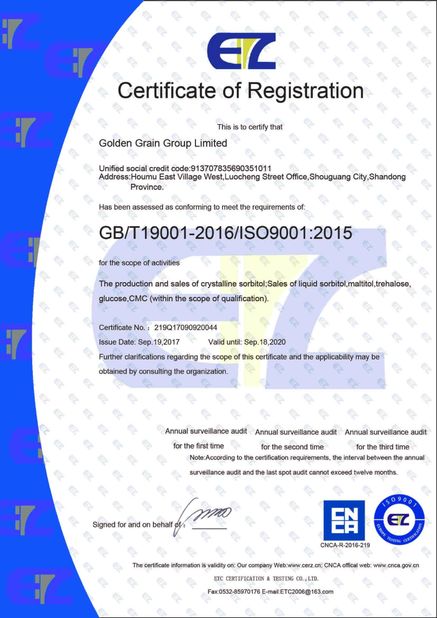
Our quality system and product certifications:
| Certificate | Scope |
|---|---|
| ISO 9001 | Quality management system |
| ISO 22000 | Food safety management system |
| Halal | Product and process, issued by an accredited certification body |
| Kosher | Product and process, issued by an accredited certification body |
Certificate copies, including the issuing body, certificate number and validity dates, are provided on request before an order — so your QA team can verify them independently rather than taking our word for it.
Can sorbitol fully replace glycerin in toothpaste?
Technically yes, practically rarely. Sorbitol is cheaper and sweeter but slightly less effective per unit as a humectant, and full replacement usually changes mouthfeel and viscosity. Most formulas settle at 50/50 to 70/30 sorbitol-to-glycerin.
Is sorbitol safe for “sugar-free” claims?
Sorbitol is a polyol, not a sugar, and is not fermented by oral bacteria — which is why it supports non-cariogenic positioning. Check your market’s labelling rules for the exact claim wording.
Do you supply pharma-grade sorbitol for medicated toothpaste?
Yes — BP/USP grade with full pharmacopoeia documentation is available. Tell us the destination market and we will confirm which monograph applies to your filing.
What is the minimum order?
It depends on grade and destination. One pallet is a common starting quantity for a trial, and full container loads are the normal commercial volume. Send us your port and we will quote both.
Can you supply a sample before a container order?
Yes. Samples and COA/MSDS are issued before commercial orders, so your lab can run a trial batch first.
Tell us the grade, the volume, and the destination port — we will come back with price, packing options and lead time.
Send your specification or your current formula target, and we will match the grade to it rather than the other way round.