 |
| Place of Origin: | China |
| Brand Name: | Golden Grain |
| Certification: | ISO9001, COA,SDS |
| Model Number: | GLMA-01771 |
| Minimum Order Quantity: | 1300kg |
|---|---|
| Price: | USD450-USD550/MT FOB QINGDAO, CHINA |
| Packaging Details: | 250kg/drum, 270kg/drum, 275kg/drum with new plastic drum, 1300kg IBC drum, flexible bag |
| Delivery Time: | 7 - 10 working days |
| Payment Terms: | L/C, T/T, D/P, D/A |
| Supply Ability: | 1000MT per month |
| Freezing Point: | Below 0 °C (varies With Concentration) | Grade: | Industrial Grade |
|---|---|---|---|
| CAS No.: | 50-70-4 | EINECS No.: | 200-061-5 |
| Application: | Industrial Raw Material, Plasticizer, Chemical Intermediate, Moisture Retention Agent, Coating Additive, Textile Additive | Storage Condition: | Store In A Cool, Dry Place |
| Molecular Formula: | C6H14O6 | Shelf Life: | Typically 2 Years When Stored Properly |
| Main Applications: | Surfactants (Span/Tween), Polyurethane Polyols, Alkyd & Polyester Resins, Isosorbide, Industrial Humectant | Type: | Crystalline & Non‑Crystallizable Grade |
| Chemicalname: | Sorbitol | Viscosity: | Higher Than Water, Viscous Liquid |
| Active Ingredient: | Sorbitol | Physical State: | Liquid |
| Odor: | Odorless |
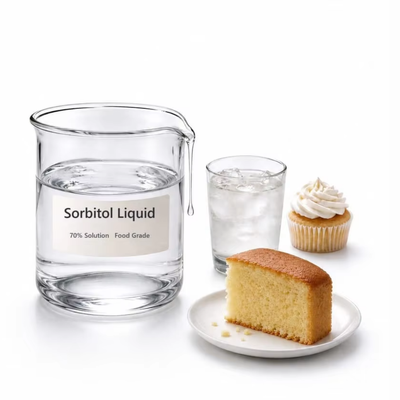
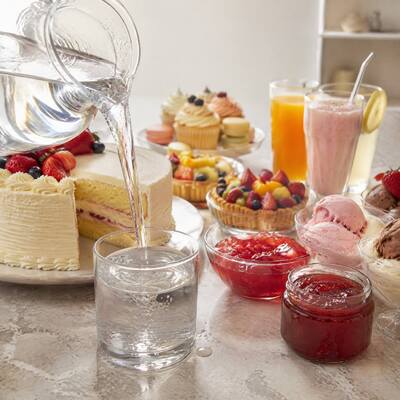
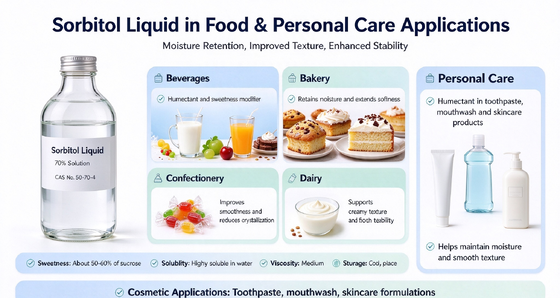
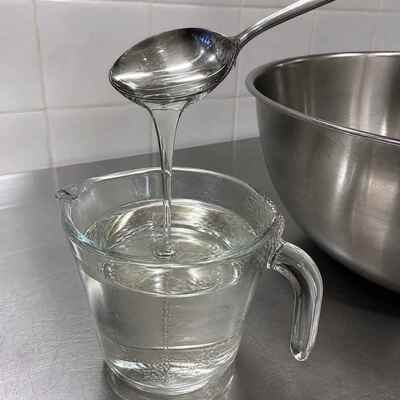
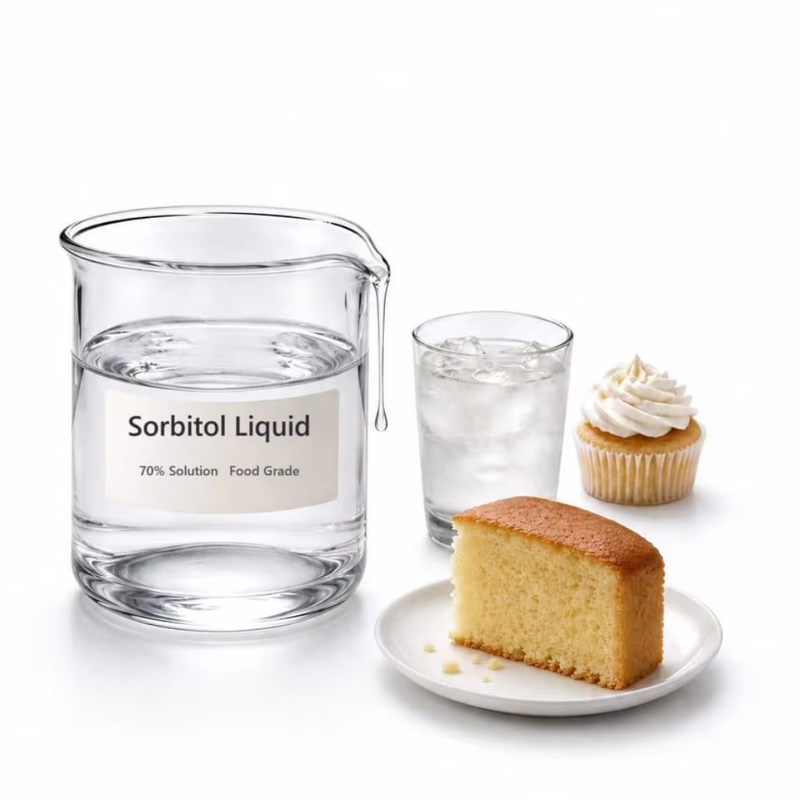
Our Sorbitol Solution 70% is a clear, colorless, odorless syrupy liquid manufactured to food-grade standards for beverage and food applications. Chemically identified as D-Glucitol (E420, INS 420(ii), CAS 50-70-4), it is a plant-derived sugar alcohol that functions as a low-calorie sweetener, humectant, and texture builder. This is a non-crystallizing grade, specifically suited for beverage production where clarity and stability over time are critical. It meets the requirements of FCC (Food Chemical Codex), FAO/JECFA, and EU E420 specifications, and is produced from non-GMO corn or wheat starch through catalytic hydrogenation — a process entirely plant-based with no animal-derived inputs. Sorbitol Solution 70% is a clear, colourless D-Glucitol syrup at 70% dry substance. In beverages its value is not raw sweetening power but the shape of the sweetness curve and the fact that it brings no colour and no sediment into a product the consumer sees through. Clarity is the first hurdle. A beverage is judged before it is tasted, and haze in a clear drink reads as spoilage even when the microbiology is clean. The syrup is filtered and supplied free of suspended matter, and it stays in solution at the dilution levels used in a finished drink, so it does not throw a ring at the shoulder of the bottle or a floc in the base of a concentrate tank. Its low reducing sugar content matters here too: reducing sugars react slowly with amino compounds in a warm warehouse, and that reaction is one of the routes to a colour shift in a stored concentrate. The second point is sweetness. Sorbitol is about two thirds as sweet as sucrose, with a clean front and a slight cooling tail, and no licorice or metallic linger. That makes it useful in two ways: as a partial sucrose replacement that softens an over-sweet profile without adding a foreign note, and as a masking partner for high-intensity sweeteners, where it rounds off the bitter edge that a steviol glycoside or acesulfame blend leaves at the back of the tongue. In a concentrate it also acts as a solubiliser, keeping flavour oils and clouding agents dispersed and reducing the ringing that appears when a batch is held cold. Typical specification. The certificate of analysis issued for each shipment is the governing document. A certificate of analysis is issued for each lot, and a safety data sheet is available with the shipment documents. Clean, Mild Sweetness Without the Sugar Stays Clear, Stays Stable Works in Tea and Functional Beverages Multi-Functional Beyond Sweetness Beverages – Flavored drinks, functional beverages, tea-based drinks, and reduced-sugar juices. Provides body and mouthfeel without the calories of sugar. Dairy & Frozen Desserts – Ice cream, yogurt drinks, and frozen desserts. Helps control crystallization and improves texture. Confectionery – Sugar-free candies, chewing gum, and chocolate. Non-cariogenic (does not promote tooth decay). Baked Goods – Retains moisture, extends shelf life, and maintains product softness. Sauces & Condiments – Stabilizer and viscosity modifier. Still and flavoured water. A small addition rounds the sweetness and lifts the fruit note, with no haze and no colour pickup in a clear bottle. Carbonated soft drinks. Partial replacement of sucrose lightens a heavy profile and reduces the sticky mouthfeel that a high-sugar formula leaves. Concentrates and syrups. The syrup holds flavour oils in dispersion and does not crystallise in a cold tank, which keeps a batch uniform throughout the tank. Reduced-sugar and zero-sugar drinks. Sorbitol masks the bitter tail of high-intensity sweeteners and adds body that water alone cannot carry. Sports and functional drinks. A moderate glycaemic load and a clean taste make it workable in a formula where the electrolyte and acid balance already limits sweetness. Typical use is 2-8% of the finished drink, calculated against the target brix and the sweetness already supplied by sucrose or a high-intensity blend.Product Overview

Technical Specification
Parameter
Specification
Product name
Sorbitol Solution 70%
Chemical name / CAS number
D-Glucitol / 50-70-4
E number
E420
Appearance
Clear, colourless, odourless viscous liquid
Assay (D-Glucitol, dry basis)
70.0% min
Dry substance / water
69.0-71.0% / 29.0-31.0%
pH (25 °C)
5.0-7.0
Density (20 °C)
1.285-1.315 g/cm³
Colour (ICUMSA)
15 IU max
Grade
Food Grade
Typical Certificate of Analysis
Test item
Typical result
Method
Assay (D-Glucitol)
70.3%
HPLC
Appearance
Clear, colourless
Visual
Colour
6 IU
ICUMSA
Turbidity
< 5 NTU
Nephelometric
Dry substance
70.1%
Refractometric
Water content
29.9%
Karl Fischer
pH (25 °C)
6.2
pH meter
Reducing sugars
0.03%
Titrimetric
Total heavy metals (as Pb)
< 5 mg/kg
Colorimetric
Total plate count
< 100 cfu/g
Plate count
Yeast and mould
< 10 cfu/g
Plate count
What This Means for Your Beverage
Sorbitol provides approximately 50–60% of the sweetness of sucrose with a pleasant, cooling taste. For beverage formulators working on reduced-sugar, sugar-free, or diabetic-friendly products, it delivers bulk and mouthfeel that high-intensity sweeteners alone cannot provide.
The “non-crystallizing” designation matters for beverages. Standard sorbitol solutions can develop crystals over time, especially under cool storage. This grade is formulated to resist that, keeping your product clear and visually appealing through its shelf life. Industry specification sheets confirm this grade exhibits a delayed tendency to crystallize.
Sorbitol has been shown to work synergistically with other sweeteners in tea-based beverages, helping mask the bitterness of non-polymer catechins — a common challenge in green tea and functional tea formulations.
In beverages and liquid foods, sorbitol also acts as a humectant, stabilizer, and thickener. One ingredient, multiple jobs — simpler formulation, fewer additives to manage.Applications
Quality is built into every stage of production, from raw material intake to finished drum release. Our QC system is designed to meet the expectations of international beverage and food manufacturers, importers, and regulatory bodies.
Raw Material Control
Starch raw materials (corn or wheat) are sourced from approved suppliers with established vendor qualification records.
Incoming lots are tested for identity, moisture, and microbiological safety before release to production.
Certificates of analysis from raw material suppliers are retained and cross-referenced with internal batch records for full traceability.
In-Process Control
The production of sorbitol involves catalytic hydrogenation of glucose syrup under controlled temperature and pressure. Critical parameters are monitored throughout:
Hydrogenation: Temperature, pressure, and reaction time are controlled within validated ranges to ensure complete conversion and minimize residual reducing sugars.
Catalyst removal: Nickel catalyst is removed through filtration and ion exchange. Residual nickel is monitored as a critical safety parameter.
Purification & concentration: Ion exchange and evaporation steps are controlled to achieve the target dry substance content and clarity.
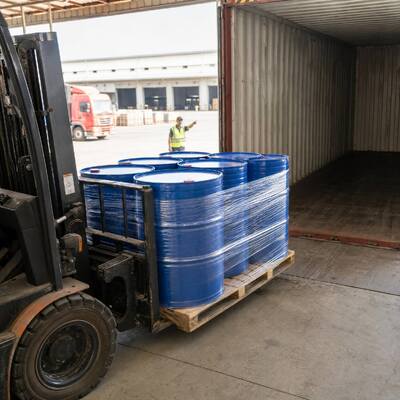
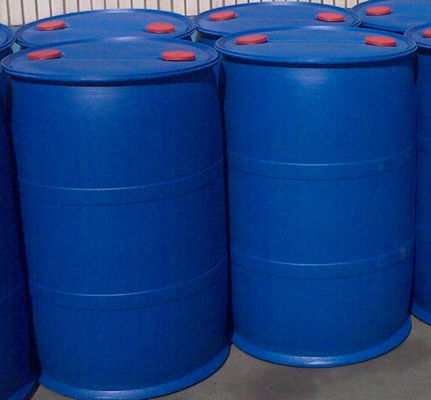
The standard pack is a 250 kg blue tight-head drum with food-grade lining and sealed bungs, labelled with product, grade, net weight and lot number. Drums are palletised four to a pallet and stretch-wrapped, with 80 drums per 20 ft container; for concentrate plants, 1000 kg food-grade IBC tanks with a bottom valve are available. Neutral or buyer-branded drums can be arranged, and loading is confirmed against the destination port and the pallet pattern requested.
Keep drums closed and upright in a store held between 15 °C and 30 °C, out of direct sunlight. Warm storage accelerates colour development, which is fatal in a clear drink, and cold storage raises viscosity and can start crystallisation at the drum wall. Draw just what a shift needs, reseal at once, and keep drums away from flavour essences and cleaning agents, since the syrup absorbs aromatics through an open bung. Part-used drums should be used before a new one is broached.
Food-Grade, Non-Crystallizing Grade – Specifically suited for beverage clarity and stability.
• Full Documentation – COA with every batch, plus FCC/JECFA/EU compliance statements available on request.
• Non-GMO, Plant-Based – Produced from non-GMO corn or wheat starch, no animal-derived inputs.
• Consistent Quality Every Drum – Stable 70% concentration and reliable performance batch after batch.
• Bulk Supply Ready – 250kg drums with flexible arrangements for trial orders or ongoing production.
• Export Experience – We understand the documentation and shipping requirements for international food ingredient supply.
Clarity measured, not assumed. Turbidity and ICUMSA colour are release tests on every lot, because haze and tint are the two defects a clear beverage cannot hide.
Sweetness profile support. Our technical team can model a partial sucrose replacement or a high-intensity blend against your target brix and acid level.
Concentrate handling. The syrup stays in solution and holds flavour dispersion in cold tanks, which keeps a concentrate uniform through the run.
Low reducing sugars. Held low to limit colour development in warm warehouse conditions, which protects a light-coloured drink through its shelf life.
Drum and IBC options. 250 kg sealed drums for smaller runs, 1000 kg food-grade IBC tanks for continuous concentrate production.
Documents before dispatch. Certificate of analysis, safety data sheet and packing list are issued with the booking, and container loading is confirmed per order