 |
| Place of Origin: | China |
| Brand Name: | Golden Grain |
| Certification: | ISO9001, ISO22000, HALAL, KOSHER |
| Model Number: | GLMA-02077 |
| Minimum Order Quantity: | 100kg |
|---|---|
| Price: | USD850-USD950/MT FOB QINGDAO, CHINA |
| Packaging Details: | 25kg/Bag with Paper Drum and PE Inner |
| Delivery Time: | 7 - 10 working days |
| Payment Terms: | L/C, T/T, D/P, D/A |
| Supply Ability: | 1000MT per month |
| Grade: | USP / BP / EP / FCC, Food Grade | Application / End Use: | Pharmaceutical Excipient, Chewable Tablet, Wet Granulation, Syrup Preparation |
|---|---|---|---|
| Function: | Diluent, Binder, Sweetening Vehicle, Humectant | Assay / Purity: | >= 98.0% (typical 99.5%) |
| Particle Size: | 20-60 Mesh | Heavy Metals: | <= 5 Ppm (as Pb); Lead <= 0.5 Ppm; Arsenic <= 1 Ppm |
| Synonyms / Other Names: | D-Glucitol, D-Sorbitol, Sorbit | CAS No. / E-Number: | 50-70-4 / E420 (INS 420) |
| Certification: | ISO 9001, ISO 22000, HACCP, Halal, Kosher | Packaging: | 25kg Kraft Bag With PE Inner Liner |
| HS Code: | 29054400 |
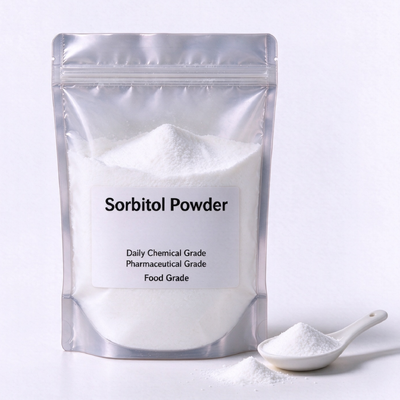
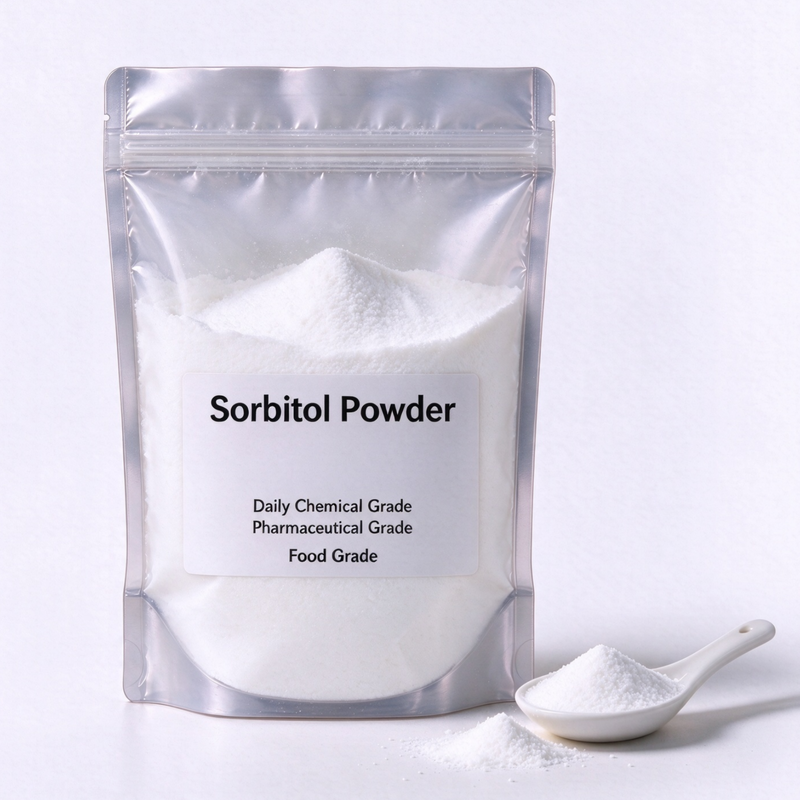
Our Sorbitol Powder (D-Glucitol, CAS 50-70-4, E420) is a white, crystalline granular material with a mild sweet taste, roughly half as sweet as regular sugar. It is a sugar alcohol derived from glucose and is one of the most widely used ingredients in pharmaceutical tablet manufacturing. This grade meets BP, USP, and EP pharmacopoeial standards, is supplied in 20–60 mesh granular form, and serves as a sweetener and humectant in tablet excipient applications.
Sorbitol has a long history in pharmacy. It is described as a humectant, plasticizer, sweetening agent, and tablet and capsule diluent, used extensively across pharmaceutical, cosmetic, and food industries. In tablets, it acts as a filler or diluent—giving the tablet its size and bulk while blending with active ingredients. It is particularly common in chewable tablets because of its sweet taste and pleasant mouthfeel.
The 20–60 mesh granular form is practical for tablet production. Granular sorbitol flows well, filling the tablet die evenly and helping produce tablets of consistent weight. The non-caking nature of this grade keeps the powder free-flowing in storage and during production, avoiding the lumps and flow interruptions that standard hygroscopic sorbitol can experience.
As a humectant, sorbitol holds onto moisture and helps maintain tablet stability over time. As a sweetener, it provides a clean, mild sweetness with a cooling sensation, making medicines more pleasant to take—especially for children and elderly patients. It is also non-cariogenic, meaning it does not contribute to tooth decay.
This product is packed in 25 kg PP bags, with bulk supply available for pharmaceutical and nutraceutical manufacturers.

| Parameter | Specification |
|---|---|
| Product name | Sorbitol Powder, D-Glucitol |
| CAS number / E number | 50-70-4 / E420 |
| Molecular formula / weight | C6H14O6 / 182.17 |
| Appearance | White crystalline powder, free flowing |
| Assay (dry basis) | 99.0% min |
| Particle size | 20-60 mesh, 90% min within range |
| Loss on drying | 0.5% max |
| Specific rotation | +4.0° to +7.0° (dry basis) |
| Total heavy metals (as Pb) | 5 mg/kg max |
| Grade / standard | BP, USP, EP |
The certificate of analysis issued for each shipment is the governing document.
| Test item | Typical result | Method |
|---|---|---|
| Assay (D-Glucitol) | 99.2% | HPLC |
| Appearance of solution | Clear and colourless | Visual |
| Particle size, 20-60 mesh | 94% within range | Sieve analysis |
| Loss on drying | 0.15% | Karl Fischer |
| Specific rotation | +5.4° | Polarimetry |
| Related substances | Within monograph limits | HPLC |
| Lead | < 1 mg/kg | ICP-MS |
| Nickel | < 1 mg/kg | ICP-MS |
| Total aerobic microbial count | < 100 cfu/g | Plate count |
| Total combined yeasts and moulds | < 10 cfu/g | Plate count |
Every lot is released against the monograph in force, and the certificate of analysis accompanies the shipment.
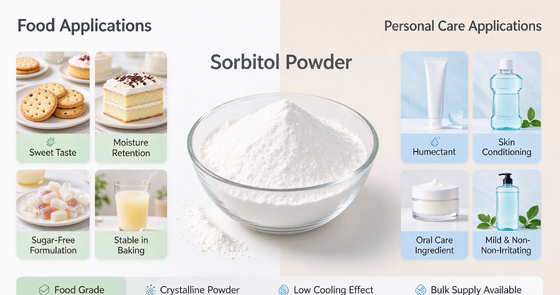
Pharmaceutical (Primary)
• Chewable tablets: Sweet taste and pleasant mouthfeel for vitamins, antacids, and other chewables
• Tablet filler: Diluent in wet granulation and direct compression formulations
• Capsules: Plasticizer for gelatin shell flexibility
• Sugar-free syrups: Sweetness and stability
Food & Confectionery
• Sugar-free candy and gum: Sweetness and cooling effect
• Tableted confectionery: Pressed mints and candy tablets
Personal Care
• Toothpaste and mouthwash: Moisture retention and mild sweetness
Charged as a dry component or as part of the granulating solution, sorbitol dissolves and re-crystallises during drying to bind the primary particles. The result is a granule with enough mechanical strength to survive pneumatic transfer without generating the fines that cause weight variation at the press.
Where the active makes up a fraction of a percent of the tablet weight, the diluent carries the blend. Sorbitol's solubility allows it to be deposited on the active during granulation, which improves content uniformity and reduces the segregation risk that a simple dry blend would carry.
Degradation in storage is often driven by residual water in the tablet matrix rather than by water in the pack. A sorbitol base holds little free water and takes up little in service, so hydrolysis and other water-mediated reactions are slowed without changing the packaging format.
For chewable and dispersible formats needing a non-cariogenic base, sorbitol provides bulk and a clean sweetness with a cooling note, and it does not promote the tooth decay associated with sucrose-based tablets.
These formats are packed in foil because atmospheric moisture destroys them. A diluent with low hygroscopicity keeps the blend dry enough to handle in an open room, which reduces sticking on the press and extends the working time of the bulk before packing.
Typical use is 20-60% of tablet weight as the diluent, adjusted against the active dose, the chosen binder system and the target hardness; granulation trials remain the dependable way to fix the final level.
Each lot is tested against the BP, USP and EP monographs for assay, appearance of solution, loss on drying, specific rotation, related substances, lead and nickel, with microbiological counts run on the finished powder. Elemental impurity testing is carried out by ICP-MS, and results are reported numerically against the limits rather than as a simple conformity statement.
The lot number on the bag links to the crystallisation batch and the packing record, and retained samples are kept for the full retest period so that stability questions can be answered against the material supplied. Documentation is issued in a format suitable for inclusion in a supplier qualification file.
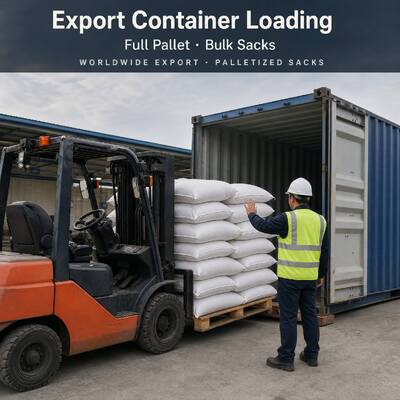
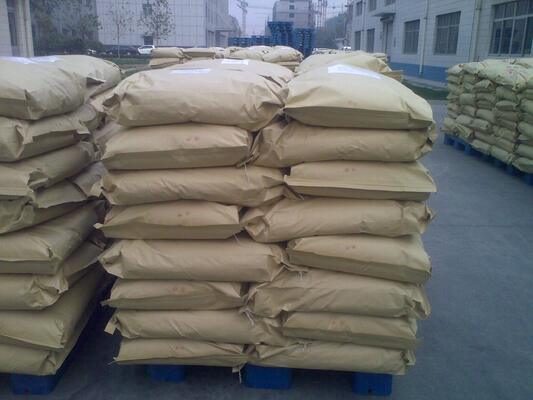
The powder is packed in 25kg PP woven bags with a food-contact PE liner, heat-sealed to protect the contents from humidity in transit. Palletised, shrink-wrapped units are available on request, and neutral or buyer-labelled printing is offered for bulk orders. Loading is confirmed per order against the destination port, and full container, LCL and mixed shipments are all handled, with the certificate of analysis issued before the container leaves.
Store in a cool, dry, well-ventilated area away from sunlight, off the floor and clear of condensing walls, and do not keep the bags alongside odorous chemicals. Avoid temperatures above 40°C and repeated opening of the liner. Original unopened bags stay free flowing for 24 months under these conditions; once a bag is opened, reseal it promptly and consume the remainder within the current manufacturing campaign.
Compendial testing on every lot. Assay, related substances, specific rotation, loss on drying, lead and nickel are run against the BP, USP and EP monographs before release, and the results are issued as a lot-specific certificate.
Particle size suited to granulation. A 20-60 mesh cut gives the granulator a consistent starting point, and the distribution is measured by sieve analysis rather than assumed from the mill setting.
Production in our own facility. Crystallisation, milling and packing are under one roof, so the physical form you qualify during trials is what repeats on commercial deliveries.
Documentation for supplier qualification. Specification sheets, safety data sheets, lot-linked certificates and additional statements can be prepared against your quality agreement and audit checklist.
Low moisture, verified. Water in the diluent becomes water in the tablet. Loss on drying is held at a tight ceiling and reported per lot, which supports stability work on moisture-sensitive actives.
Packing and paperwork aligned. 25kg lined PP bags, palletised or floor-loaded to suit the receiving warehouse, with booking documents, packing list and COA issued ahead of dispatch.
Technical review before scale-up. Our team will go through the diluent level, binder interaction and compression behaviour with your formulation group so the first production batch is not the first test.