 |
| Place of Origin: | China |
| Brand Name: | Golden Grain |
| Certification: | ISO9001, ISO22000, HALAL, KOSHER |
| Model Number: | GLMA-02058 |
| Minimum Order Quantity: | 100kg |
|---|---|
| Price: | USD850-USD950/MT FOB QINGDAO, CHINA |
| Packaging Details: | 25kg/Bag with Paper Drum and PE Inner |
| Delivery Time: | 7 - 10 working days |
| Payment Terms: | L/C, T/T, D/P, D/A |
| Supply Ability: | 1000MT per month |
| Particle Size: | 80-120 Mesh | Grade: | Food Grade / FCC |
|---|---|---|---|
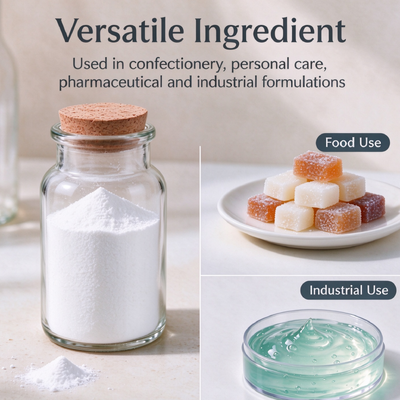
| Application / End Use: | Confectionery Coating, Tablet Compression, Toothpaste, Powdered Beverage Mix | Function: | Sweetener, Humectant, Bulking Agent |
| Form & Appearance: | White Crystalline Fine Powder, Free-Flowing, Non-Caking | Synonyms / Other Names: | D-Glucitol, D-Sorbitol, Sorbit |
| CAS No. / E-Number: | 50-70-4 / E420 (INS 420) | Certification: | ISO 9001, ISO 22000, HACCP, Halal, Kosher |
| Packaging: | 25kg Kraft Bag With PE Inner Liner | HS Code: | 29054400 |
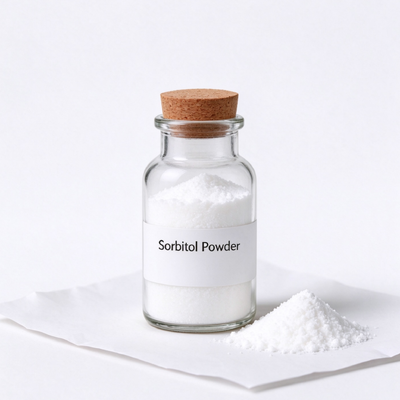
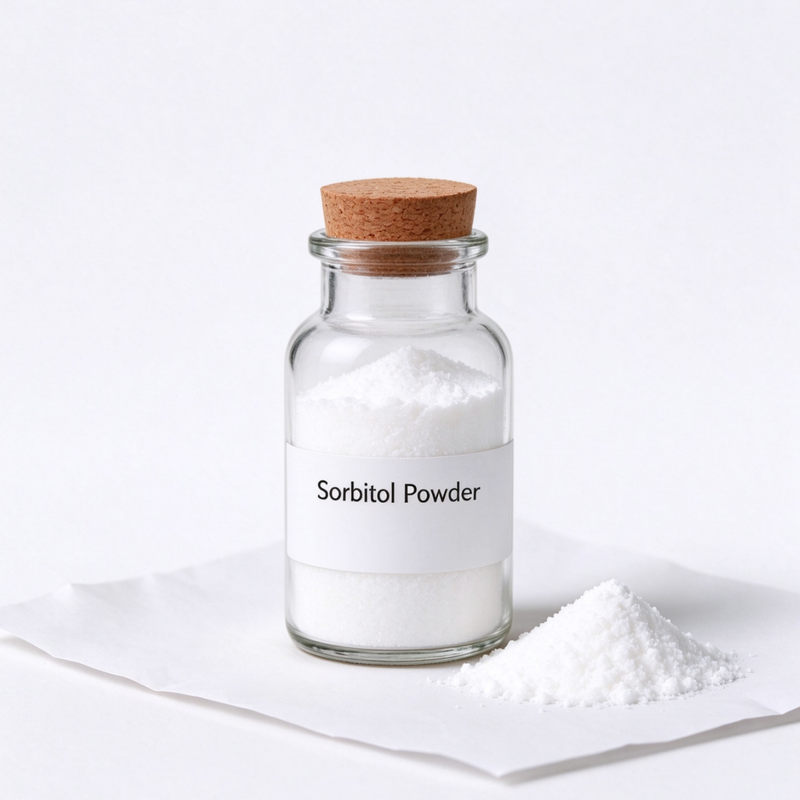
Our Sorbitol Powder (D-Glucitol, CAS 50-70-4, E420) is a white, crystalline powder with a mild sweet taste, about 60% as sweet as regular sugar. It is a sugar alcohol made from glucose and is widely used in baking to keep cakes and pastries soft, fresh, and appealing. This grade is supplied in 80–120 mesh fine powder form, treated to stay non-caking, and packed in 25kg PP bags.
In baking, sorbitol does something sugar alone cannot: it holds onto moisture. When you bite into a slice of cake or a pastry that stays soft days after baking, sorbitol is often part of the reason. It helps baked goods retain water, preventing them from drying out, becoming crumbly, or going stale too quickly. For commercial bakers, this means a longer shelf life and a product that still looks and tastes good when it reaches the customer.
Sorbitol also works as a sweetener, contributing a clean, mild sweetness. Because it is less sweet than sugar, it allows bakers to reduce overall sweetness without losing the bulk and texture that sugar provides. In some formulations, this means you can “de-sweeten” a product while keeping its structure intact. Sorbitol is also non-cariogenic—it does not feed the bacteria that cause tooth decay, which is a nice bonus for products positioned as tooth-friendly or sugar-free.
The non-caking property matters in a bakery environment. Standard sorbitol can absorb moisture from the air and form lumps, which disrupts weighing, blending, and automated dosing. This grade stays free-flowing, so it moves smoothly through production without interruptions. The 80–120 mesh fine powder disperses evenly into cake batters and pastry doughs, ensuring uniform sweetness and moisture distribution throughout the batch.
| Parameter | Specification |
|---|---|
| Product name | Sorbitol Powder, D-Glucitol |
| CAS number / E number | 50-70-4 / E420 |
| Appearance | White crystalline powder, free flowing, no visible foreign matter |
| Assay (dry basis) | 99.0% min |
| Particle size | 80-120 mesh, 95% min passing |
| Moisture (loss on drying) | 0.5% max |
| Reducing sugars | 0.2% max |
| Residue on ignition | 0.1% max |
| Total heavy metals (as Pb) | 5 mg/kg max |
| Grade / standard | Food Grade, FCC |
The certificate of analysis issued for each shipment is the governing document.
| Test item | Typical result | Method |
|---|---|---|
| Assay (D-Glucitol) | 99.2% | HPLC |
| Appearance | White crystalline powder | Visual |
| Particle size, 80-120 mesh | 97% pass | Sieve analysis |
| Moisture | 0.14% | Karl Fischer |
| Reducing sugars | 0.05% | Titrimetric |
| Residue on ignition | 0.03% | Gravimetric |
| Total heavy metals | < 5 mg/kg | Colorimetric |
| Arsenic | < 2 mg/kg | AAS |
| Total plate count | < 1000 cfu/g | Plate count |
| E. coli | Absent | Plate count |
A certificate of analysis is issued for every production lot, and a safety data sheet is available on request.
Baking (Primary)
Cakes and sponges: moisture retention and softness
Pastries and viennoiserie: shelf life extension and texture improvement
Cookies and biscuits: freshness and reduced drying
Fillings and frostings: moisture control and smooth texture
Food & Confectionery
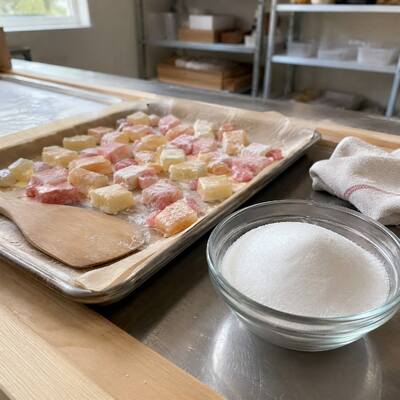
Sugar-free candy and chocolate: sweetness and bulk
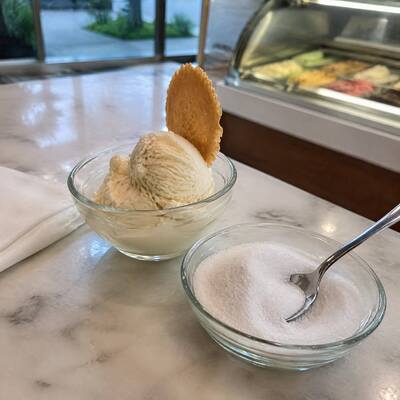
Ice cream and frozen desserts: texture and crystallization control
Personal Care
Toothpaste and mouthwash: moisture retention and mild sweetness
Replacing 10-20% of the sucrose with sorbitol keeps the crumb open and springy after cooling and reduces the dry, crumbly edge that shows up once a sponge has been sliced and packed. Because the polyol does not crystallise in the crumb, the cut face stays clean instead of forming a sugary crust.
In high-fat, low-water batters the moisture is tightly bound by the fat phase, and the cake firms quickly once wrapped. Sorbitol extends the moist window without adding water activity that would put the shelf-life target at risk, and it keeps the centre from drying at the slice line.
Graining is the usual complaint on a glazed pastry: the syrup is supersaturated, sucrose seeds out, and the surface turns dull and grainy. Sorbitol adds solids and viscosity to the boil while keeping sucrose below its saturation point, so the glaze sets with a smooth, glossy film that resists chipping in the pack.
Fillings release water into the sponge or the pastry shell over time, softening the interface and leaving the cake dry. Sorbitol binds part of that water in the filling and limits syneresis in fruit-based systems, so the deposit stays firm and does not bleed into the crumb.
Freeze-thaw cycling in gateaux and frozen slices causes ice crystal growth that ruptures the air cells and leaves the defrosted product collapsed and wet. Sorbitol lowers the free water available for crystal growth and keeps the crumb structure intact through the chain.
Typical use is 3-8% on batter weight or 2-5% on filling weight, adjusted against the existing sugar load, the water activity target and the required shelf life; a higher loading softens the crumb and may need a small increase in bake time.
Released batches are tested for assay by HPLC, moisture by Karl Fischer and particle size by sieve analysis, with reducing sugars, residue on ignition, heavy metals, arsenic and microbiological counts checked against the specification. Where a buyer requires it, colour and odour are assessed against a retained reference sample under standard lighting.
Each bag carries a lot code that links back to the crystallisation run, the packing line and the release record. Samples from every lot are retained so a query raised months later can be re-tested against the original material rather than against a fresh batch.
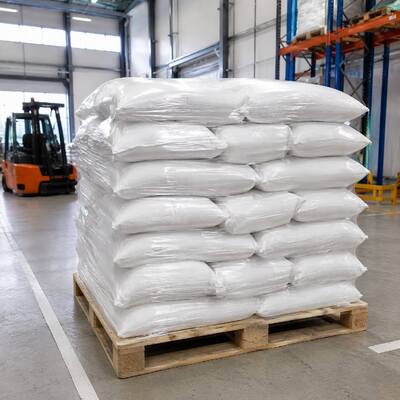
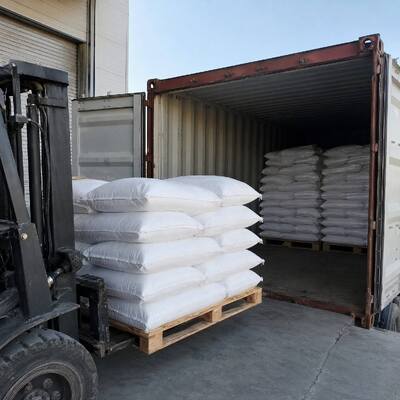
Powder is packed in 25kg PP woven bags with a food-contact PE inner liner, heat-sealed to keep moisture out on the water. Palletised and shrink-wrapped units are available on request, and bags can be printed with neutral or buyer artwork for bulk orders. Loading plans are confirmed per order against the port of destination, with full container, LCL and mixed shipments all arranged and the certificate of analysis issued before the container is sealed.
Keep bags in a cool, dry, ventilated store, off the floor and clear of walls that condense, away from sunlight and from any strong-smelling goods, as the powder absorbs odours. Do not stack against heated surfaces or store above 40°C for extended periods. Sealed original bags hold their free-flowing condition for 24 months; after opening, close the liner tightly and use the contents within the production cycle.
Consistent granulation for batter rooms. Fines and oversize particles both change how a dry blend wets out. Sieving is controlled batch by batch, so the 80-120 mesh profile your trial was based on is repeated on the next delivery.
Food Grade release testing on every lot. Assay, moisture, particle size, heavy metals, arsenic and microbiological counts are run before the bag is released, and the results travel with the goods as a certificate of analysis.
Plant-direct supply. Crystallisation, drying, milling and packing sit in one facility, which keeps the specification stable and removes the margin a trading house would add between producer and buyer.
Documentation ready for audit. Specification sheets, safety data sheets and lot-linked certificates are issued in the format your quality team works with, and additional statements can be prepared against your own template on request.
Flexible packing and load building. 25kg lined PP bags as standard, palletised or floor-loaded to suit the receiving dock, with neutral or buyer-labelled printing for larger volumes.
Technical dialogue before the first order. Cake and filling systems behave differently at different water activities. Our team will review the addition rate against your sugar load and shelf-life target so the trial starts from a sensible point.