 |
| Place of Origin: | China |
| Brand Name: | Golden Grain |
| Certification: | ISO9001, ISO22000, HALAL, KOSHER |
| Model Number: | GLMA-02053 |
| Minimum Order Quantity: | 100kg |
|---|---|
| Price: | USD850-USD950/MT FOB QINGDAO, CHINA |
| Packaging Details: | 25kg/Bag with Paper Drum and PE Inner |
| Delivery Time: | 7 - 10 working days |
| Payment Terms: | L/C, T/T, D/P, D/A |
| Supply Ability: | 1000MT per month |
| Grade: | USP / BP / EP / FCC, Food Grade | Application / End Use: | Pharmaceutical Excipient, Chewable Tablet, Wet Granulation, Syrup Preparation |
|---|---|---|---|
| Function: | Diluent, Binder, Sweetening Vehicle, Humectant | Assay / Purity: | >= 98.0% (typical 99.5%) |
| Particle Size: | 80-120 Mesh | Heavy Metals: | <= 5 Ppm (as Pb); Lead <= 0.5 Ppm; Arsenic <= 1 Ppm |
| Synonyms / Other Names: | D-Glucitol, D-Sorbitol, Sorbit | CAS No. / E-Number: | 50-70-4 / E420 (INS 420) |
| Certification: | ISO 9001, ISO 22000, HACCP, Halal, Kosher | Packaging: | 25kg Kraft Bag With PE Inner Liner |
| HS Code: | 29054400 |
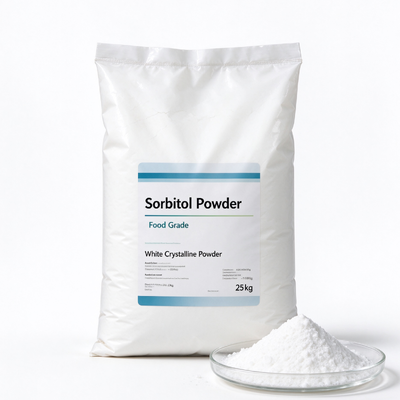
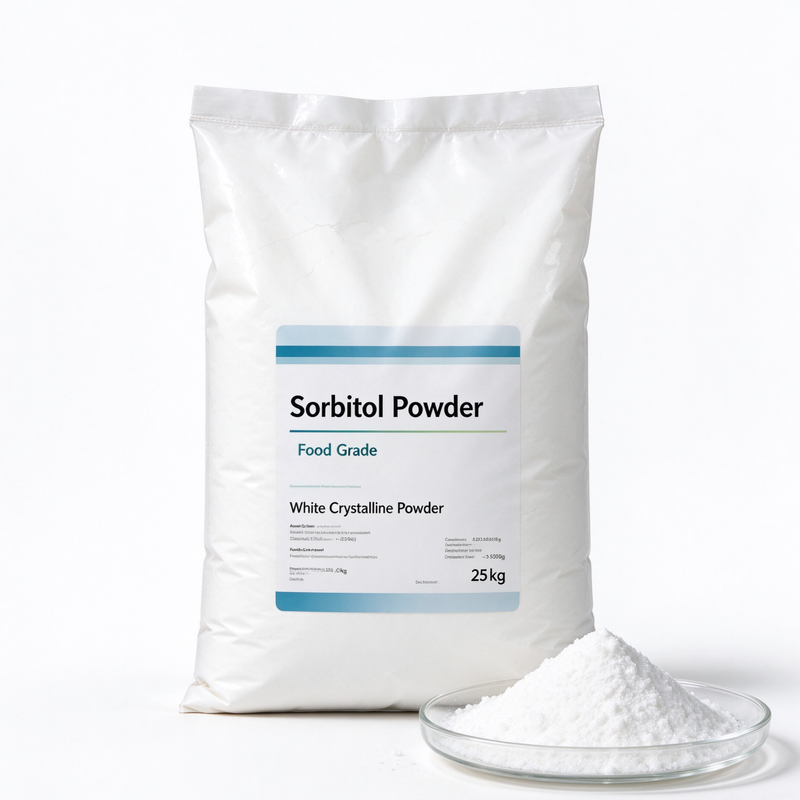
Our Sorbitol Powder (D-Glucitol, CAS 50-70-4, E420) is a white, crystalline powder with a mild sweet taste, roughly half as sweet as regular sugar. It is a sugar alcohol derived from glucose and is widely used in medicines, foods, and personal care products. This grade meets BP, USP, and EPpharmacopoeial standards, is milled to 80–120 mesh, and is specifically suited for chewable tabletmanufacturing.
Sorbitol is perhaps best known in the pharmaceutical world for its role in chewable tablets. Because it tastes sweet and feels pleasant in the mouth, it is commonly used as a tablet filler in chewable formulations, reducing or eliminating the need for extra sweeteners or flavor masking . When you chew a vitamin tablet or an antacid tablet that tastes mildly sweet and feels smooth rather than gritty, sorbitol is often part of the reason.
Beyond its taste, sorbitol is a humectant—it holds onto moisture and keeps products from drying out. In tablets, this helps maintain stability over time. In other pharmaceutical applications, sorbitol also serves as a plasticizer for capsule shells and as a stabilizer in sugar-free syrups and liquid medicines .
The 80–120 mesh particle size is a fine powder grade. For chewable tablets, this matters because finer particles disperse smoothly and evenly during tableting, helping produce tablets with consistent texture and mouthfeel. The powder flows well in tablet presses and blends uniformly with active ingredients.
This product is packed in 25 kg PP bags, with bulk supply available for pharmaceutical and nutraceutical manufacturers.

| Parameter | Specification |
|---|---|
| Product name | Sorbitol Powder, D-Glucitol, chewable tablet grade |
| CAS number / E number | 50-70-4 / E420 |
| Appearance | White crystalline powder, free flowing, no agglomerates |
| Assay (dry basis) | 99.0% min |
| Particle size | 80-120 mesh, 95% min passing |
| Loss on drying | 0.5% max |
| Specific rotation | +4.0° to +7.0° (dry basis) |
| Total heavy metals (as Pb) | 5 mg/kg max |
| Microbiological limits | TAMC 1000 cfu/g max, yeasts and moulds 100 cfu/g max |
| Grade / standard | BP, USP, EP |
The certificate of analysis issued for each shipment is the governing document.
| Test item | Typical result | Method |
|---|---|---|
| Assay (D-Glucitol) | 99.2% | HPLC |
| Appearance | White crystalline powder | Visual |
| Particle size, 80-120 mesh | 96% pass | Sieve analysis |
| Loss on drying | 0.16% | Karl Fischer |
| Specific rotation | +5.5° | Polarimetry |
| Related substances | Within monograph limits | HPLC |
| Lead | < 1 mg/kg | ICP-MS |
| Nickel | < 1 mg/kg | ICP-MS |
| Total aerobic microbial count | < 100 cfu/g | Plate count |
| E. coli | Absent | Plate count |
Every lot is released against the monograph in force, and the certificate travels with the shipping documents.
Sweet Taste, Pleasant Mouthfeel
Sorbitol provides a mild, clean sweetness with a cooling sensation. In chewable tablets, this makes the product more pleasant to take—especially important for children’s vitamins, antacids, and other chewable medicines where taste affects compliance .
Tablet Filler
Sorbitol acts as a diluent or filler, giving the tablet its size and bulk. It blends well with active ingredients and helps ensure each tablet contains a consistent dose.
Moisture Control
As a humectant, sorbitol helps the tablet maintain stability and prevents it from drying out or becoming brittle over time.
Fine 80-120 Mesh Powder
The fine mesh size disperses evenly during tableting, supporting smooth texture and uniform tablet quality.
Pharmaceutical (Primary)
• Chewable tablets: Sweet taste and pleasant mouthfeel for vitamins, antacids, and other chewable medicines
• Capsules: Helps keep the shell flexible
• Sugar-free syrups: Sweetness and stability
• Lozenges: Sweetness and cooling sensation
Food & Confectionery
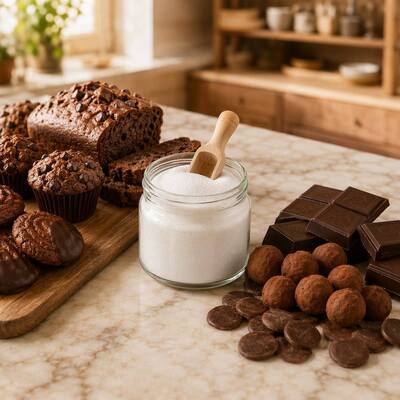
• Sugar-free candy and gum: Sweetness and cooling effect
• Tableted confectionery: Pressed mints and candy tablets
Personal Care
• Toothpaste and mouthwash: Moisture retention and mild sweetness
Vitamin premixes often carry a bitter or metallic note that a sweetener has to cover. A fine sorbitol base dissolves rapidly in saliva, releases sweetness across the chew rather than in a single hit, and its cooling effect softens the aftertaste, which is why it appears in multivitamin and vitamin C chewables.
Antacid actives are alkaline and abrasive, and a coarse base adds a gritty note of its own. The 80-120 mesh cut gives a smooth, soft chew, and the tablet still reaches enough hardness to survive blistering and transport without crumbling at the edges.
Small tablets for children need to break easily under a milk tooth yet stay intact in the pack. Sorbitol compacts at low force, so the tablet can be soft without falling below the friability limit, and it carries no cariogenic sugar.
Plant extracts bring colour, hygroscopicity and a strong taste. A non-hygroscopic base limits moisture migration from the extract into the tablet matrix, which reduces darkening and softening, and the sweetness level can be raised without adding a reducing sugar that would brown in storage.
Where a cooling sensation is part of the product, sorbitol's heat of solution supplies it directly. Blending the fine cut with a small amount of a mint or eucalyptol system gives a longer cooling curve than either component alone.
Typical use is 40-80% of tablet weight, adjusted against the active load, the chosen lubricant and the chew texture being targeted; compression force is usually set as low as friability allows.
Testing against the BP, USP and EP monographs covers assay, related substances, specific rotation, loss on drying and elemental impurities, with microbiological counts on the finished powder. For this grade the particle size result is reported with the full distribution, since the fraction passing 120 mesh drives both mouthfeel and the dusting behaviour on the press.
The lot code on the bag links the delivery to its crystallisation batch and packing record. Retained samples are kept for the retest period, and where a customer is validating mouthfeel, a reference sample from the approved lot can be held for side-by-side comparison.
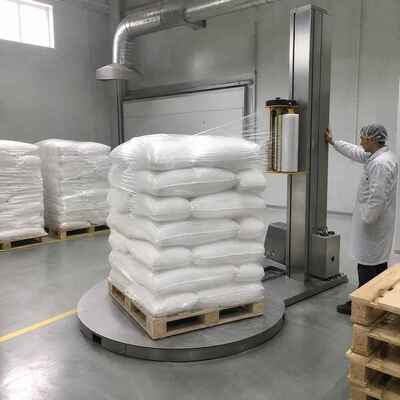
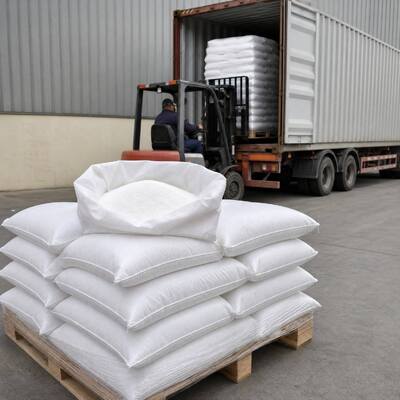
Powder is supplied in 25kg PP woven bags with a food-contact PE liner, heat-sealed to keep humidity out during the sea leg. Pallets can be shrink-wrapped on request, and bags can be printed neutral or with buyer artwork for bulk orders. Loading is confirmed per order against the destination port, and full container, LCL and mixed shipments are all arranged with the certificate of analysis issued before dispatch.
Store in a cool, dry, ventilated warehouse, away from sunlight, off the floor and clear of condensing walls, and do not keep bags near odorous goods or solvents, as the powder takes up foreign smells. Avoid storage above 40°C. Unopened original bags remain free flowing for 24 months under these conditions; after opening, reseal the liner and use the balance within the current production run.
Fine cut for a smooth chew. The 80-120 mesh distribution is sieved and reported per lot, because a shift toward coarse particles is felt immediately on the tongue even when the assay is unchanged.
Compendial release testing. Assay, related substances, specific rotation, loss on drying, lead and nickel are tested against the BP, USP and EP monographs, with microbiological counts reported on each certificate.
Compression behaviour you can plan around. The crystalline habit deforms plastically, so chewable tablets reach a soft, biteable texture at low force while staying above the friability limit for blister packing.
Own plant, stable specification. Milling, classification and bagging happen at our facility, keeping the physical form consistent from the qualification batch through to repeat orders.
Documents for your quality file. Specification sheets, safety data sheets and lot-linked certificates are issued ready for supplier qualification, and additional statements can be prepared to your template.
Packing to suit the line. 25kg lined PP bags, palletised or floor-loaded as required, with neutral or buyer-labelled printing for bulk volumes.
Formulation support. If the chew is too hard, too friable or too sweet, the fix usually sits in the base level and the lubricant. Our technical team will work through the options with your development group.