 |
| Place of Origin: | China |
| Brand Name: | Golden Grain |
| Certification: | ISO9001, COA,SDS |
| Model Number: | GLMA-01771 |
| Minimum Order Quantity: | 100kg |
|---|---|
| Price: | USD1.00-USD1.65/KG FOB QINGDAO, CHINA |
| Packaging Details: | 25kg/Bag with Paper Drum and PE Inner |
| Delivery Time: | 7 - 10 working days |
| Payment Terms: | L/C, T/T, D/P, D/A |
| Supply Ability: | 1000MT per month |
| Sweetness Level: | Approximately 70-90% Of Sucrose | Ins: | INS:965 |
|---|---|---|---|
| Hygroscopicity: | Low To Moderate | Appearance: | Crystalline |
| Glycemic Index: | 35 | E Number: | E965 |
| Molecularweight: | 344.31 G/mol | Taste Profile: | Sweet With Cooling Effect |
| Allergen Information: | GRAS, Non‑allergenic | Production Source: | Hydrogenation Of Maltose |
| Chemical Formula: | C12H24O11 |
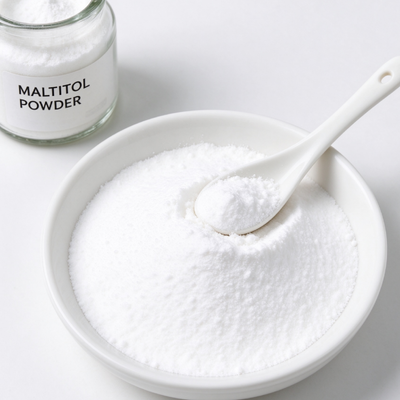
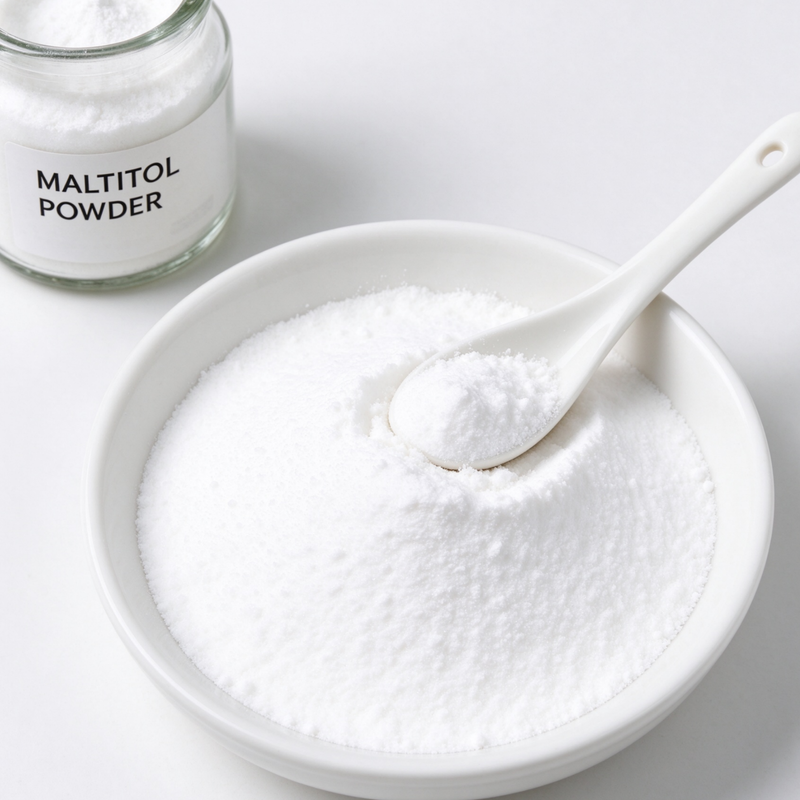
Maltitol Powder is a crystalline sugar alcohol (polyol) made by hydrogenating high-maltose glucose syrup. It delivers about 90% of sucrose sweetness with a clean taste and no bitter aftertaste, while providing the bulk and mouthfeel that high-intensity sweeteners cannot.
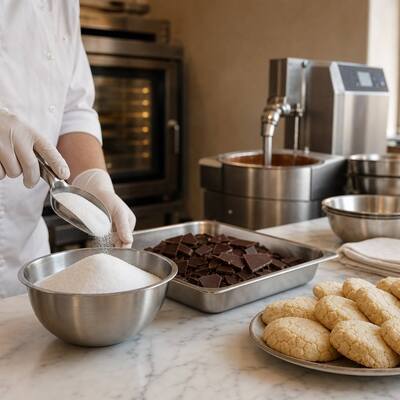
In practical terms, it is used as a bulk sugar replacement in sugar-free hard candy, chewing gum, mints, chocolate and compound coatings, reduced-sugar cookies and biscuits, cereal bars, ice cream, and sugar-free beverages. It also serves as a sweetener and excipient in nutraceutical and pharmaceutical products such as chewable tablets, lozenges, sachets, and stick packs.
What makes maltitol relevant for low-glycemic product development is its glycemic index. Published data places crystalline maltitol at a GI of around 35, compared to roughly 65 for table sugar. For formulators targeting diabetic-friendly, low-GI, or sugar-reduced products, this means maltitol can replace sucrose in many recipes while producing a lower postprandial blood glucose response. It also carries about half the calories of sugar—approximately 2.1–2.4 kcal/g versus 4 kcal/g for sucrose—making it useful for reduced-calorie formulations as well.
Maltitol behaves much like sugar in processing. It provides bulk and volume, retains moisture, controls crystallization in coatings, and does not participate in Maillard browning. For buyers reformulating existing products, this means a near one-to-one replacement is often possible without significant process changes.

| Parameter | Specification |
|---|---|
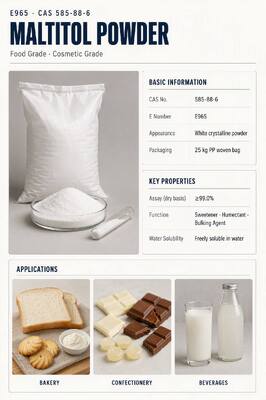
| Product name | Maltitol Powder |
| Chemical name | D-Maltitol |
| CAS number | 585-88-6 |
| E number | E965 |
| Appearance | White crystalline powder, free flowing |
| Assay (dry basis) | 99.0% min |
| Glycemic index (glucose = 100) | Around 35 |
| Energy value | 2.1 kcal/g (8.8 kJ/g) |
| Mesh / Moisture | 30-80 / 0.5% max |
| Grade / Packaging | Food Grade / 25kg PP woven bag with PE inner liner |
The certificate of analysis issued for each shipment is the governing document.
| Test item | Typical result | Method |
|---|---|---|
| Assay (D-Maltitol) | 99.3% | HPLC |
| Maltitol content on dry basis | 99.4% | HPLC |
| Glucose and maltose (total) | < 0.5% | HPLC |
| Appearance | White powder, free flowing | Visual |
| Mesh distribution (30-80) | 96% pass | Sieve analysis |
| Moisture | 0.17% | Karl Fischer |
| Residue on ignition | 0.02% | Gravimetric |
| Total heavy metals (as Pb) | < 5 mg/kg | Colorimetric |
| Total plate count | < 500 cfu/g | Plate count |
| Yeast and mould | < 50 cfu/g | Plate count |
Low Glycemic Response
Crystalline maltitol has a GI of approximately 35, significantly lower than sucrose's GI of about 65. This supports low-GI and diabetic-friendly product positioning.
Sugar-Free & Reduced Calorie
At roughly 2.1–2.4 kcal/g versus 4 kcal/g for sucrose, maltitol enables meaningful calorie reduction without sacrificing the bulk and texture that sugar provides.
Non-Cariogenic — Tooth-Friendly
Maltitol is not fermented by oral bacteria that produce caries-causing acids. It supports "tooth-friendly" and "does not promote tooth decay" claims on sugar-free gum, mints, and confectionery.
Near Sucrose-Like Functionality
Provides bulk like sugar, retains moisture, prevents crystallization in coatings, and does not brown during baking. Reformulation stays straightforward.
Replacing sucrose at 30 to 50 percent of the formula keeps the moulding behaviour, the snap and the melt while lowering both the sugar content and the glycemic load of the finished piece. The bulk of the maltitol also carries the cocoa solids the way sugar did, so the refiner setting does not need to be rebuilt from scratch.
A bar binder has to hold the mass together over shelf life without turning hard. Maltitol supplies the plasticity and the sweetness, and its lower glycemic contribution fits the positioning that most bar brands are already making on the front of the pack.
In a reduced-sugar biscuit, maltitol keeps the dough workable and the baked piece tender, so the sugar reduction does not have to be paid for with a dry, crumbly texture that consumers notice immediately.
The freezing point depression from maltitol is lower than from the same weight of sucrose, so a reduced-sugar mix freezes with a firmer body and less icy mouthfeel than a straight sugar replacement would allow.
For a sugar-free candy or pellet gum, the bulk and the crystalline structure come from the polyol, and the glycemic positioning is carried by the base rather than by a sweetener blend that has to be declared separately.
Every batch is tested before shipment for purity, moisture, reducing sugars, heavy metals, and microbiological safety. A Certificate of Analysis reporting actual results for your specific lot ships with every order. Batch codes on each 25 kg bag link to retained samples kept for the full shelf life, so any question about a delivery can be traced back quickly.
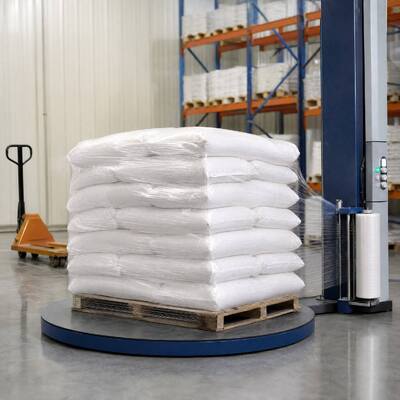
Standard shipment is 25kg PP woven bags with a food-grade PE inner liner, heat-sealed, palletised 40 bags to a tonne or loaded loose for hand-stacked containers. Bags carry the product name, net weight, lot code and a storage line, and the pallet label repeats the lot so a warehouse can book a delivery without opening a sack. Neutral bags and buyer artwork are available for bulk orders, and full container, LCL and mixed shipments are all arranged. Documents and certificate of analysis are issued before dispatch.
Store in a cool, dry, well-ventilated warehouse away from direct sunlight, with bags closed and off the floor. The powder is stable at ambient temperature but will cake if it takes up moisture, and a caked bag is hard to blend evenly, which is exactly the unevenness a reduced-sugar formula cannot absorb. Keep the store free of strong odours and rotate on a first-in, first-out basis. In unopened original packaging kept dry, the grade holds its specification for 24 months.
Low GI grade: Meets E965(i) specification, suitable for low-glycemic and sugar-free product claims
Batch consistency: Every lot tested and released against agreed specification before shipment
Export-ready packaging: 25 kg PP bags designed for sea freight stability
Flexible volumes: From trial orders to full container loads
Technical support: Guidance on maltitol use in sugar-free candy, chocolate, and bakery applications