 |
| Place of Origin: | China |
| Brand Name: | Golden Grain |
| Certification: | ISO9001, COA,SDS |
| Model Number: | GLMA-01771 |
| Minimum Order Quantity: | 1300kg |
|---|---|
| Price: | USD450-USD550/MT FOB QINGDAO, CHINA |
| Packaging Details: | 250kg/drum, 270kg/drum, 275kg/drum with new plastic drum, 1300kg IBC drum, flexible bag |
| Delivery Time: | 7 - 10 working days |
| Payment Terms: | L/C, T/T, D/P, D/A |
| Supply Ability: | 1000MT per month |
| Active Ingredient: | Sorbitol | Chemical Formula: | C₆H₁₄O₆ |
|---|---|---|---|
| Freezingpoint: | Below 0°C (depends On Concentration) | Cas: | 50-70-4 |
| Odor: | Odorless | Standard: | BP, USP, EP, FCC |
| Sorbitol Content: | 68‑72% | Viscosity: | High Viscosity Viscous Liquid |
| Molecularweight: | 182.17 G/mol | Packing: | 1300kg/drum, IBC Drum |
| Usage: | Toothpaste, Cosmetics | Ph: | 4.5 - 7.0 |
| Type: | Non-Crystallizing | Boilingpoint: | Not Applicable (aqueous Solution) |
| Shelf Life: | 2 Years |
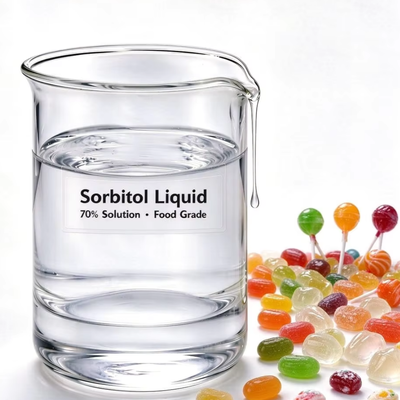
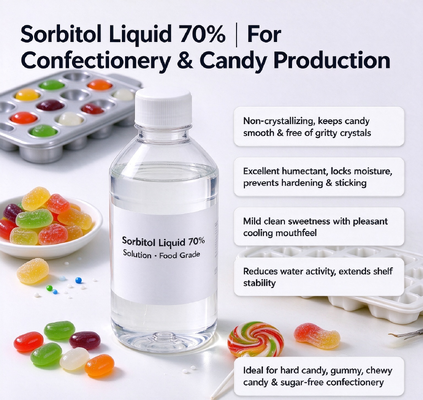
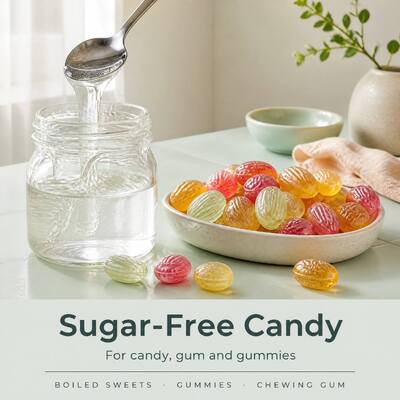
Our Sorbitol Solution 70% is a non-crystallizing, food-grade syrupy liquid manufactured for candy and confectionery applications where crystal formation would compromise texture and appearance. Chemically identified as D-Glucitol (E420, INS 420(ii), CAS 50-70-4), it is a plant-derived sugar alcohol that functions as a sweetener, humectant, and anti-crystallizing agent. Typical specification. The certificate of analysis issued for each shipment is the governing document. Every drum is released against a certificate of analysis, and a safety data sheet accompanies the shipping documents on request. High-boiled candy. Replacing 10-25% of the sugar solids keeps the glass clear through the drop roller, and the non-crystallizing syrup suppresses the seeding that shows up as white streaks on the sweet surface.Product Overview
The non-crystallizing designation is defined by its composition. According to JECFA specifications, non-crystallizing sorbitol syrup contains D-sorbitol alongside hydrogenated oligosaccharides formed during glucose hydrogenation — these oligosaccharides are what prevent crystallization in the finished product. This makes it fundamentally different from standard sorbitol solutions that tend to crystallize under storage or processing conditions.
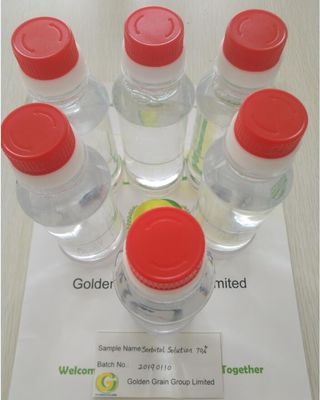
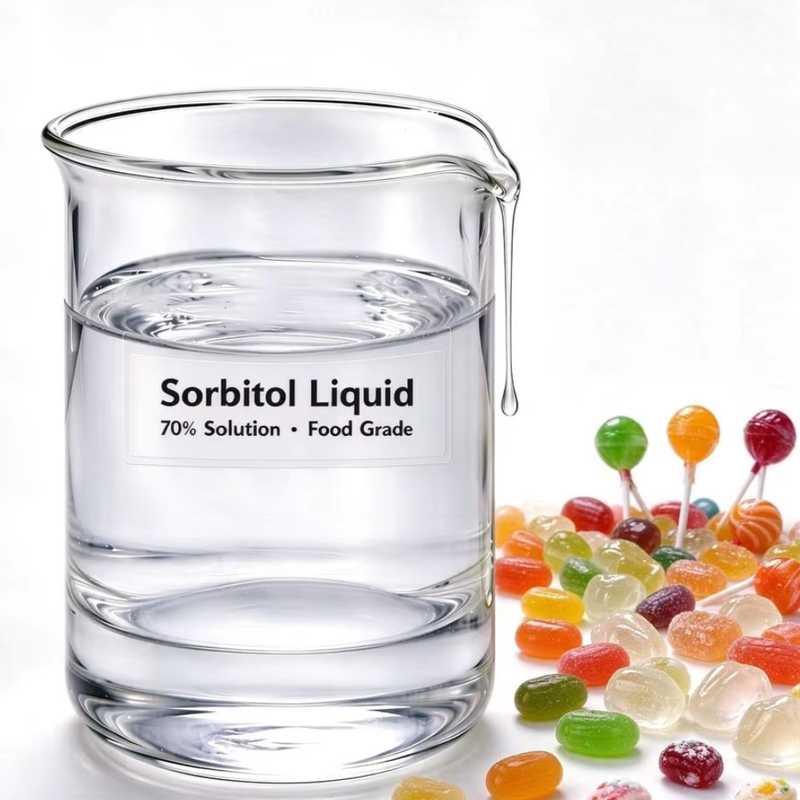
Sorbitol Solution 70% is an aqueous syrup of D-Glucitol, supplied at 70% dry substance in a clear, colourless, viscous liquid form. It is non-crystallizing by design, which separates it from a crystalline sorbitol grade and makes it the practical choice for a candy kitchen that doses sweetener through a pump and a flow meter rather than by weighing bags into a mixer.
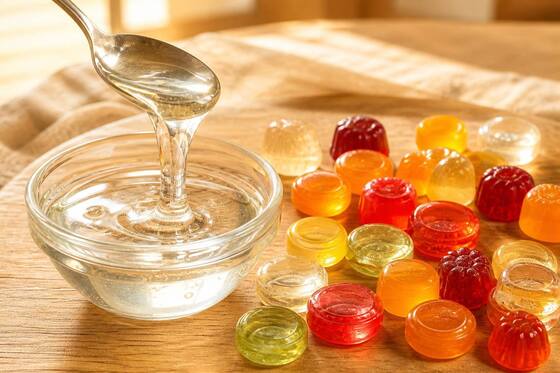
The problem it solves on a boiled sweet line is graining. A sucrose and glucose syrup blend cooked to a glass is supersaturated, and any seed crystal, dust particle or cold spot at the drop roller can start a chain of nucleation that turns a clear sweet opaque and gritty. Sorbitol interrupts that chain. Because the syrup itself does not crystallise, it keeps the continuous phase mobile while the glass sets, and the sweets come off the line clear. The trade-off is water: every kilogram of solution carries roughly 0.3 kg of water that has to be driven off in the cooker, so the vacuum and temperature set points are calculated on total solids rather than on the sugar charge alone.
On chewy and deposited lines the same syrup controls cold flow and surface tack. At 6-12% on syrup solids it softens the chew without making the piece stick to its twist wrap, and it holds moisture in the piece so the texture does not turn short and crumbly during the first weeks in the bag. Its sweetness is roughly two thirds that of sucrose, with a clean cooling finish, which lets a formulator cut sugar and keep the flavour profile without a heavy aftertaste.
Technical Specification
Parameter Specification Product name Sorbitol Solution 70% Chemical name / CAS number D-Glucitol / 50-70-4 E number E420 Appearance Clear, colourless, odourless viscous liquid Assay (D-Glucitol, dry basis) 70.0% min Dry substance / water 69.0-71.0% / 29.0-31.0% pH (25 °C) 5.0-7.5 Density (20 °C) 1.285-1.315 g/cm³ Reducing sugars 0.2% max Grade Food Grade Typical Certificate of Analysis
Test item Typical result Method Assay (D-Glucitol) 70.6% HPLC Appearance Clear, colourless Visual Dry substance 70.2% Refractometric Water content 29.8% Karl Fischer pH (25 °C) 6.4 pH meter Density (20 °C) 1.302 g/cm³ Pycnometer Reducing sugars 0.04% Titrimetric Total heavy metals (as Pb) < 5 mg/kg Colorimetric Arsenic (as As) < 2 mg/kg AAS Total plate count < 100 cfu/g Plate count Yeast and mould < 10 cfu/g Plate count Applications
Chewy toffee and nougat. At 6-12% on syrup solids the syrup holds the chew soft and limits cold flow in warm packing halls, so wrapped pieces keep their shape in the carton.
Deposited and moulded sweets. The solution meters cleanly into a depositor hopper and does not settle or crust, which keeps piece weight steady across a shift.
Gummy and jelly. Sorbitol works alongside gelatin or pectin to slow moisture loss, so the piece does not turn leathery at the exposed face during retail display.
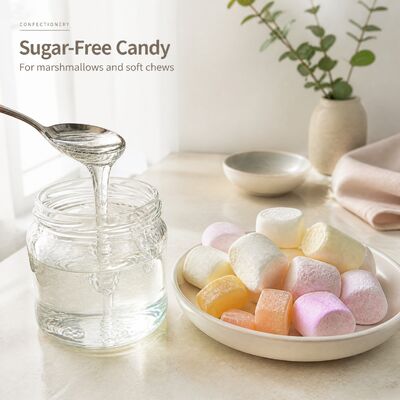
Reduced-sugar and sugar-free lines. The lower sweetness and cooling finish let sugar be cut without a linger, and the humectancy keeps the texture from drying out at the reduced sugar load.
Addition rates are set against the total solids of each formula, with the water carried in by the solution deducted from the cook water.
Each incoming lot is sampled at three levels of the drum before it is accepted into the candy plant, and the retained sample is held against the delivered drum number. Dry substance is read on a refractometer at the tank, assay is confirmed by HPLC, and a crystallisation resistance test at 18 °C over 48 hours confirms that the lot still behaves as a non-crystallizing syrup after transport and storage.
Reducing sugars are tracked because they drive colour pickup in the cooker, and colour is checked against a freshly prepared reference so a lot that has darkened in a warm container is caught before it reaches a white boiled sweet. Microbiological counts, heavy metals and arsenic are run on the finished solution, and each release record is filed against the drum label so a sweet produced from a given drum can be traced back through the plant.
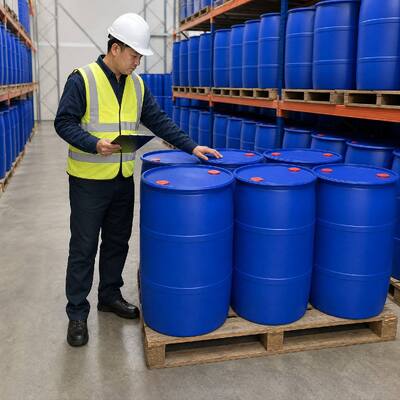
Standard packing is a 250 kg blue tight-head drum with food-grade internal coating and two bungs, closed with tamper-evident seals and labelled with product, grade, net weight and lot. Drums are stacked four to a pallet and stretch-wrapped for export, with 80 drums to a 20 ft container as a full load. Food-grade IBC tanks of 1000 kg are available where the line can take bulk, and neutral or buyer-branded labels are applied on request before dispatch.
Keep drums closed and store between 15 °C and 30 °C, away from direct sun and from radiators or steam lines. Below 15 °C the syrup thickens sharply and can cloud or seed, so a cold loading dock should not be used as a storage area; if a drum has chilled, move it to a warm room and let it equilibrate for a full day before pumping. Above 30 °C the syrup darkens slowly and picks up colour, which is visible in a white sweet. Reseal part-used drums, keep them upright, and avoid storing next to solvents or spices, since the syrup takes up foreign odours through the bung.
Syrup made for pumping, not for bagging. The solution is filtered and adjusted to a dry substance that stays uniform from drum to drum, so your depositor and your flow meter see the same viscosity on every delivery.
Graining tested before release. A crystallisation resistance check at 18 °C over 48 hours runs on each lot, which is the test that matters on a boiled sweet line and the one most suppliers skip.
Full documentation per drum. Certificate of analysis, safety data sheet and packing list travel with the shipment, and lot numbering links the drum label to the production record.
Drum and IBC options. 250 kg blue drums for smaller kitchens, 1000 kg IBC tanks for continuous lines, both food-grade and sealed.
Stable colour and low reducing sugars. Colour is checked against a fresh reference and reducing sugars are held low, so a white candy stays white and a clear candy stays clear.
Formulation support. If the cook water balance or the addition rate needs to be recalculated against your existing glucose syrup, our technical team will work through the numbers with your product development side.