 |
| Place of Origin: | China |
| Brand Name: | Golden Grain |
| Certification: | ISO9001, COA,SDS |
| Model Number: | GLMA-01771 |
| Minimum Order Quantity: | 100kg |
|---|---|
| Price: | USD850-USD950/MT FOB QINGDAO, CHINA |
| Packaging Details: | 25kg/Bag with Paper Drum and PE Inner |
| Delivery Time: | 7 - 10 working days |
| Payment Terms: | L/C, T/T, D/P, D/A |
| Supply Ability: | 1000MT per month |
| Density: | 1.33 G/cm³ (approximate) | Hazard Classification: | Non-hazardous |
|---|---|---|---|
| Molecular Formula: | C₆H₁₄O₆ | Moisture Content: | 0.5% Max |
| Molecular Weight: | 182.17 G/mol | Bulk Density: | 0.8-1.0 G/cm³ |
| Storage Conditions: | Store In A Cool, Dry Place | Bulkdensity: | 0.6-0.8 G/cm³ |
| Appearance: | White Crystalline Powder | Food Additive: | Sweetener, Humectant |
| Origin: | China | Melting Point: | 95-100°C |
| Purity: | ≥ 99% |
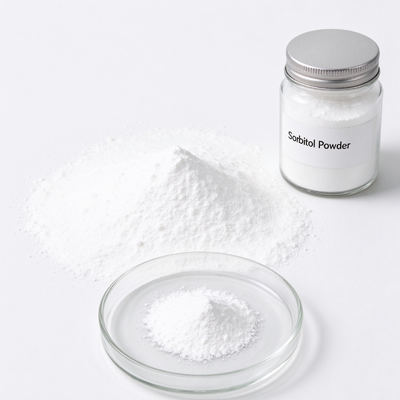
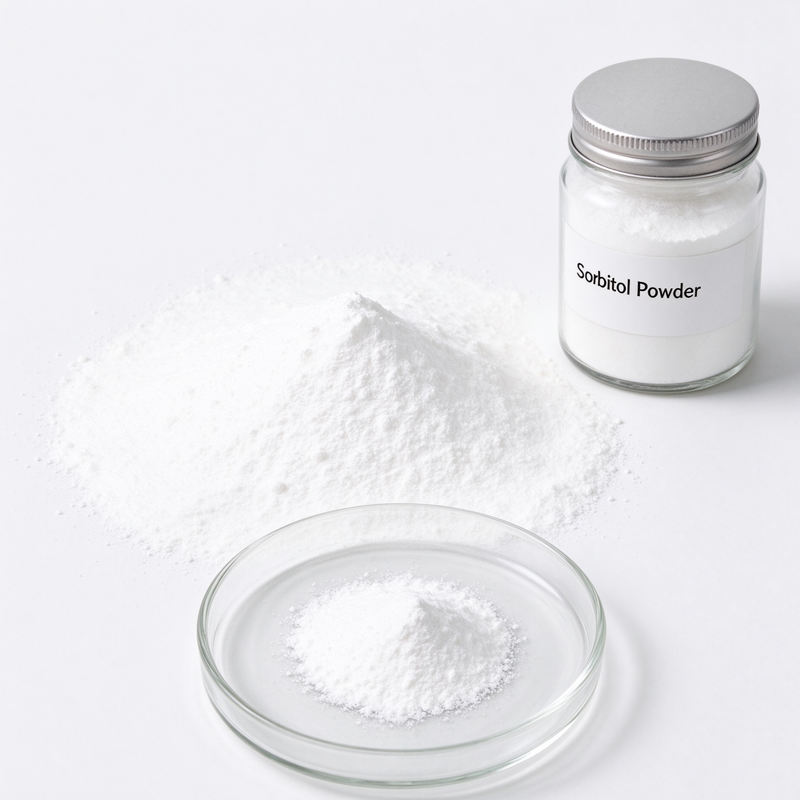
Our Sorbitol Powder (D-Glucitol, CAS 50-70-4, INS No. 420(i)) is a food-grade sugar alcohol produced by catalytic hydrogenation of glucose. It is a white, crystalline powder with a faint sweet taste, approximately 50–60% as sweet as sucrose. This grade is specifically processed to 100 mesh particle size and engineered for non-caking performance, ensuring the fine powder remains free-flowing during storage and handling.
Sorbitol functions as a sweetener and humectant, with JECFA listing its functional uses as sweetener, humectant, sequestrant, texturizer, stabilizer, and bulking agent . The 100 mesh specification means the majority of particles pass through a 100-mesh screen (approximately 150 μm opening), yielding a fine powder suitable for applications requiring smooth texture, rapid dispersion, and uniform blending. As a non-caking sweetener, it delivers sweetness without the lumping and flow disruption that standard hygroscopic sorbitol can experience under humid conditions.
The non-caking property is achieved through controlled crystallization processes. Patent literature describes methods where seed crystals are dispersed in melted sorbitol under controlled temperature, followed by an aging process, to produce solid sorbitol that “hardly cakes even in long storage” . This ensures the 100 mesh fine powder maintains consistent flowability from bag to production line. The product is packed in 25 kg PP bags and available for bulk supply.

| Parameter | Specification |
|---|---|
| Product name | Sorbitol Powder, 100 mesh |
| CAS number | 50-70-4 |
| E number | E420 |
| Appearance | White fine crystalline powder, free flowing |
| Assay (dry basis) | 99.0% min |
| Mesh | 100 (95% min passing) |
| Moisture | 0.5% max |
| Bulk density | 0.45-0.60 g/cm3 |
| Grade | Food Grade |
| Packaging | 25kg PP woven bag with PE inner liner |
The certificate of analysis issued for each shipment is the governing document.
| Test item | Typical result | Method |
|---|---|---|
| Assay (D-Glucitol) | 99.3% | HPLC |
| Appearance | White fine powder, free flowing | Visual |
| Mesh distribution (100) | 97% pass | Sieve analysis |
| Bulk density | 0.52 g/cm3 | Tapped cylinder |
| Moisture | 0.19% | Karl Fischer |
| Reducing sugars | 0.05% | Titrimetric |
| Residue on ignition | 0.02% | Gravimetric |
| Total heavy metals (as Pb) | < 5 mg/kg | Colorimetric |
| Arsenic (as As) | < 2 mg/kg | AAS |
| Total plate count | < 1000 cfu/g | Plate count |
| Yeast and mould | < 100 cfu/g | Plate count |
A certificate of analysis is issued for every batch, and a safety data sheet is available on request.
Particle Size Definition
A 100 mesh screen corresponds to an opening of approximately 150 μm. Sorbitol powders designated as 100 mesh typically have the majority of particles passing through this screen, yielding a fine, uniform powder. Commercially available sorbitol is offered in grades including 20-60 mesh and 100 mesh, with the finer grade selected where smoothness and dispersion are priorities .
Advantages of 100 Mesh
• Smooth mouthfeel: Fine particles disperse rapidly on the palate without grittiness, ideal for chewable tablets, lozenges, and oral care products.
• Uniform blending: The fine, consistent particle size promotes homogeneous distribution in dry mixes and tableting formulations.
• Rapid dissolution: Smaller particles dissolve faster in aqueous systems, beneficial in beverage powders and liquid preparations.
• Effective dusting: In chewing gum and confectionery processing, fine sorbitol can be used as a dusting agent to prevent sticking .
Non-Caking Engineering
Standard crystalline sorbitol is hygroscopic and can cake under humid conditions or prolonged storage. The non-caking grade addresses this through production methods that yield a more stable crystal structure. Patent descriptions note that without proper aging during crystallization, “the obtained solid sorbitol cakes with time” . This grade is processed to minimize that tendency, maintaining free-flowing characteristics in the 100 mesh fine powder form.
Sweetener
Sorbitol provides a mild, clean sweetness at roughly 50–60% the intensity of sucrose. It is suitable for sugar-free and reduced-calorie formulations. Its negative heat of solution produces a cooling sensation on the palate, valued in chewing gum, mints, and oral care products.
Humectant
As a non-volatile polyol, sorbitol absorbs and retains moisture, preventing products from drying out, cracking, or losing texture during storage. This function is critical in baked goods, confectionery, toothpaste, and cosmetic creams.
Bulking Agent and Stabilizer
Sorbitol contributes body and mouthfeel without excessive sweetness. It inhibits sugar crystallization in syrups and confections, maintaining smooth texture and appearance .
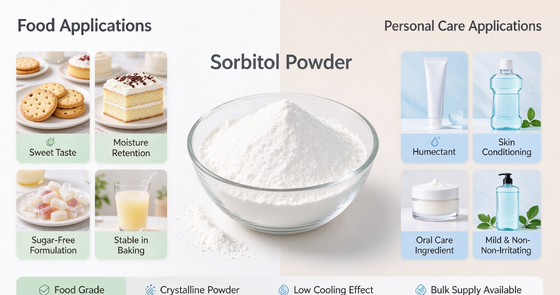
Food & Beverage
• Sugar-free confectionery: Chewing gum, candies, mints—fine powder ensures smooth texture and uniform distribution
• Bakery & desserts: Sugar-free cakes, fillings, frostings—humectancy and crystallization inhibition
• Dry mixes: 100 mesh fine powder disperses uniformly in baking premixes and beverage powders
Pharmaceutical & Oral Care
• Chewable tablets and lozenges: Fine particle size provides pleasant mouthfeel without grittiness
• Sugar-free syrups and elixirs: Rapid dissolution and palatability
• Toothpaste and mouthwash: Humectant, plasticizer, non-cariogenic sweetness
Personal Care
• Cosmetic creams, lotions, and hair care: humectant and skin conditioning agent
At 5-20% of the dry blend, the fine powder dissolves in cold water with a few turns of a spoon and does not leave a sweet layer at the bottom of the glass. Its particle size also matches the sugar and acid components closely enough that the blend resists segregation in a sachet.
In a premix the 100 mesh powder distributes through flour and improves the uniformity of the humectant in the dough. Smaller batches gain the most, because a fine powder spreads through a few hundred kilos without the dead spots a granule can leave in a ribbon blender.
Where sorbitol is dissolved into a liquid phase before pumping, the fine cut goes into solution without a prolonged hold, which shortens the batch cycle and reduces the risk of undissolved particles reaching the filler.
Used as a dusting agent, the fine powder coats a sticky surface evenly and dries to a thin film rather than a heavy crust. In coating suspensions it stays dispersed with light agitation instead of settling out.
In dry seasoning the powder acts as a carrier and humectant, helping hygroscopic salt and acid components stay free flowing in the sachet while blending evenly through the spice phase.
Every lot is tested for assay by HPLC, moisture by Karl Fischer and particle size by sieve analysis, with the percentage passing 100 mesh recorded against a 95% minimum. Bulk density is measured because it predicts how the powder will behave in a volumetric feeder. Heavy metals, arsenic, residue on ignition and microbiological counts are cleared against the food grade limits before release.
Fine powders are more sensitive to moisture pickup between the dryer and the bag, so the packed material is re-tested rather than relying on the dryer outlet result. Samples are drawn at the mill and at the packing head, and retained samples are kept against the lot code.
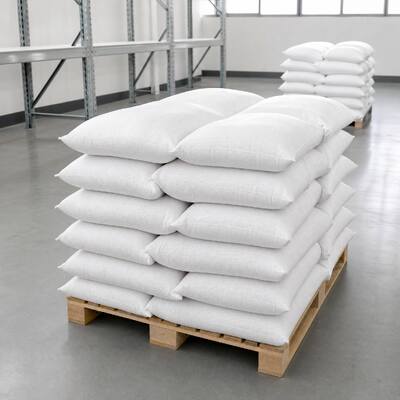
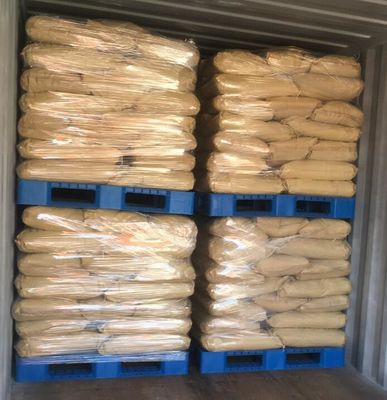
Packing is a 25kg PP woven bag with a PE inner liner, heat-sealed at the filling head to protect a grade that has more surface exposed to humid air. Bags are palletised and shrink-wrapped on request, and neutral or buyer-labelled print is available for bulk orders. Container loading is planned against the destination port and pallet pattern, with full container, LCL and mixed shipments arranged and the certificate of analysis issued before dispatch.
Store in a dry, cool, ventilated warehouse, off the floor and away from condensing walls, with the bags closed between uses. Because the surface area is high, this grade takes up moisture faster than a granule, so a part-used bag should be resealed the same shift. Keep the pallets away from strong odours and from storage above 40°C. Unopened bags hold their full specification for 24 months.
Fineness you can rely on. The percentage passing 100 mesh is measured per lot against a 95% minimum, so the dissolution rate you qualified is the rate that arrives.
Non-caking, sealed at the head. Each bag is heat-sealed immediately after filling, which matters more for a fine powder than for a granule.
Bulk density reported. Feeder settings can be calculated from the certificate instead of being tuned by trial on arrival.
Food grade release testing. Assay, moisture, mesh, heavy metals, arsenic and microbiological counts are checked before the lot is released.
Factory direct supply. Milled and packed at our plant, so the specification approved on the sample is the specification that ships.
Packing and logistics handled. 25kg PP woven bags with PE liner, palletised on request, with booking documents and certificate of analysis issued before dispatch.
Technical support. If a dry blend segregates or a feeder floods, our technical team will review the cut and the handling setup with your production side.