 |
| Place of Origin: | China |
| Brand Name: | Golden Grain |
| Certification: | ISO9001, ISO22000, HALAL, KOSHER |
| Model Number: | GLMA-012761 |
| Minimum Order Quantity: | 100kg |
|---|---|
| Price: | USD850-USD950/MT FOB QINGDAO, CHINA |
| Packaging Details: | 25kg/Bag with Paper Drum and PE Inner |
| Delivery Time: | 7 - 10 working days |
| Payment Terms: | L/C, T/T, D/P, D/A |
| Supply Ability: | 1000MT per month |
| Grade: | Industrial Grade, Food Grade | Application / End Use: | Resin Production, Textile Auxiliary, Paper Coating, Detergent Formulation, Tobacco Humectant |
|---|---|---|---|
| Function: | Polyol Raw Material, Humectant, Chemical Intermediate | Particle Size: | 20-60 Mesh |
| Form & Appearance: | White Crystalline Powder Or Granular | Synonyms / Other Names: | D-Glucitol, D-Sorbitol, Sorbit |
| CAS No. / E-Number: | 50-70-4 / E420 (INS 420) | Certification: | ISO 9001, ISO 22000, HACCP, Halal, Kosher |
| Packaging: | 25kg Kraft Bag With PE Inner Liner | HS Code: | 29054400 |
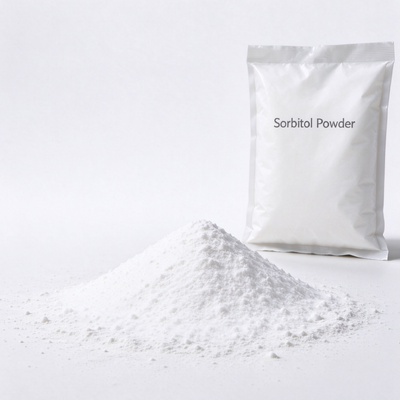
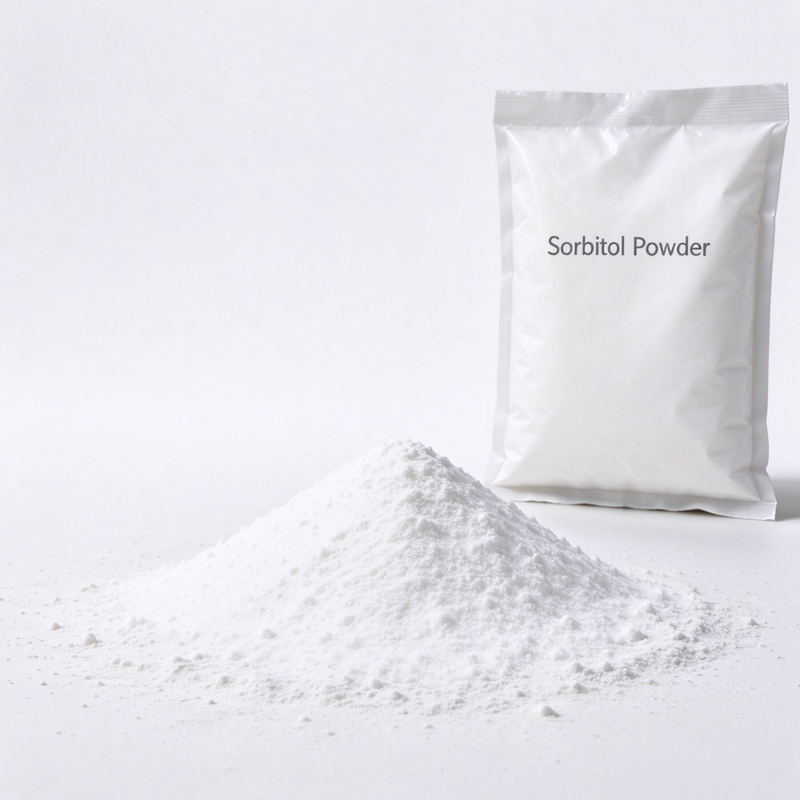
Our Sorbitol Powder (D-Glucitol, CAS 50-70-4, E420) is a white, crystalline granular material with a mild sweet taste. It is a sugar alcohol made from glucose and is widely used in foods, medicines, personal care products, and industrial applications. This grade is supplied in granular form, packed in 25 kg PP bags, and suitable for use as a sugar alcohol humectant in detergent and various industrial formulations.
Sorbitol is perhaps best known as a humectant—a substance that holds onto moisture and keeps products from drying out. It is non-volatile, meaning it stays in the product and provides long-lasting moisture control rather than evaporating away. In industrial applications, this property is valuable because it helps maintain consistent texture, flexibility, and performance over time.
In the detergent industry, sorbitol is used for its wetting, stabilizing, and building properties. It can also act as an enzyme stabilizer in liquid detergent formulations, helping the detergent remain effective during storage. Beyond detergents, sorbitol is used in glues and adhesives as a softener and flexibilizer, in paper as a moistening agent, and in textiles and leather processing for moisture retention and flexibility.
The granular form flows well and is easy to handle, making it suitable for dry blending and industrial processing. It is food-grade, meaning it meets purity standards for use in products that may come into contact with consumers, while also being suitable for the industrial applications listed above.

| Parameter | Specification |
|---|---|
| Product name | Sorbitol Powder, granular |
| Chemical name | D-Glucitol |
| CAS number | 50-70-4 |
| E number | E420 |
| Appearance | White crystalline granules, free flowing |
| Assay (dry basis) | 99.0% min |
| Mesh | 20-60 |
| Moisture | 0.5% max |
| Grade | Food Grade, supplied for industrial use |
| Packaging | 25kg PP woven bag with PE inner liner |
The certificate of analysis issued for each shipment is the governing document.
| Test item | Typical result | Method |
|---|---|---|
| Assay (D-Glucitol) | 99.3% | HPLC |
| Appearance | White granules, no visible fines | Visual |
| Mesh distribution (20-60) | 95% within cut | Sieve analysis |
| Bulk density | 0.62 g/cm3 | Tapped cylinder |
| Moisture | 0.21% | Karl Fischer |
| Reducing sugars | 0.05% | Titrimetric |
| Residue on ignition | 0.03% | Gravimetric |
| Chloride | < 50 mg/kg | Titrimetric |
| Total heavy metals (as Pb) | < 5 mg/kg | Colorimetric |
| Total plate count | < 1000 cfu/g | Plate count |
A certificate of analysis is issued for every batch, and a safety data sheet is available on request.
Humectant
Sorbitol holds onto moisture, keeping products from drying out, cracking, or becoming brittle. Unlike some humectants that evaporate over time, sorbitol stays in the product and provides lasting protection. In detergents, this helps maintain product consistency. In glues and adhesives, it keeps the material flexible and workable. In paper and leather, it prevents brittleness during drying and storage.
Stabilizer in Detergents
Sorbitol can act as an enzyme stabilizer in liquid detergent formulations, helping the active ingredients remain effective during storage. It also contributes to the overall stability of the detergent product.
Softener and Flexibilizer
In glues and adhesives, sorbitol acts as a softener and flexibilizer, increasing toughness and flexibility while providing protection against humidity effects. This makes it useful in industrial adhesive formulations.
Wetting Agent
Sorbitol has wetting properties that can help industrial formulations spread and penetrate more effectively, which is useful in detergent, textile, and leather processing applications.
Detergent Industry
Liquid and powder detergents: enzyme stabilization, wetting, and stabilizing properties
Industrial cleaning formulations: moisture control and product stability
Industrial Applications
Glues and adhesives: softener, flexibilizer, and humidity protection
Paper manufacturing: moistening agent to enhance paper properties and facilitate processing
Textiles and leather: moisture retention, softening, and flexibility during processing and storage
Metal surface treatment: chelating, stabilizing, and wetting agent
Food & Personal Care (Food Grade)
Toothpaste and mouthwash: humectant and mild sweetness
Cosmetics and creams: skin hydration and texture improvement
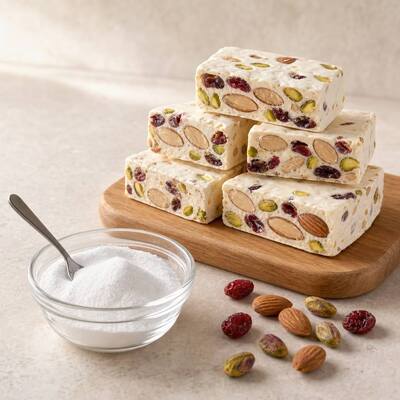
Confectionery and baked goods: moisture retention
Added at 1-4% of the batch, the granule moderates moisture movement between zeolite, carbonate and sulfate particles, which reduces caking in the carton and keeps the powder running through auger fillers and vertical form-fill-seal lines. The rate is set against the hygroscopicity of the base powder and the storage climate at destination.
At 2-6% the granule acts as a dry binder and plasticiser in the compact. Green strength improves, edge chipping during transfer falls, and the tablet still disintegrates once it meets water because sorbitol dissolves freely and does not leave an insoluble skeleton.
In alkaline cleaners, floor powders and general industrial blends the same behaviour is useful where a hygroscopic salt would otherwise set hard in the bag. The 20-60 cut also limits dust in manual weighing rooms, which helps against cross-contamination between batches.
Where percarbonate or perborate is present, a low heavy-metal profile matters, since trace iron and copper catalyse peroxide breakdown. The specification is tested against a 5 mg/kg total heavy metals limit, and the result is reported on the certificate for each lot.
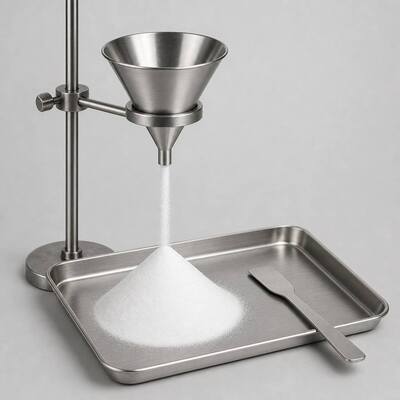
Release testing covers assay by HPLC, moisture by Karl Fischer, particle size by sieve analysis and bulk density on a tapped cylinder. Chloride, residue on ignition and heavy metals are checked against the specification, and a plate count is run on the finished granules. Fines content is watched because a granule that breaks down in the blender behaves like a fine powder at the filling head, which is exactly what this grade is meant to avoid.
Each lot is sampled at the crystalliser, at the screening deck and at the packing line, so a size drift introduced by the screen can be separated from a drift that started in crystallisation. Retained samples are kept for re-test if a customer reports flow problems after storage.
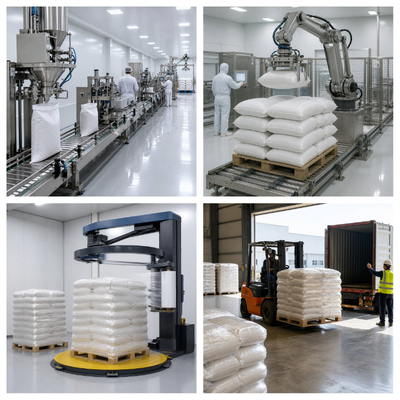
Bags are 25kg PP woven with a PE inner liner, heat-sealed against moisture pickup, and can be palletised and stretch-wrapped on request. Neutral packing or buyer-labelled print can be arranged for bulk orders. Loading is planned against the destination port and the pallet configuration, and full container, LCL and mixed shipments are handled with the booking documents and certificate of analysis issued before dispatch.
Store in a dry, ventilated warehouse below 40°C, with bags closed, off the floor and clear of condensing walls. Keep the pallets away from strong odours and from open drums of solvent or fragrance, since the granules adsorb smells. Do not stack more than the bag print allows, because compression on a warm pallet is what turns a free-flowing granule into a lump. Shelf life is 24 months in unopened original packaging; reseal part-used bags and consume them within the current production cycle.
Granule size held to the cut. Sieve analysis is run on every lot at the screening deck, so the 20-60 band you validated in your blender is the band that arrives.
Flow behaviour tested, not assumed. Bulk density and fines content are reported alongside assay, because those are the numbers that predict how the powder will run at the filling head.
Low heavy metals for bleach systems. Each lot is tested against a 5 mg/kg total heavy metals limit, which matters where percarbonate is part of the formulation.
Factory direct, one specification. The material is crystallised, screened and packed at our plant, so the approved specification is the shipping specification with no trading layer in between.
Packing to suit the line. 25kg PP woven bags with PE liner as standard, palletised on request, with neutral or buyer-labelled print for bulk orders.
Documents ready before dispatch. Certificate of analysis, safety data sheet and export paperwork are issued ahead of container release, and LCL or mixed loading can be arranged for trial volumes.
Support on dosage and blending. If a powder blend cakes at destination or a tablet needs more green strength, our technical team will review the addition rate against your base powder and packing format.