 |
| Place of Origin: | China |
| Brand Name: | Golden Grain |
| Certification: | ISO9001, ISO22000, HALAL, KOSHER |
| Model Number: | GLMA-01367 |
| Minimum Order Quantity: | 100kg |
|---|---|
| Price: | USD850-USD950/MT FOB QINGDAO, CHINA |
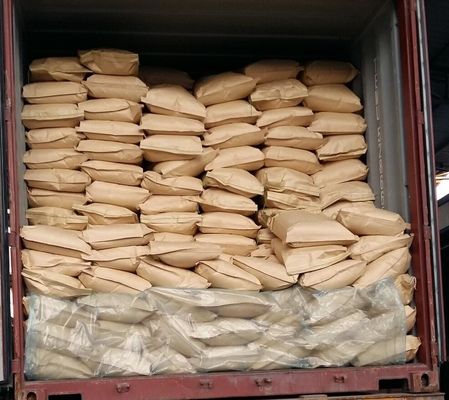
| Packaging Details: | 25kg/Bag with Paper Drum and PE Inner |
| Delivery Time: | 7 - 10 working days |
| Payment Terms: | L/C, T/T, D/P, D/A |
| Supply Ability: | 1200MT per month |
| Particle Size: | 80-120 Mesh | Grade: | Food Grade / FCC |
|---|---|---|---|
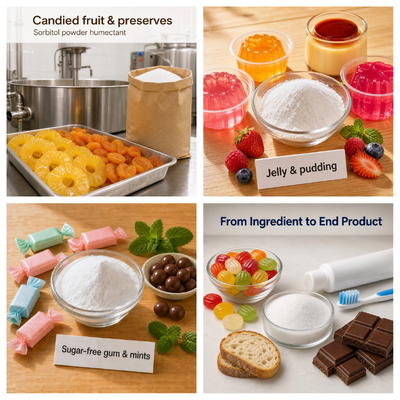
| Application / End Use: | Confectionery Coating, Tablet Compression, Toothpaste, Powdered Beverage Mix | Function: | Sweetener, Humectant, Bulking Agent |
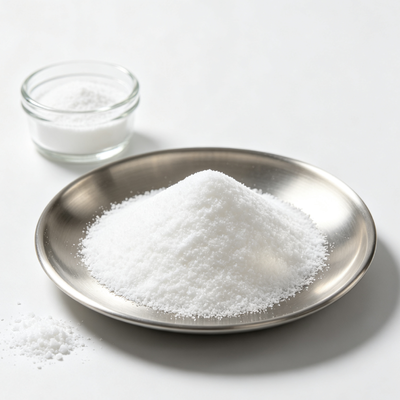
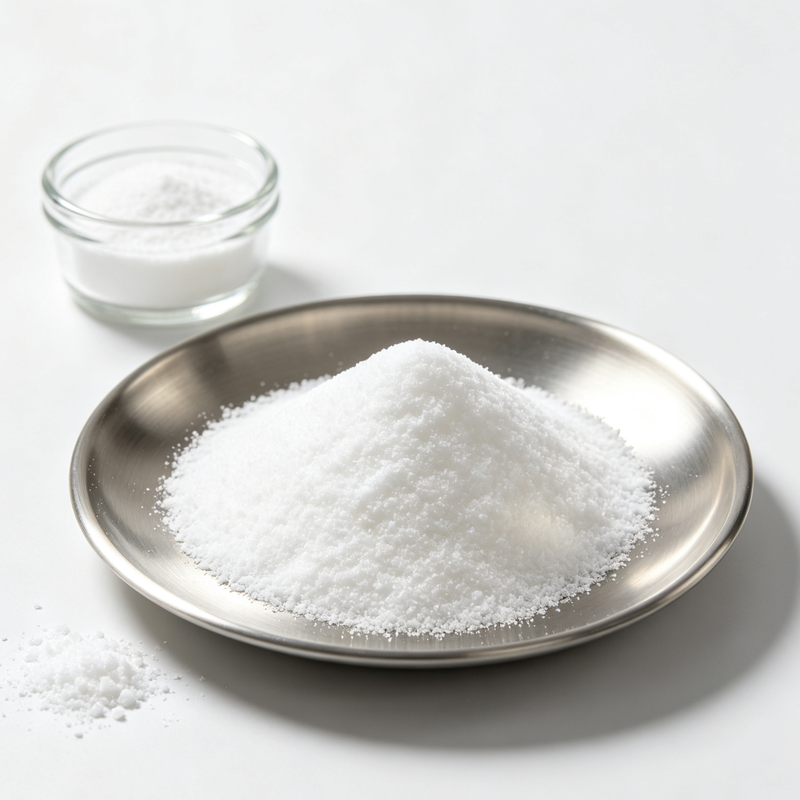
| Form & Appearance: | White Crystalline Fine Powder, Free-Flowing, Non-Caking | Synonyms / Other Names: | D-Glucitol, D-Sorbitol, Sorbit |
| CAS No. / E-Number: | 50-70-4 / E420 (INS 420) | Certification: | ISO 9001, ISO 22000, HACCP, Halal, Kosher |
| Packaging: | 25kg Kraft Bag With PE Inner Liner | HS Code: | 29054400 |
Our Sorbitol Powder (D-Glucitol, CAS 50-70-4, E420) is a white, crystalline powder with a mild sweet taste, roughly half as sweet as regular sugar. It is a sugar alcohol made from glucose and is one of the most widely used ingredients in sugar-free chewing gum. This grade is supplied in 80–120 mesh fine powder form, treated to stay non-caking, packed in 25 kg PP bags, and available for bulk supply.
Sorbitol is the backbone of most sugar-free gum formulations. In fact, crystalline sorbitol accounts for approximately 50% of typical sugar-free chewing gum formulations . It serves two essential roles: as a sweetener that provides mild, clean sweetness with a cooling sensation, and as a bulking agent that gives the gum its body and chew. Unlike regular sugar, sorbitol is not fermented by oral bacteria, meaning it does not produce the acids that attack tooth enamel . This is why sugar-free gum sweetened with sorbitol is considered tooth-friendly.
The non-caking property is particularly important for gum manufacturing. Standard sorbitol can absorb moisture and form lumps, which disrupts the steady flow of powder into mixing and extrusion equipment. This grade is processed to remain free-flowing, so it moves smoothly through production lines without interruption. Patent literature confirms that properly processed solid sorbitol “hardly cakes even in long storage” .
The 80–120 mesh fine powder disperses evenly into the gum base, ensuring uniform sweetness and texture throughout the batch. Fine particles integrate smoothly without creating gritty spots in the finished gum.

| Parameter | Specification |
|---|---|
| Product name | Sorbitol Powder, D-Glucitol |
| CAS number / E number | 50-70-4 / E420 |
| Appearance | White crystalline powder, free flowing, odourless |
| Assay (dry basis) | 99.0% min |
| Particle size | 80-120 mesh, 95% min passing |
| Moisture (loss on drying) | 0.5% max |
| Reducing sugars | 0.2% max |
| Total heavy metals (as Pb) | 5 mg/kg max |
| Microbiological limits | TPC 1000 cfu/g max, yeast and mould 100 cfu/g max |
| Grade / standard | Food Grade, FCC |
The certificate of analysis issued for each shipment is the governing document.
| Test item | Typical result | Method |
|---|---|---|
| Assay (D-Glucitol) | 99.3% | HPLC |
| Appearance | White crystalline powder | Visual |
| Particle size, 80-120 mesh | 96% pass | Sieve analysis |
| Moisture | 0.15% | Karl Fischer |
| Reducing sugars | 0.04% | Titrimetric |
| Residue on ignition | 0.02% | Gravimetric |
| Total heavy metals | < 5 mg/kg | Colorimetric |
| Arsenic | < 2 mg/kg | AAS |
| Total plate count | < 1000 cfu/g | Plate count |
| E. coli | Absent | Plate count |
A certificate of analysis and a safety data sheet are issued with each order; retained samples are available for re-test.
Sweetener with Cooling Effect
Sorbitol provides a mild, clean sweetness with a pleasant cooling sensation in the mouth. This cooling effect is especially valued in mint-flavored gums and breath-freshening products.
Bulking Agent
Sorbitol gives the gum its body and chew. Without a bulking agent, sugar-free gum would lack the texture and volume that consumers expect. Sorbitol fills that role while keeping the product sugar-free .
Tooth-Friendly
Sorbitol is not metabolized by the bacteria in dental plaque. It does not produce the acids that cause tooth decay, making it a preferred sweetener for oral-health-positioned gum products .
Non-Caking for Production
The powder stays loose and free-flowing in storage, feeding evenly into mixing equipment. No lumps, no flow interruptions, no inconsistent batches.
Chewing Gum (Primary)
Sugar-free chewing gum: sweetener and bulking agent
Pellet gum and stick gum: body, texture, and cooling sensation
Breath-freshening gum: mild sweetness with cooling effect
Food & Confectionery
Sugar-free candy and mints: sweetness and cooling effect
Tableted confectionery: pressed mints and candy tablets
Personal Care
Toothpaste and mouthwash: moisture retention and mild sweetness
In a standard gum batch the powder is added to the softened base in stages, and each addition has to be absorbed before the next. A controlled 80-120 mesh cut disperses without forming dry pockets that later show as hard specks, and the low moisture content keeps the base from softening past the point where the sheet sags on the cooling tunnel.
Compressed gum is a dry blend of ground base and polyol compressed on a rotary press. Sorbitol supplies bulk, sweetness and compactibility; its free-flowing nature keeps die fill consistent at speed, and its low hygroscopicity stops the blend from picking up water in the hopper during a long run.
In a coating pan, sorbitol is applied as a powder charge between syrup additions to build a crisp shell. Here the requirement is fines control: an excess of dust sticks to the pan wall instead of the pellet, while coarse particles leave a rough, uneven shell that chips when the pellet is chewed.
Before sheeting and scoring, a light dusting of sorbitol keeps the gum ribbon from adhering to the rolls and the stacking sheets. Because the powder does not dissolve on contact, it acts as a true parting layer rather than forming a syrup film that would re-bond the pieces in the pile.
Filled pellets combine a liquid core with a gum shell, and water migration from the core is the usual cause of shell softening and leakage. Sorbitol in the shell formulation binds part of that moisture and keeps the shell firm enough to hold the fill through storage and transport.
Typical use is 45-60% of the gum formula as the bulk sweetener, adjusted against the base level, the softener system and the target chew profile; coating applications usually run far lower and depend on pan loading.
Release testing covers assay by HPLC, moisture by Karl Fischer, particle size by sieve analysis, reducing sugars, residue on ignition, heavy metals, arsenic and microbiological counts. Because gum is a dry blend, moisture and fines are the two results that decide whether a lot is suitable for a given line, and both are reported numerically rather than as pass or fail alone.
The lot code on each bag links back to the crystallisation run and the packing record. Retained samples are kept from every lot, so a complaint about grit or specking can be checked against the material actually shipped.
Powder is filled into 25kg PP woven bags with a food-contact PE liner, heat-sealed at the mouth to block moisture during the sea leg. Pallets can be stretch-wrapped on request, and bags may carry neutral or buyer artwork for bulk orders. Loading is planned per order against the destination port and the pallet configuration, and full container, LCL and mixed shipments are all arranged with the certificate of analysis issued before dispatch.
Keep the bags in a cool, dry, ventilated store away from sunlight, standing off the floor and clear of walls that sweat. Do not store near solvents, spices or other strongly odorous goods, as the powder takes up odours that would carry into the finished gum. Avoid temperatures above 40°C. In sealed original bags the powder keeps its flow for 24 months; after opening, close the liner and use the balance within the current production run.
Made for Chewing Gum
The 80–120 mesh fine powder and non-caking treatment are selected for gum manufacturing. Sorbitol’s dual role as sweetener and bulking agent makes it the most widely used polyol in sugar-free gum .
Tooth-Friendly Sweetness
Sorbitol does not feed the bacteria that cause tooth decay, supporting oral-health claims on your gum products .
Non-Caking for Smooth Production
The powder stays free-flowing in storage and during production, avoiding the lumps and flow interruptions that standard hygroscopic sorbitol can experience.
25 kg PP Bag, Bulk Supply Ready
Standard 25 kg PP bag packaging suits trial runs and production-scale purchasing. Bulk supply capacity supports repeat orders and contract volumes.
Contact us for samples, COA, and bulk pricing.